The Index Card Summary of “Think Bigger: How to Innovate”

As a former innovation consultant, who designed initiatives, competitions, and recommended approaches for diverse clients, I was intrigued to hear that decision science scholar Sheena Iyengar, famous for her “jam study”, was now teaching, writing, and advising on innovation. I, of course, wanted to compare notes. Iyengar asserts that there are no new ideas, only new combinations of old ideas. True to her word, her methodology combines tried and true methods.

The Think Bigger Methodology

In Think Bigger: How to Innovate, Iyengar proposes a practical, six-step method to generate innovative solutions:

  1. Choose the [right] problem. Start by focusing on the problem, not the solution. Defining the right problem is a goldilocks challenge: to yield impactful, innovative results, you need a problem that balances specificity with broad enough relevance.
  2. Break down the problem. Address each component of the problem separately; this will enable combinatory options in Step 5.
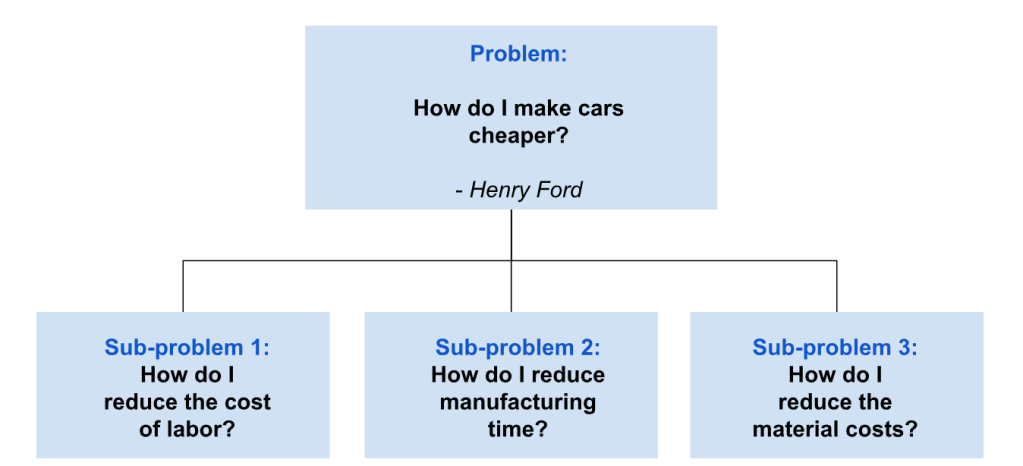
Iyengar uses Henry Ford’s auto manufacturing innovation as a case study for the Think Bigger methodology.

3. Consider desires. Identify the motivations and desires of those impacted by the problem — including you, the innovative problem-solver; the target beneficiary; and third party stakeholders.

4. Search existing solutions. Learn from past attempts to address the problem; identify both failures to avoid and insights to use.

5. Create a “Choice Map”. Consider different combinations of wide-ranging solutions to the sub-problems. Select several full solutions to investigate further.

A Choice Map is a mix-and-match menu of sub-solutions, to help identify and test different combinations.

6. Seek validation: Get feedback on targeted aspects of your candidate solutions from others.

Iyengar’s key advice

Source: Nordic Business Forum

In addition to simplifying the innovation process, Iyengar also strives to debunk common misconceptions. To increase efficacy, she advises targeting your efforts as follows:

  1. Get over shiny new object syndrome. The most unusual ideas are rarely perceived as more innovative. Instead, new applications and combinations of old ideas often get the most traction.
  2. Listen to your gut before you listen to the data. Ideas are a dime a dozen. But motivation is finite. Notice the direction of travel of your enthusiasm. Is it trending up, down, or flat as you refine your idea? This “real talk” will help eliminate magical thinking about your level of commitment. You need to feel passion to power through the process successfully.
  3. Spend more time researching solution options than you think you should. In contrast to the Lean Startup paradigm, which now dominates Silicon Valley and recommends racing to a minimum viable product, Iyengar recommends spending more time researching many possible MVP options.
  4. Don’t ask for feedback on the full solution. People are likely to judge your idea before its fully-baked. To effectively refine your concept, ask for selective, narrow feedback on specific aspects you are testing.

Nothing new under the sun

Iyengar arrives at core principles consistent with what I’ve seen work. Essentially, she is an advocate of open innovation and lateral thinking — problem-solving by looking beyond traditional organizational or social boundaries and connecting seemingly outside ideas. Given how tried and true her methodology is, I wondered why she chose to write the book. Iyengar herself highlights that even her Choice Map is largely derived from the GE Trotter Matrix.

I believe Iyengar wrote Think Bigger for three reasons: 1) she believes everyone can be innovative and, thus, sought to create an empowering “user manual” of sorts, 2) she observed common pitfalls among her students that she wants to help others avoid, and 3) she’s an academic — she must publish or perish.

To the first motivation, I agree that anyone can be innovative if they look outside their disciplinary or professional silo. This is part of what drew me to study Public Policy as an undergraduate student — it combines a basket of disciplines oriented around solving a challenging problem: designing rules for society. Political Science, Philosophy, Economics and other disciplines can not take on this challenge single-handedly. But while I agree that solutions to complex problems need to come from outside a single silo, I do not think a solopreneur or small team can crack the code as easily as Iyengar implies.

By optimizing her solution identification process for a single person, Iyengar’s methodology is both empowering and overpromising. Think Bigger reads as if one person can transform a product category, industry — nay, the world! — with little more than a worksheet. Yes, it’s a handy worksheet, and with time a single person can run the research process of identifying promising solutions to the target problem. But this individualistic approach limits output to that of one person / team vs. incentivizing many solvers to tackle the challenge — which is the core of a true open innovation approach.

To the second motivation, Iyengar’s advice certainly can save time and help individuals learn from others’ mistakes. As a decision-psychologist, she is versed in the mental tricks our own minds play on us. However, Iyengar’s own biases color her advice. As a full-time academic, she over-indexes on research, suggesting conducting enough research to produce thousands of potential solution combinations. Acknowledging this overwhelming option set, Iyengar then suggests selecting test solutions using a random number generator. How odd to recommend a big upfront investment, followed by an arbitrary narrowing-down process. Perhaps this is where the third motivation — to publish due to peer-pressure — may be tainting her recommendations as well.

Iyengar closes by reasserting, there are no new ideas, just different combinations of old ideas. This claim sums her book up well. She steels with pride and references, offering handy tools that can spur focused creativity. But they are not quite the cure-all implied.

The Index Card Summary of “The Five Dysfunctions of a Team”

The Five Dysfunctions of a Team is Patrick Lencioni‘s New York Times Best Seller for a reason: any team member can see themselves in this list of foibles.

Each of the five dysfunctions require leadership interventions to solve. Below is a brief summary of what that entails.

The Index Card Summary

1. Building trust

What. The foundation of a functional team is trust: confidence that peer intentions are good, that there is no reason to be protective around the group. Trust minimizes second-guessing and makes it easier to ask for help.

How. Create shared experiences over time, and understand unique attributes of team members. Team-building exercises, discussing team effectiveness, 360 feedback, and team leader role modeling can all drive the psychological safety and honesty needed to engender trust.

2. Addressing conflict

What. All relationships require productive conflict to grow. Without direct, content-focused conflict, teams can be handicapped by back-channeling and personal attacks that doom people to revisiting issues endlessly without resolution.

How. Acknowledge that conflict is productive; agree that impassioned debate is welcome. Ask for permission to address conflicts for the good of the team.

3. Driving commitment

What. Commitment requires both clarity and buy-in. Desire for consensus and/or certainty can weaken commitment and delay decision-making which, in turn, can paralyze teams and weaken their confidence.

How. Drive alignment through tight information cascades, close to the time decisions are made. Reduce ambiguity by setting intermediate deadlines. Address fears with contingency plans or worst-case-scenario analysis. Normalize decisiveness starting in low-risk environments. Leaders must also role model commitment by being ok with wrong decisions, asking for commitment, and reducing emphasis on certainty or consensus.

4. Welcome accountability

What. Peers need to welcome peer call-outs on actions that might negatively impact the team or actions others should model and amplify.

How. Leaders can enable and normalize peer accountability through setting agreed upon standards and goals, encouraging peer feedback, and giving collective team rewards for collectively modeling the right behaviors.

5. Focus on results

What. Time-bound, outcome-based performance drives business success. Yet it can often be crowded out by team or individual status or focus on survival.

How. Define specific target results that you publicly commit to, and reward only supporting actions; tie compensation to outcomes. Leaders must also reinforce a focus on results; if the team leader shows they value and reward other things, teams will react accordingly.

Disconnects and Through-lines

Unpacking the “How”

While Lencioni provides excellent tactical suggestions for tackling the numerous team dysfunctions, he spends too little time exploring where to start. While ‘absence of trust’ is named as the foundational problem, I think the easiest place to start is at the top, with the most visible problem: ‘inattention to results.’ Once you have specific results targets, you can drive accountability, which then motivates commitment, and so on down the pyramid.

Addressing the foundational dysfunctions, ‘fear of conflict’ and ‘absense of trust,’ is admittedly more challenging. In large organizations especially, cross-functional teams may not even conceive of themselves as teams and, thus, may see little benefit to engaging in conflict and little need to build trust. In those instances leaders play an even more critical role. Leaders with a longer-range view will be mindful of the personal costs of these more insidious dysfunctions: energy poorly spent, low morale, and high unwanted turnover.

Across the five dysfunctions, communication and leadership sit at the center of many proposed solutions. Spending more team time together drives trust, can root out conflict and reduce confusion. Documenting decisions and desired results and rapidly sharing and reinforcing them keeps teams in sync. And leadership modeling the right behavior and taking challenges head-on can inspire healthy team culture. These are all reasonable tactics to pursue, but side-step the issue that so much rests on leadership, especially the larger an organization gets.

Addressing the “Why”

Lencioni claims that “teams succeed because they are exceedingly human.” But realistically, it is equally why they fail. Humans are full of bias and are often more focused on their individual experience over organizational goals. Thus, even if an organization starts with a high-functioning team culture, it’s hard to scale; heterogeneity via sub-cultures is normal the larger an organization gets, and cultural drift is equally normal through turnover, changing external contexts, and organizational evolution. With this in mind, it makes more sense to think of high functioning teams as a practice to commit to rather than an end state. Like so much of life, it’s a journey, not a destination.

Source: aspitzer.com

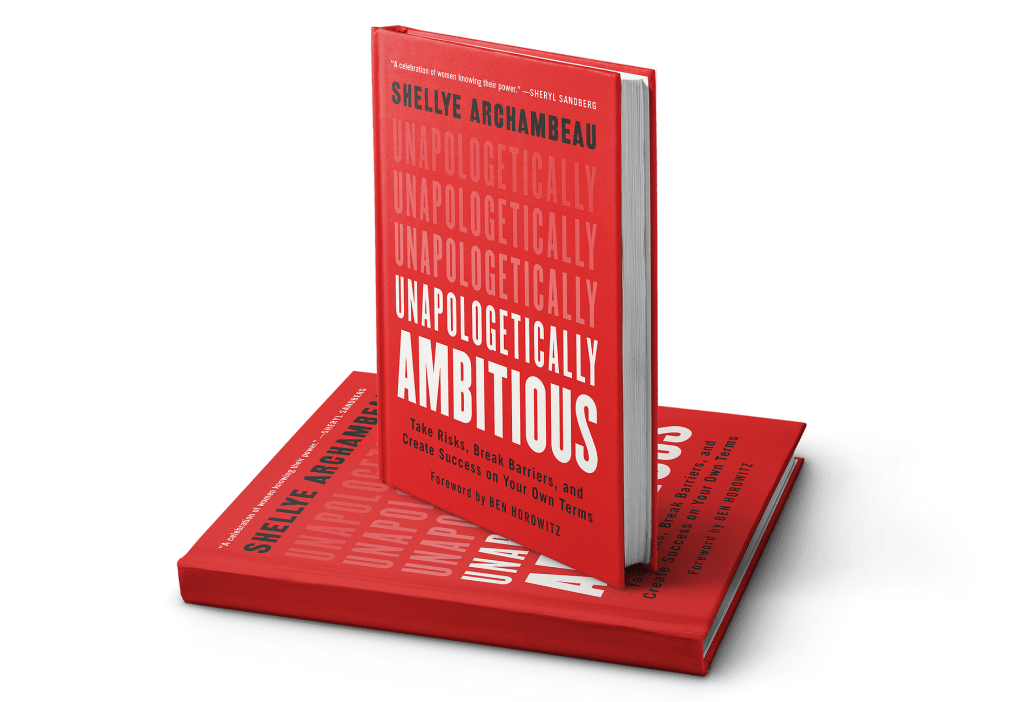
The Index Card Summary of “Unapologetically Ambitious”

Shellye Archambeau is one of Silicon Valley’s first female African American CEOs. She shares her life’s story and every decision-making principle that has guided it in: “Unapologetically Ambitious: Take Risks, Break Barriers, and Create Success on Your Own Terms.”

Her book is rich with 39 chapters of life decisions and insights. Across it, three key themes stood out:

  1. Master your mindset
  2. Prepare for opportunity
  3. Learn from others

The Index Card Summary

Your professional success, Archambeau argues, depends on three self-guided processes:

1. Master your mindset

Archambeau believes three feeling are prerequisites to professional confidence: competence, autonomy, and relatedness. Competence is the ability to handle yourself no matter what arises. Autonomy is the confidence to make your own choices. And relatedness is feeling like you fit in. If you are missing any one of these three, you are more likely to withdraw from challenges. But if you have all three, you will feel prepared to set goals and reach them.

To feel competent, you must accept your circumstances while owning your agency. To feel autonomous, you need to know your values. Naming your values will give you a standard for decision-making. And to feel relatedness, you must feel empathy towards your teams while earning their respect and building alliances.

Your personal and professional cheerleaders can bolster all three elements. Cheerleaders can especially build your confidence in your own decision-making.

2. Prepare for opportunity

Once you’ve got the right mindset for taking action, you can set goals according to what you want and need, and make a plan to achieve them. But how does one make a robust plan with a good chance of success? Archambeau focuses on identifying patterns associated with power.

Archambeau knew in high school she wanted to be a CEO. She then made choices that minimized the friction for achieving her goal. She picked a growth industry — technology — that would offer more opportunities. And she looked for patterns to decode how her industry and roles worked. When she noted that executives are all great speakers, she joined Toastmasters. Throughout her whole career, she acquired skills and experiences common to top candidates. She also time-boxed her plans. If promotions were slow to come, even with her top performance, she looked for opportunities outside of her company.

But you can’t prepare for every possible workplace situation, and you can’t plan for the macroeconomic environment. So how does this advice jive with managing the unexpected? Archambeau recommends identifying worst-case scenarios based on the current environment. Validate your plan based on a clear fact base. After that, there’s no time for second thoughts! Once you begin to act, you can adapt to changing circumstances with creative problem-solving. To move with conviction, you must accept that your choices mean saying yes to one path and no to another.

3. Learn from others

There’s almost nothing new under the sun. So you might as well learn from someone who’s done what you’re trying to do. Ask someone who’s achieved what you’re trying to achieve for advice. Then following up on how that advice worked out. This is the simplest way to attract a mentor: make your ask small and share what the mentor’s advice yielded.

You will need to do the upfront work of networking to find the right people to ask for advice. At the same time, don’t limit your thinking about who can help support you in achieving your goals. Tell everyone you know what you’re trying to accomplish. Broadcast your intentions. This will keep you top of mind when opportunities appear.

Learning from others also includes learning from your team. Ask for help when you need it. And be willing to delegate. Embracing your limits will empower your team to take the lead when they are better placed to do so.

Requisites and truths

Each of the three key themes holds underlying requisites. Mastering your mindset requires you to know yourself — one of the hardest things to do for most people. This, for me, felt especially hard when I had limited work experience. Preparing for opportunity presupposes you buy into the institutions that dominate your industry. Archambeau recommends ‘finding the current’ of power and jumping in it. But if you disagree with the system, it will be hard to position yourself to move with it. And learning from others can be hard to balance against confidence in your own decisions. Not all advice is good advice, so how do you filter in only the good advice? In addition, garnering advice in the first place will be difficult if you haven’t learned how to network in a way that suits you.

Still, none of these caveats reduces the wisdom of Archambeau’s advice. Once you have your own inner foundation firm, decision-making will become easier. Preparing for the future you want can only aid you in achieving your ambitions. And finding sources of advice and support will put the wind at your back. This includes ‘micro-mentors’ — people willing to give timely advice — and supportive teammates.

Success, Archambeau notes, is a continuous process. If you’re moving in the right direction, every day is a success.

The Index Card Summary of “The Upside of Stress”

In the era of COVID-19, emotional, physical, and financial stress have become inescapable for the foreseeable future. And with every time of hardship, we have a choice about how to respond to it. At least that is the premise of The Upside of Stress: Why Stress is Good for You and How to Get Good at It by Kelly McGonigal, PhD. Her research-based advice can be summed up in 3 simple points:

  1. There are three types of stress responses:
    • Fight or flight response
    • Challenge response
    • Tend and befriend response
  2. You can influence which stress response you experience
  3. Choosing a more helpful response is beneficial in virtually all circumstances

Below is a brief dive into the findings and advice behind each point above.

1. There are three types of stress responses

Stress responses come in three flavors: fight or flight, challenge response, and tend and befriend.

Fight or flight is the best known but most maladaptive, because it primes you to either fight or run — neither of which is appropriate if triggered in most modern settings. (Fist fights with people not observing social distancing is not advisable).

By contrast, the challenge response is a physiological reaction to stress that increases self-confidence, motivates action, and helps you learn from your experience. A challenge response makes you feel focused, not fearful, and creates a sense of flow that allows you to rise to the occasion.

And finally, the tend and befriend response releases stress hormones that increase courage, motivate care-giving, and enhance empathy, leading to strengthened social relationships.

While fight or flight is a self-protective response, the challenge response and tend and befriend response produce more pro-social outcomes.

2. You can influence which stress response you experience

How you think about stress can directly determine how your body processes it. If you perceive stress as a threat, you are more likely to have a fight or flight response, which negatively impacts both your psyche and physiology. Alternatively, if you have an optimistic framing of stress, invoking the challenge response or tend and befriend response, your body will release the types of stress hormones that help you recover and learn.

You can choose to think or act in ways that are known to trigger positive stress responses. Learning a new point of view has been shown to transform the stress response. For example, journalling for five minutes about the hardest experience of your life and what you learned from it that later improved your life can lead to a lasting improvement to life satisfaction and resilience. Specific actions, like volunteering for a charity, can invoke a positive stress response by shifting from self-focus to larger-than-self-focus.

3. Choosing a more helpful response is beneficial in virtually all circumstances

If you harness your stress response to help you engage and grow, over time you can experience “stress inoculation”: your brain will become conditioned to seeing stress as an opportunity to learn. McGonigal has found measurable benefits across social circumstances and psychological states. Adversity creates resilience and correlates with higher satisfaction.

What you can do today

Consider what your narrative about stress is, your behaviors around stress, and how those make you feel. What beliefs can you trade up for ones that give you hope, bravery, resilience, or a sense of connection? Such small shifts in mindset can lead to a cascade of effects. So rather than changing a million things in your life, change your mindset, and the rest will flow.

The Index Card Summary of “Ultralearning”

Anyone in the working world today knows that life-long learning isn’t just an option anymore; it’s a necessity. From “new math” to new job categories, technology and bleeding-edge research will continue to keep any working person on their toes, lest we become irrelevant. (We all have that elder relative still using yahoo mail or, *gasp*, AOL…) Fast changes in tech mean we need to be fast to adapt, too. We need to be able to learn new skills pretty quickly. We need to be, in the words of Scott Young, “ultralearners”.

Building on the Deep Work concepts of intensity of time investment and focus, “Ultralearning: Master Hard Skills, Outsmart the Competition, and Accelerate Your Career” goes into the an arsenal of tactics that, when deployed, can rapidly accelerate skill acquisition. These are boiled down below into five key steps.

  1. Make a plan
  2. Learn in context
  3. Drive retention
  4. Collect feedback
  5. Experiment

1. Make a plan

It is hard to learn in a targeted way without a specific goal in mind. Equally, it is hard to retain what you’ve learned if you don’t have a plan for exercising your knowledge. Thus, efficient learning requires you to have a clear picture of why you want to learn a skill, what your learning plan will consist of, an approach for how you will learn, and a plan for when you will exercise and maintain the skill once it is developed.

2. Learn in context

Young advocates for “directness,” or learning tied closely to the context you want to use it in. This method ensures that your learning will directly translate to real-life application.

3. Drive retention

Retention requires over-learning the most critical aspects of a skill, and then repeating exposure over time to make it stick. This will initially demand sustained focus, followed by re-enforcement with drilling and retrieval practice. Near-term learning is honed through drilling specific aspects that will aid performance. Long-term learning is enhanced by practicing retrieval of information, rather than passive review.

4. Collect feedback

Feedback can be outcomes-based, informational, or corrective. Outcomes, like a grade on a test, and informational feedback, like an error message when coding, fail to give corrective feedback on how to fix the problem. Regardless of which type of feedback you can access, strive to get immediate feedback, ideally via direct practice.

5. Experiment

Mastery requires originality, not just proficiency. Try experimenting with your techniques for learning, your style of application, and the resources or materials you draw on to find what works best for you.

Is ultralearning actually something new?

You might be wondering, how is this any different from what others, from Cal Newport in Deep Work to Malcolm Gladwell in Outliers, have been saying for years?

I think the emphasis on contextual learning combined with a detailed review of tactics places Young more in the realm of data-driven coach than thought leader. Contextualized learning has been trending in the education world, because it is linked to stronger learning outcomes and is seen as a mechanism for making youth and adults alike more work and future-ready than traditional classroom models. As someone who brute-forced her way through many a high school class, I wish I’d taken more care to optimize how I was learning as much as I optimized how much I was learning.

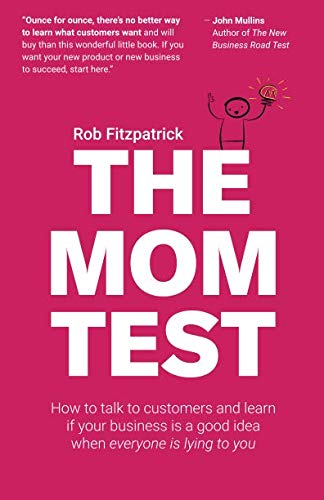
The Index Card Summary of “The Mom Test: How to talk to customers & learn if your business is a good idea when everyone is lying to you”

The graveyard of Silicon Valley is littered with dead startups that launched based on false positive feedback. How does one avoid the misdirection of enthusiasts trying to avoid awkward hurt feelings? Rob Fitzpatrick offers a cheat sheet of cardinal rules of informational interviewing while refining your business concept in The Mom Test. Below is the index card summary of the Rob’s rules for collecting honest feedback.

The Index Card Summary

1. Avoid mentioning your idea.

2. Avoid the “premature zoom”.

3. Ask terrifying questions that force you to focus.

4. Lower the stakes.

1. Avoid mentioning your idea

We are a social species – we like to be liked! As a result, if you signal to someone that it’s important to you that they like your idea/product/approach, you are biasing that person towards positive feedback. But soliciting only positive feedback, even if this is not your intention, will impede your ultimate goal of improving your idea/product/approach. So how to avoid bias? Ask questions related to the problem you want to solve rather than the solution you have in mind.

2. Avoid the “premature zoom”

Fitzpatrick calls jumping to tweaking your idea before validating it the “premature zoom”. You need to validate that the problem you are trying to solve is a real problem. Validate that your interviewee cares about the problem before you collect feedback on the nuances. Ask if they like ice cream before you ask if they prefer chocolate or vanilla (and don’t assume strawberry is out of the running, intuitive, though it may seem). This may sounds simple, but it’s actually very hard. Because we all carry many implicit assumptions with us. To succeed in a new venture, we need to identify all assumptions explicitly, and test each one.

3. Ask terrifying questions that force you to focus

Pre-plan up to three key questions for each of the stakeholder groups that will affect the success of your idea/product/approach. These might include customer segments and investors, managers and teammates, etc. Many of these questions should be ones you’re a little scared to hear the answer to.

If you get feedback all over the map, it may mean you haven’t meaningfully defined the use case of your idea/product/approach. You should have a specific user segment in mind. If your feedback is scattered with no common thread, you may be trying to cover too much.

4. Lower the stakes

Not every conversation needs to feel super high stakes. If you have your key questions at the ready, you can ask them whenever you bump into anyone connected loosely or tightly to your idea/product/approach. Don’t save all of your key questions for one big meeting with one critical stakeholder. This would make you vulnerable to perfectionism and procrastination.

Making good feedback less hard to come by

From 360 reviews to side hustles, we all need feedback; we can’t operate in a vacuum. Yet it can be easy to do so, to stay in our comfort zone of wanting to think our ideas and our work are 100% awesome all of the time. Unless you care more about results than your ego. And the easiest way to get there is to start asking the right questions early and often. So go forth and solicit feedback!

From Adam Grant to Susan Cain: What introverted leadership looks like

The article is for all the introverts out there who have risen to a leadership position. Looking at your peers, you may intuitively notice as you look laterally and above you what the data show: 96% of leaders self-report as extroverts. You may be wondering if you can succeed and be effective as a leader, given your personality type. Let’s look at what at the science has to say.

First, can you fake it til you make it?

Your first course of action may be to consider, can I just act like an extrovert until I become one? The science of personality suggests that this would likely be an uphill battle. The Big 5 personality traits (which have more research backing than the Myers-Briggs framework) have been shown to have strong consistency over time, with only moderate changes over many years. The Extroversion/Introversion trait is highly stable; it can vary somewhat over time, but not significantly. So your best bet is to figure out how to play to your own strengths as an introvert.

The research summary that follows re-frames leadership from having “correct and incorrect” styles to “pros and cons” that pair with personality type. There is a way to play to your sweat spots and craft your environment for success.

The research

You may remember the best-selling book Quiet: The Power of Introverts in a World that Can ́t Stop Talking. Authored by Wall Street lawyer turned author, Susan Cain, who took the reader through her seven years of aggregated research on the strengths that introverts wield and the cultural dynamics that they navigate. Adam Grant has recently brought back to the fore some of the key findings on what type of people introverts manage best. Below is a summary of the key points for business leaders to consider.

In Index Card Summary style, the three key lessons to keep in mind, and that I walk through below are:

1. Introverts and extroverts make equally good leaders, but are more effective at leading different types of people.

2. Yet the extrovert bias is real and present in corporate America.

3. Effective leaders who are careful to avoid similarity bias will craft environments for each personality type to thrive in.

1. Introverts and extroverts make equally good leaders, but are more effective at leading different types of people

Cain and Grant both cite introverts as being uniquely good at leading initiative-takers. Their inclination to listen to others and lack of desire to dominate social situations makes introverts more likely to hear and implement suggestions. By encouraging the talents of their teams, they can more easily motivate them to be even more proactive. The challenge for introverts is to manage misguided or less proactive employees.

2. Yet the extrovert bias is real and present in corporate America

As Cain shared with Business Insider, “Extroverts are routinely chosen for leadership positions and introverts are looked over, even though introverts often deliver better outcomes. They’re not perceived as leadership material.” The modern American archetype of a leader is a talkative alpha who is comfortable in the spotlight – the more a person talks, the more attention they receive, and the more powerful they are perceived to be. The result is that introverts are seen as poor leaders by 65% of executive leadership. They also earn ~20% less and manage half as many people as extroverts, according to Truity Psychometrics.

3. Effective leaders who are careful to avoid similarity bias will craft environments for each personality type to thrive in

Adam Grant posits that the dynamism of modern business environments makes proactive employees critical, and introverted leaders tend to encourage and cultivate such employees. The most effective teams are composed of a good mix of introverts and extroverts, and it is highly possible to create a symbiotic environment for both. Leadership can craft and distribute tasks based on people’s natural strengths and temperaments. For example, extroverts can more effectively manage information overload, high pressure, and multi-tasking, while introverts are better at solving complex problems through patience, clarifying, and persistence. Projects and their timelines can be crafted and distributed accordingly.

We need introverted leaders

Being an introvert does not make you a bad leader – in fact there are many strengths you can play to. The challenge is that you won’t be able to learn everything by example from your extroverted peers. Don’t focus on changing your personality – the science says this would be draining and would yield limited results. Your version of successful leadership will activate a more proactive workforce and enable you to tackle long-range problems.

To think of a classic introvert/extrovert duo, Bill Clinton and Al Gore immediately come to mind. One ascended to the presidency for 8 years, carried in part by his charisma. The other was perceived as dry and dispassionate on the campaign trail, but went on to be a pivotal leader in the modern climate change movement. Looking at Cain’s descriptions of personality characteristics, these aren’t surprising outcomes: perhaps Clinton is the action-oriented and rewards-sensitive extrovert, while Gore is the slower and more deliberate introvert, less attracted to wealth and fame. Which is a more effective leader? That, I would argue, is the wrong question.

 Source: YouTube
Source: YouTube

The Index Card Summary of “Wait: the Art and Science of Delay”

There is a famous military mantra that “slow is smooth, and smooth is fast”. Frank Partnoy, author of Wait: The Art and Science of Delay, thoughtfully unpacks the benefits of taking one’s time and the contexts in which it is most important.

The Index Card Summary

Partnoy’s key takeaways boil down to three points:

  1. We should wait as long as possible to act, to ensure we have the maximum possible information.

  2. To be able to wait as long as possible, you need to be able to execute quickly.

  3. Doing things quickly comes with a cost to quality, which you can mitigate by becoming and expert.

Partnoy provides the reasoning, methods, and frameworks for taking on the challenging task of slowing down to achieve better results.

1. Why wait?

Because it is optimal. Partnoy posits that humans are hardwired to react quickly, as part of our inbuilt fight or flight instincts. Modern society taps into this wiring, tempting us to react instantly to its many demands. Yet we are often better off resisting both our biology and our technology. Waiting as long as possible ensures that you have the maximum possible information available to inform your next decision.

2. Making time to wait means executing quickly

In the ideal world, you would spend much less time executing and re-executing. You would optimize outcomes by minimizing execution time. OODA is an effective framework for developing a strategy without reacting too hastily.

The Observe, Orient, Decide, Act (OODA) framework requires the decision-maker to observe the changing environment and process the disorder occurring before deciding how to act. One can act fast without necessarily acting first. Act too quickly, and you may provoke a problem that would have otherwise gone away. Further, if you spend too much time acting (e.g. building a presentation), you have less time to observe (e.g. calibrate the actual project needs and goals).

3. To keep quality high during fast execution, become an expert

Novices and experts are two extremes on the experience spectrum. Whereas experts can act quickly based on the muscle memory of prior experience, novices may be better off not acting at all. For example, time pressure does not impact grandmaster chess players in the way it impacts novice chess players. Under time constraints, grandmasters make few mistakes whereas novices make many.

However, there are times when even experts should wait. Importantly, novel circumstance can still arise in one’s sphere of expertise. Medical professionals face this challenge often.

The considered take

Partnoy is one of the few voices in the modern world telling us to wait. We’re in an era of high-speed internet, one-click orders, two-day shipping, high-frequency trading….the list goes on. Partnoy counters our culture by making the case that waiting is optimal.

I appreciate that Partnoy makes the important distinction that artful delay and procrastination are not the same thing. This means that you need to define what “waiting as long as possible” means in your own context. In many businesses, on time is late and early is ontime. So, for example, waiting until the final hour to submit an application online, and then hitting a computer glitch, could leave you out of luck.

Partnoy also underscores that rushing when you are not an expert will not produce good results — making it all the more important to accurately assess where you are at in a skill set and allocate execution time accordingly. So how does one become an expert? A few ideas:

  1. Spend a lot of time thinking through how to do something in a deliberate manner, so that when the time arrives, you can execute quickly.

  2. Use checklists, which can force you to pause, be more systematic, and reduce errors. 

  3. Pursue deliberate practice so that you are trained in the skill you care about.

As Partnoy summed it up, the essence of modern intelligence may be knowing when to think and act quickly and when to think and act slowly.

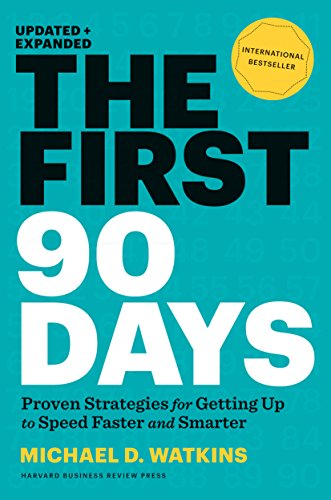
The Index Card Summary of “The First 90 Days”

For those who just started new jobs this past summer or fall, you may be closing in on the end of your first quarter. As someone who came from a liberal arts background and spent college summers working at non-profits or on my own initiatives, I recall my first corporate job being something altogether different than any setting or challenge I had encountered to date. Standing on the threshold of my first office, I realized that the system I was joining was a whole new kettle of fish. Whether you’re joining a new sector or a new company, the way you prepare and get smart for a new role is distinct to the business context and requires some focused, diligent attention. This summary walks through the key actions for leading your own transition.

Michael Watkins’ The First 90 Days: Proven Strategies for Getting Up to Speed Faster and Smarter gives guidance on how to position yourself for success in a new role. While the target audience is new managers, he identifies challenges common to all new employees and provides a structure for recognizing and addressing the types of challenges that come with differing organizational contexts.

First off, why 90 days? The author posits that the first quarter is a good time to get judged, as people’s impressions and perceptions are starting to solidify. The faster you can get up to speed and move from a “transition” period to having ongoing positive impact, the better. Watkins recommends taking the following steps.

The index-card summary

  1. Out with the old assumptions and habits, in with the new skills

  2. Understand your business context

  3. Manage up: show your boss you can achieve their priorities

  4. Collaborate with your team

  5. Identify influencers

The detail

  1. Out with the old assumptions and habits, in with the new skills

    Leave behind old assumptions and habits tied to your old role. A new company has its own culture, dynamics, and norms. Focus on attuning your mindset and your skillset to your new role. Recognize that you will need to perform at a higher standard than your last role.

    To begin, construct a learning agenda in which you identify competencies to upgrade and skills to gain. Develop a learning schedule in which you summarize your learning needs. Then, figure out the best way to learn, including questions that you need to ask. Create a support network with mentors to support your transition.

  2. Understand your business context

    Identifying the business context you are operating in will aid you in identifying what will be valued in terms of activities and outcomes. Common business situations include Startup, Turnaround, Accelerated Growth, Realignment, and Sustaining Success — or STARS. Each situation will have a different emphasis on learning vs. doing, offense vs. defense, etc. and, thus, will differ in what must be done to secure an “early win”.

  3. Manage up: show your boss you can achieve their priorities

    You will need to establish credibility with your new boss. This means taking on your boss’ objectives and definitions of success as your own. You can then define goals relevant to your role and find opportunities to demonstrate your ability to achieve success by pursuing a few early wins.

    As you identify a path forward, it is your responsibility to keep your boss posted and ensure that expectations are communicated. No surprises is the best policy in working with your boss. You must also adapt to your boss’ style rather than assuming you can change them. Your relationship with your boss is your responsibility. By aligning on your priorities and defining your strategy, you can create a shared vision and establish a clear direction of progress.

  4. Collaborate with your team

    You must align you strategy and vision with your teammates. Assess their strengths and weaknesses, in a non-judgemental fashion. Establish the right structure for speed and effectiveness. Identify personal and team timelines for analysis and action planning. Don’t make decisions before you are ready.

    Develop a common language of communication. This will speed up action and remove misunderstandings.

  5. Identify influencers

    In an ideal scenario, you win the respect of people whom your boss respects. Beyond your immediate teammates, identify and understand the influence of indirect stakeholders, who may impact your goals.

The quick take

I like that this book focuses on what is in your control, and the importance of being proactive as well as receptive to the new environment. It’s worth underscoring that the most important thing you control is your mindset. What I am less convinced by are the tactical tips about quickly identifying all facets of success and converting them into an action plan. Watkins makes it all sound easy. The reality is, it isn’t always easy. In a new work environment, particularly the large ones, I’ve often found my senses on overload, not knowing what’s true vs. what’s marketing, and finding advice from different veterans inconsistent or even at odds. In the end we all have to make our own foundations by choosing how we define success in the context of our careers, beyond just a single job.

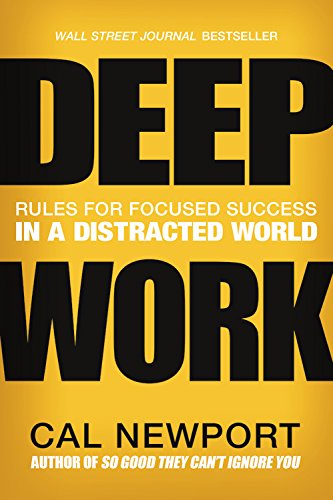
The Index Card Summary of “Deep Work”

Does it ever feel like your brain is overheating from fragmenting attention between too many things, flitting back and forth between tasks, with sometimes little progress to show for it? Well you’re not alone, and Cal Newport is going to be our Dr. Phil of attention, helping us to improve our quality of work and quality of life. The following summary of Deep Work walks through his advice on how to build our ability to engage deeply with our activities.

The Premise

Newport argues that in the modern economy there will be three types of winners: 1) those with access to capital, 2) those that are the best in their fields, and 3) those who work well with increasingly complex machines. The most viable route to economic success for must of us will be Path #3.

To work well with ever-evolving machines, you must be a great learner who can do deep work, i.e. focus intensely. Fun fact: intense focus triggers the same brain cells repeatedly and builds up myelin, which bulks up that neural pathway. Sort of like body building for your brain.

 Deliberate practice of a task bulks up the myelin in the related neural pathways

Deliberate practice of a task bulks up the myelin in the related neural pathways

The approach

1) The measure of deep work is time spent x intensity of focus. That’s what you want to maximize!

2) Deep work can be done bimodally (days to months as a time); rhythmically (several blocks of time each day); or like a journalist (whenever you can squeeze time in on the go)

Note on Technique: for those with less control over your schedule and less recent practice with deep work, the Pomodoro Technique may work best for blocking off deep work sessions followed by shallow work sessions or breaks. For example, 40 minutes of deep work followed by 20 minutes of shallow work 6 times a day can still achieve the target of 4 total hours of deep work per day. These shallow work periods may end up as over-flow buffers initially as you train yourself up to longer, unbroken periods of time.

You need to have 10 consecutive unbroken deep periods of a given time increment, as short as 10 minutes, before you start building up to longer periods.

3) Set up a systematized ritual – create a time bound, distraction free environment with all the right materials and enough food/energy

4) Avoid frequent task switching, as this leaves “attention residue”, a state of semi-attention as you’re still thinking about the last task when you start a new one

5) Choose to work on “the wildly important”

6) Collaborate with others in a way where you still break off for independent deep work

Pitfalls and solutions

1) Switching to an easier thought task – avoid this by structuring the path forward

2) Looping, i.e. reviewing what you know already – avoid this by consolidating gains upon which to build

3) Shallow activities – cut these out without excessive apology

4) E-mail – lay out a ‘path to closure’ to open-ended e-mails by laying out all steps to completion in one fell swoop

Note on E-mail: we’ve all rattled off quick replies that we know will generate three or more back-and-forths. Nip this in the bud by laying out everything you know will be discussed, including your availability for meetings requested, or any further information you will need. Add “no reply expected” or “I will consider your reply a confirmation” to minimize future e-mail traffic.

The path forward laid out by Newport is a call to action, with the knowledge that this means dragging our brains kicking and screaming. Our brains are seekers of distraction yet, paradoxically, convey the most satisfaction to us when we hit the “flow state” associated with deep work. Like eating your greens or hitting the gym, your body and mind will thank you for the deep work exercise you put it through. So pull out that weekly schedule or that Pomodoro timer, block out that time or set that target daily hours tally. You can start sculpting that focused mind today. (I say this having written this post with only one coffee break and two 5 minute side chats in between. We’re all a work in progress 🙂