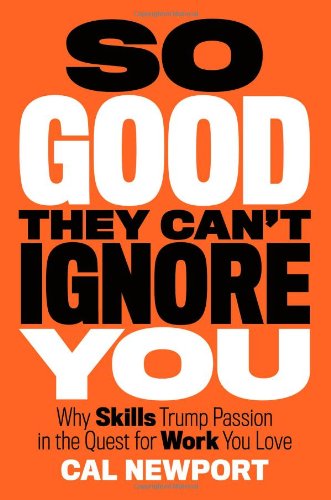
The Index Card Summary of “So Good They Can’t Ignore You”

Cal Newport incisively speaks to the millenial heart that has been somewhat misguided by the role models of our day with the prompt to “follow your passion”. We’re told to just identify something we like doing, that we’re good at, and that people are willing to pay for. Simple, right? But if it were simple, college kids would not be picking up every single leaflet at every job fair. There would not be nearly so many applying to strategy consulting jobs. We’d all be on “a mission from God,” Blues Brothers style.

The “happy place” in the middle is what popular guidance tells us to seek…

In fact, it seems to be the vast minority of people who have charted out a specific interest from a young age and don’t miss a beat on the way to med school or engineering. The secret truth is, most of the highly successful people we know didn’t experience the ven diagram above simultaneously, but sequentially. The order is 1) Develop a talent, 2) Prove out market demand, then 3) Experience the passion that comes from being skilled and the autonomy that comes with carving out a market niche. Here is how Cal Newport breaks it down.
  1. Passion comes from being good at something, not the other way around

  2. Being good at something – which we’ll call having “career capital” – comes from deliberate practice

  3. Deliberate practice requires continuous feedback, clear standards and goals, and stretching beyond your current abilities

  4. The Law of Financial Viability: Your skills must be something people are willing to pay for

  5. Think small, act big: have a mission, and identify “the adjacent possible” to push boundaries and inject meaning into your work

  6. Know your market: success requires that you knowing what kind of “game” you’re playing – is it an auction market, or winner-take-all?

Once you achieve exceptional skill, you can then command more autonomy, an essential element to satisfying work. Unfortunately Cal Newport observed in his research that this is typically they point when employers push back on unique demands from the highly skilled, since it means ceding more of the value generated by the employee to the employee. But the uber-skilled seem to win out in the end.

So the moral of the story, as Lin Manuel Miranda attributed his success to, is to pick a lane and start running ahead of everyone else.

Ready? Set? Go!

The Short and Sweet Summary of “Messy: The Power of Disorder to Transform Our Lives “

Index Card Book Summaries: because most practical books can be summarized on an index card

Tim Harford posed a provocative question as to whether orderliness always benefits us. He unearths the human psychology that causes us to seek order while also showing the pitfalls and missed opportunities from being too orderly and the benefits of strategic mess! While Tim does this in 300 pages, I’m happy to share the 3 bullet summary:

1. Messy processes can bread creative and higher quality solutions

2. Trying to force structure on naturally messy processes can result in negative unintended consequences

3. As people have become very automated in their own social interactions, they should look to self-disrupt to re-engage with one another

Point 1 is an obvious one for artists and the avant garde. But in relation to point 3, if we find ourselves in the well worn grooves of work and personal life patterns, how do we tap into the rest of our brains to enliven and draw on the other ideas and connections we can make? More on that in a minute.

Point 2 is particularly dangerous with the automation of legal decisions. I’ve heard of several friends being mistakenly placed on terrorist watch lists, interrupting medical degrees and personal lives. This isn’t to say that machine learning can’t be leveraged to accelerate pattern recognition, but we just need to be careful about the new robo cops on the block receiving too much autonomy.

Back to unpacking Point 3, the subtle call to self-disrupt.  What this will mean in the macro and micro, personal and professional level is really up to you. The humble high achievers out there might be shivering at this business-bantery term and feel the impulse to artfully side step the charge, lest they become too much of a walking resume. But what this really is about is engaging your full self. It’s about snapping out of “shoulds” and survival mode, and tuning into the bigger you. Like the X-Men Apocalypse entourage, but for good. 

If you’re curious for a longer read, here’s the book link!

The Short and Sweet Summary of “Growth Mindset”

Index Card Book Summaries: because most practical books can be summarized on an index card

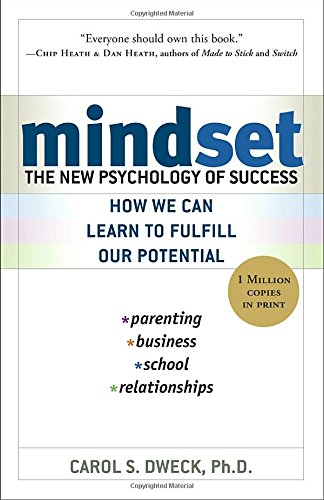
Carol Dweck has taken the business world by storm by popularizing her success psychology book Mindset. I listened to the whole thing on Audible because I’m slightly OCD about completing books. I’ll share with you a little secret: the book is well summarized in a few lines, which follow.

There are only two types of mindsets

1. A growth mindset posits that you can grow and develop

2. A fixed mindset holds that how you are now is all you can achieve (i.e. is fixed)

The results and drivers of each mindset are listed in the table below.

Mindset Fixed Growth
World View You’re a finished product You’re a work in progress
Impact on Outcomes Regressive Progressive
Drivers Short term view, Stereotype threat Long term view, Constructive thinking about setbacks
Approach Haphazard, Uncontrolled, Reliance on raw talent Strategic, Tactical, Focused on taking charge of the process
Results Leads to short cuts, Inability to cope, Need to establish superiority Tunes out the negative, Cultivates character, Care about personal best

The book makes the compelling argument that people with a growth mindset are more successful in everything that they do. But how does the mindset of the managers and other authorities you work with factor into your ability to action a growth mindset? That will be saved for another post 🙂

Introducing Index Card Book Summaries

90% Unnecessary

Most avid readers of self improvement and business books will have noticed a common thread among all of them: they are overly padded. Watch the TED talk or listen to a podcast cameo by the author, and you’ll have absorbed 90% of the book content already. Naturally the anecdotes, statistics, and gritty details give more color and life to the author’s premises that support learning styles of every type. But for folks with limited time and considerable ground they’d like to cover in the practical learning department, I think an index card summary would suffice.

Why an Index Card?

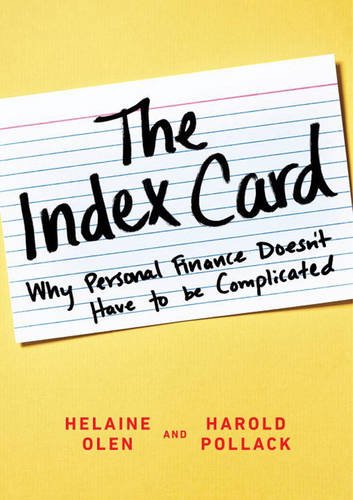
Of course I am not the first to make the observation that authors add some cushion to their content in their endeavor to build a brand, substantiate a product, and look good on a shelf next to other books. Harold Pollack first made this now widely accepted observation about personal finance books in a now famed article. Of course his followers asked “Where’s the index card?” He replied with a photo of a handwritten index card summarizing all the key personal finance principles, which went viral. And, of course, his summary was soon padded out into a book: The Index Card: Why Personal Finance Doesn’t Have to Be Complicated.

Get ready to get to the punch line

In an effort to conveniently aggregate the latest wisdom and research for navigating our offices and lives, I am initiating a new series: the Index Card Book Summaries. As I continue to read these books that I think shouldn’t be books, I’ll share the pithy version of the key findings with you. Happy not reading!