Meal kit cook off: a side-by-side comparison

As a youngish professional spending most of my time in Manhattan, I find myself in food deserts from time to time, or move to move as it were. Each new move can spur a renewed exploration of meal kits, which have proliferated as a consumer offering in the last 5-10 years. A lot of listicles like Reviewed.com rate the mail-and-cook kit options, without factoring in the changing face of grocery. Thinking outside the FedEx box means recognizing that Whole Foods is in on the game now, and it’s not just Weight Watchers selling ready healthy meals anymore. Below is a side-by-side comparison sampling one of each of the three mealkit styles:

  • Blue Apron representing mail-and-cook

  • Amazon Meal Kits debuting pick-up-and-cook

  • Freshly repping mail, heat and eat

Amazon Meal Kits: I’m impressed

Amazon always does everything a little differently. In this instance, they’ve priced each meal kit differently, ranging from $15.99 to $19.99. This makes sense when the ingredients range from chicken to shrimp, and departs from the typical meal kit practice of flat pricing.

Also distinctive is the short, simple instructions and minimal number of ingredients. This meant that the 30 minute cooking time was a true 30 minutes! I tried the pork dish, and appreciated the fresh crunch and flavors, likely aided by the fact that I cooked it the same day that I bought it.

Freshly: full of flavor

Freshly caught my eye with a promotion, and now they have me sold. Six single meals for $60 gets you imaginative dishes like “Aloha Chicken” and wild-caught mahi. I had my doubts about microwave dishes, but the spices and the fresh ingredients mean there is only a little added softness from the microwave steaming. It’s all a huge upgrade from the panini and chicken salad sandwiches of downtown delis.

Blue Apron: light on flavor, long on time

I gave up on Blue Apron last year. The long recipe descriptions and amount of chopping for a knife-skills novice meant that the “30 minute” prep times were usually more like 60 minutes – that’s 100% overage! Also, they seemed to think salt, pepper, and olive oil were all you need to make a dish pop. It got a bit boring after a short while. And even with all the cooking time, I didn’t become a significantly better cook. Hence my back-tracking to the simpler options above.

The final evaluation: price, time and flavor

So who wins the a battle of price, time, and flavor? I’ve conveniently plotted price vs. time performance of these three options below, and plotted flavor against prep time in a 2×2 below.

 Price vs. prep time for 3 types of meal kits

Price vs. prep time for 3 types of meal kits

When evaluating flavor against prep time, we see Amazon and Freshly are in the lead.
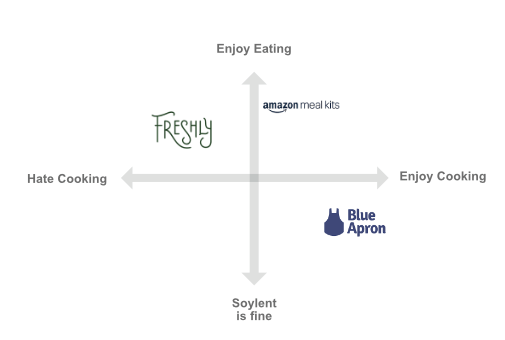
 Plotting each meal kit on the amount of flavor and the amount of prep time each offers.

Plotting each meal kit on the amount of flavor and the amount of prep time each offers.

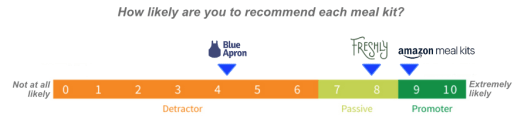
Using the Net Promoter Score scale for each of the three, rating how likely I am to recommend each kit on a scale of 0 to 10, here’s where I personally land on ratings for Amazon, Freshly, and Blue Apron.
Bon appetit!

Keeping social media from steeling your vacation

Unhashtag your vacation

I noticed a bold ad campaign at 14th St. for a city not a lot of people talk about. It’s a city I’ve been to, the home of Mozart, with airy music chambers graced by string quartets and delicious chocolate deserts. Things that are engage the senses beyond sight. Their ad campaign slogan is “unhashtag your vacation”. Their campaign images use a hashtag like a strike-through. They suggest to the viewers that they should engage with experiences personally rather than positioning them for personal branding on social media.

These ads are a bold statement – speaking to America, the birthplace of Mad Men, in our own language – marketing. Because social media has literally become dangerous.

Death by selfie

The viral photo of the queue of mountaineers waiting to take their selfies at the summit of Mt. Everest, and also struggling for oxygen, has shocked the world into a moment of reflection.

Eleven deaths resulted from the excess of wealthy adventurers. Have vacations been reduced to photo ops for bragging rights?

In the same moment, Vienna is challenging us to think about the purpose of vacations and the role of photography – big questions in a world with a growing middle-class and a camera on every personal device. To answer these big questions, it’s worth walking back to the land before digital photography and the world before social media, which I grew up in.

My journey from photography to social media

My first experiences traveling were on middle school trips. My parents let me borrow their film-based camera, and I took as many as 3 roles of film for a 3 day trip to places like Salem, Massachusetts and Washington, DC. With film, you never knew how a photo would come out until it was processed, so I erred on the side of volume. I assumed everything was interesting, worth capturing and documenting, from store fronts to tourist attractions to friends. Eventually I realized that my documentary style photography was a little extreme, and only ~10% of the photos had strong visual interest – I wasn’t even looking at most of the photos! In high school, I had fewer field trips and was more selective about what I photographed. My photography became anthropocentric, capturing natural moments that I valued and events that were firsts or celebratory. I made my favorite photos into little gifts, which friends loved. They were personal moments made special, for private consumption.

When digital photography arose in my college years, I had opportunities to travel again and work in other countries in the summers. My first digital camera was quickly stolen, and when I finally acquired a new one, I was more sparse and selective about what I photographed. Only the most beautiful sites that I would not want to forget. The misted mountains of Machu Picchu. The colorful sands of the Atacama Desert. Enchanting sights that I had never imagined existed, let alone having the chance to visit.

As I was starting to travel, social media was on the rise. This meant, for the first time, large scale external feedback, for better or for worse. I joined the fray of “look how awesome a time I’m having” posts for a while, but found myself naturally limiting my Facebook consumption to one hour a week. Yet I found that hour to be mostly an unhappy one. I told myself I was keeping up with friends, but increasingly just felt left out of all the fun people were having without me. But business school amplified my use and, thus, the detrimental effects of social media, which have now become well documented.

I now sit in the in-between. Sometimes I feel like I should participate in social media because my peers do, yet it doesn’t fully make sense to me. I see lots of photos of food with hundreds of likes, yet when I take similar photos they feel uncompelling, and I never post them. It feels strange, creating content that has become part of our typical virtual communication, but it feeling entirely forced and artificial. Increasingly, I try to eat my chocolate cake without photographing it, too.

Vacation for vacation’s sake

It goes without saying, vacations are more than just selfie opportunities. They are about your being present in a refreshing setting, not about the social media story you tell about it. I used to take a ton of photos and go through roles of film. Then I realized I was neither stopping to look at the photos nor stopping to really soak in the sites I was visiting. Vacations should not be about the external feedback that social media provides. What is most important is the internal moments of reflection, observation, and appreciation that they offer. And the same is true of our weekends, our moments with family and close friends, and every joie de vivre.

NYC social Tetris: where dog friendly meets kid friendly

This weekend I had my first baby-puppy meet up with b-school friends. Yes, we’re all in that phase of life ranging from millennial pawent to full fledged parenthood. We chose what seemed like the perfect meeting point: Madison Square Park. It boasts a modern playground and one of the rare small dog parks for the under 20 lb pooches. When the six adults converged we began dancing a fine line. A cluster of us filtered into the playground where the dog wasn’t allowed. Then we switched to the dog park, where the two-year-old was less than thrilled but stoical about being surrounded by animals larger than her. Finally, we all decided it was time to stroll in search of a truly common ground: the outdoor cafe. Yet such spots are somewhat elusive, seasonal, and in high demand at this time of year. At this point I started to realize what parenthood is really about: planning.

I began the search for the ideal map of places that meet all of our familial needs. And here is what I found:

Dog friendly cafe map

The Dog People, powered by Rover.com, wins my earnest respect for actually pinning their favorite dog-friendly restaurant to a map! While it’s limited to Manhattan, that’s the hardest borough to navigate with a fluffy friend. Bring Fido comes in second for its colorful food photography, although the “New York, New York” tag for every location doesn’t add much.

Kid friendly restaurant list

Time Out New York is certainly guilty of over-indexing on Times Square, but lots of their picks, like Alice’s Tea Cup, are super legit. I personally love their pumpkin scones – which taste like real British scones, with buttery rich moisture. (If you thought you didn’t like scones, you should still try these ones!)

The overlap

Time Out New York’s kid friendly list and the Dog People’s dog friendly list share two of the top ten restaurants! They are:

1. Barking Dog Luncheonette (Upper East Side)

2. Cowgirl NYC (West Village)

And I made a map of the overlap! Now I know exactly where to go when we have a multi-family, multi-species outing. Happy spring!

Dogercise: the Millennial parent workout solution

As a new millennial parent, also known as a “pawent”, I have had to make some lifestyle adjustments. As gym sessions got swapped for dog walks, I realized I didn’t want to gain a friend and also a couch bod. I recognized the need to raise the fitness bar with my furry friend. So to complement my airport yoga routine, which helps me stretch my way through JFK on work trips, I’ve developed a plan for me and my dog to both keep up with the squirrels: dogercise. With this new approach to workouts, you’ll see you lose none of your fitness and gain all the time you need with your fuzzy companion.

Bench press → Puppy press

Use a 10-15 lb dog for toning. To build muscle mass, choose a 20-50 lb dog. On a flat back with bent knees, position one hand on the ribs and one hand mid-belly. Repeat 3 sets of 15 reps. Stretch in between by fully extending arms while scratching your dog’s back in reward for being a good boy.

Running → Chasing

In a place where your dog can be off leash, either in a dog park or a living room, chase dog in circles until he or she has been panting for at least 5 minutes. To get your dog highly motivated to maintain the pursuit, bait him or her with a favorite “keep away” object not intended for chewing, such as a shoe or sock. Ensure that the baiting shoe is not one you will miss.

Mason twists → Mason tugs

Sit on the ground with your back angled at 45 degrees. Get your dog engaged with a tug toy by squeaking or shaking in front of his or her nose. Once dog grips the tug toy, raise legs parallel to the ground, with toes pointed, and pull the tug toy under your legs. Pass the tug toy from one hand to the other, until dog has walked a 180 degree arc under your legs. Repeat the passing for 20 reps. Rest in between sets by snuggling your dog.

Yes, you truly can have it all. And as they grow from puppy to adult, yoga may be the next frontier, with tandem downward dog. Namastay. Good boy.

Fortnight vs. Netflix: the battle of the attention economy

The CEO of Netflix issued a letter to shareholders in January warning that the greatest threat to its growth is not from traditional media companies, but from video game Fortnight. In short, CEO Reed Hastings is signalling that the boundaries of the Netflix competitive set are not limited to direct competitors, but are inclusive of anyone competing in the attention economy.

In our technology-infused day and age, the attention economy has become a fierce battleground. Initially, most addictive, arms-reach entertainment could fill the cracks, folding around one another. People have typically browsed Facebook on commercial breaks or tweeted while watching a live event. However, two trends are forcing stiffer competition for attention. First, consciousness about screen time. Screen time has gone from a neutral to a threatening and uncertain term. Its perceived deleterious effects on our brains and social skills has led to a wave of pushback, from studies professing its harms, to new built-in features in phones for self-regulation. At the same time, video games like Fortnight have taken a page from traditional consumer marketing playbooks, engineering their games to be more “snackable”; each Fortnight round lasts only 15 minutes, easily nudging players into a “just one more” mentality. This segment of time is just tantalizing enough yet substantial enough to lead players and observers to look up and realize hours have passed, hours that are no longer available for other TV and streaming options.

The finite resource of our time is forcing choices as the number of options only increases. And the Fortnight vs. Netflix battle is yet another example of the brave new economy we are operating in, where capabilities are what scale rather than discrete consumer offerings. Fortnight and Netflix are highly skilled at capturing attention. Other companies, like Amazon and Uber, are breaking into new markets by leveraging their logistics capabilities and distribution, with Prime Video and Uber Eats. Unfortunately for Netflix, their capabilities only scale to compete in the most finite market of all: the market for time.

Taking control of your privacy: 3 resources to make yourself more cyber secure

2018 was an epic year for security hacks, from Marriott to Facebook. Following on the tails of the 2017 Equifax hack that exposed half of American social security numbers, now hackers can pair that up with passport numbers and birthdates with a quick purchase on the ever-growing dark web.

While most Americans don’t trust institutions to protect their data, they also don’t seem to care. For me, it was easy enough to take basic password precautions, using 1password or the like to keep passwords varied and random. But now, after listening to Reply All’s interviews with hackers — boasting about destroying people’s credit and lives with ease — I’ve been scared straight into taking responsibility for my cyber-safety. There are three resources that are free, low hanging fruit to reduce your presence on the internet and deter hackers.

1. Google Voice

You may have noticed that two factor authentication these days often involves a text message. Unfortunately hackers know this too, and are now in the habit of targeting phone companies to get targeted numbers transferred to them to enable their cyber hacks. (Details in The Snapchat Thief episode of Reply All). This is where Google Voice comes in handy! You can either port your number over to Google Voice, or start using a Google Voice number as your two-factor authentication number. As a bonus, you can get a Google Voice number for free with a Google account.

If you don’t like fiddling with your phone every time you need a second factor authentication, you could also pay $36 a year for 1password. 1password both securely stores passwords and provides the second factor authentication by automatically pasting the temporary code to your clipboard – Crtl-V and you’re done.

2. Hidden from the Internet workbook

The aforementioned Reply All episode included many helpful security links in the show notes, including this handy workbook. This excerpt from Hidden from the Internet walks through how to freeze your credit (remember that Equifax breach?) and remove your personal information from public databases. There are an eye-popping number of such databases, but the author highlights the top 10 that will have the biggest trickle-down effect of wiping your info from the internet.

3. DuckDuckGo

DuckDuckGo’s Chrome plugin and search engine offer three fantastic benefits. First, they force sites to use encrypted connections when available. Second, they automatically block tracker networks from spying on you across the internet. Lastly, they tell you how private each site you visit is with a grade, based on how they treat your data — a grade which is boosted by the first two measures. Thus, a privacy rating could move from a D to a B with some automatic protections enabled by DuckDuckGo. I previously used Ghostery for this, which has similar functionality, but it had more manual design, the search was less accurate, and the mobile app was super slow.

Picking the low hanging fruit

Of course I know these measures wouldn’t protect me from a committed hacker, but at least it’s a deterrent for the lazy ones. Not taking these steps is like leaving your front door unlocked. Taking them is simply adding a button lock that could be picked. At the very least, with less of my info on the internet, I’ll get less spam and marketing!

Christmas Tree Arbitrage Redux

Does the fact that you are on the corner mean that you can corner the market?

Previously, on Christmas Tree Arbitrage …

Since our 2016 article on Christmas tree arbitrage opportunities in local markets, we added the backstory of supply & demand based on planting and harvest cycles affected by prior recessions. This year, we peal back two more layers of the onion: the entry of e-commerce into the market, and the temporal aspect of pricing.

Decades ago Christmas tree shopping in New York was simply a story of street corner competitors. Then came the chain stores, like Whole Foods and Home Depot. And now, enter stage left the biggest player of them all: Amazon. Yes, this season e-commerce is in the Christmas tree market.

Amazon is testing a new thesis on tree shopping: delivery to your door trumps walking to the corner. Aesthetic items used to be squarely in the “try before you buy” category, which only brick and mortar can provide. But our consumer behaviors continue to evolve with the proliferation of e-commerce options, and Amazon thinks the time is now to give e-trees a try.

As Christmas tree prices have remained somewhat elevated following last year’s shortage, Amazon’s pricing of $109 + free delivery is actually a steal! Whole Foods is playing an even more competitive pricing game (likely riding the Amazon wholesale cost advantage), with pricing starting at $35 for a 6-foot tree on Black Friday Weekend. Compare this to the guy on the corner selling $120 trees, and it may be worth the extra avenue of carrying making your husband carry your freshly cut pine – and it’s an excuse to walk off the turkey!

But perhaps you want to optimize for distance walked more than price, and are interested in supporting tree farmers directly. In that case, you can also save some money by buying your tree from your corner vendor in mid-to-late December, rather than early December, when tree demand is highest.

Personally, even at ~20% off, I’m not convinced that buying a Christmas tree blind is a better experience than bundling one up that I’ve examined, checked the moisture levels of, and chatted with a farmer about. I want to know the sustainability policy of his or her farm, and that my tree is locally sourced, 100% organic, free range, cruelty free, and fair trade. I want to be reassured that it had a loving upbringing with a good family. And even if Amazon got all that right, if they are really serious about the e-tree game, I’d want a generous return policy, so that I can order three trees in different sizes, compare them, and return the extras.

Happy tree shopping!

5 things my dog taught me about management 

My new puppy has brought home a few important things to me in the last month, and not just the balls I ask him to fetch. Learning to train him has illustrated some of the most foundational principals of effective management. Below are the top five training points for building up your working relationships with those you manage, whether human or canine.

1. Build effective communication 

Before you can expect a dog to behave well, you need to be able to identify the cues they are giving you as to their needs. Are you annoyed that they are barking? What might they be trying to communicate to you? Perhaps they are hungry or haven’t gotten enough exercise that day. Noticing what your dog needs and providing that clears away concerns that may prevent them from being receptive to your guidance. When you have met your dog’s needs, you can also communicate your needs by praising the right behaviors (like chewing chew toys) and disincentivizing the wrong behaviors (like chewing shoes).

If you’re experiencing friction with an employee, have you taken cues from them as to their work style? Have you established communication norms? Have you provided clear feedback about what is working for you and what is not? (Pro tip: try creating a Management Readme on Readme.bio for each of your teammates, to more quickly orient yourself to everyone’s work style preferences.)

2. Break it down

Further to the communication point, it often is not enough to just say “be better” at XYZ, as such asks are not specific, and do not delineate a path forward. My dog initially struggled with “leave it”. I started with a simple piece of paper towel in my hand (which he normally loves to chew). He successfully left it. But I made the mistake of jumping right to putting it on the floor and walking away. He chewed it immediately. It was too big a leap for him. I’d skipped across the incremental steps that would have built up his focus. Similarly, explaining a piece of a process to colleagues and then jumping to the end, without breaking out the steps in between, makes it likely that you will lose people in the process. For managees, throwing them in the deep end with minimal prep is much more overwhelming than incrementally increasing responsibility.

I invested time in learning about dog training so that I could figure out how to lead him to the behaviors I wanted to see. Similarly, managers much invest the time to specify what precisely they want to see in terms of actions and outcomes, and work with their team to identify how to get there in the needed time frame.

3. Be consistent

Being consistent and predictable to those you manage helps them to figure out how to work best with you. My dog now start making little noises at 7am every day, as he knows that’s when we take him out to do his morning business, get fed, and play. He doesn’t make noises at night, as he knows we intend to sleep all the way through it. Similarly, managees can meld to your schedule and style if you are consistent. If you always block off 8-9am to review final work, they will plan to provide you content for review at that time. If you praise people for thoughtful project planning or being vocal during meetings, you can expect to see more of that.

4. Have patience 

Dogs take months and even years to be fully trained even in a single behavior. Expect them to make mistakes, and be forgiving yet persistent. Even smart dogs take a lot of positive reinforcement to solidify a habit. Humans need the same! It is perfectly normal to need to repeat yourself over and over, in different settings, so be accepting of this reality.

5. Invest

Dogs grow into behaviors, not out of them. If you continue to invest in building the right behaviors in the first year, you will reap the benefits for a lifetime. Your puppy will grow into an impressive dog who is a loyal companion. It goes without saying that people are also worth the investment! Your managees will prove resilient, and can grow leaps and bounds with the right support.

Intelligent design: how NYC has planned for millions of moving parts

Hello beautiful nerds, this week in MBA in the City, we explore the design choices of NYC’s above ground public infrastructure that have helped the flow of the city. Yes, I’m talking about how the city has made way for the explosion of bicycles.

In the last decade, the number of daily bike trips in the city has more than doubled. And from the ever-expanding bike lane network to the ever-available bike racks throughout the city, our movement has become a little more perfect. And how has New York achieved this visible transformation? Using the mightiest of modern weapons: data. With New York’s Open Data policy and numerous beta tests and A/B tests, it’s clear our policy makers aren’t afraid of data. And New Yorkers aren’t shy about sharing opinions. This match made in heaven has produced decisions by and for the city’s 8 million residents. Respect.

Now for the highlights real! The back stories and photo documentary of where we’ve arrived by bike.

Bike racks can be beautiful

A decade ago the City launched an international competition to design the next generation bike rack. The results ranged from elegant to intriguing, producing a series of sample designs that were sprinkled throughout the city. Public comments read like Amazon reviews:

“Looks-wise the Y-rack is the only serious contender in the NYC icon stakes. Even though the paint was already a bit scratched, it still stood out from the crowd.”

— Public comment, CityRacks Design Competition

Most free opinions are worth their actual weight, but ones from New Yorkers make me feel like I’m watching reality TV: inexplicably mesmerized.

Once the winner was selected, these racks rolled out across the city, with some interesting auxiliary effects.

Now you see it…

…now you don’t

What I really love more than these elegant DOT racks is the ripple effect it had with private property owners, inspiring bank buildings and art galleries alike to get into bespoke bike racks. For the choosy bikers, there’s something for everyone – sleek or artsy, industrial or modern.

I wanted to be an outdoor gym, but this is a close second.
I feel invisible…such is the artists life.

There is a dark side to more cycling, though — with more bikes has come more bike thefts. But as a New Yorker, my inner monologue chimes the classic excuse for everything that is unacceptable in most places, but somehow not here: “That’s New York!”

I, once had a bike,
or should I say, it once had me

Citi Bike: onward and upward

In keeping with the city’s green initiative and the growing public love of the sharing economy, a shared biking system was conceived of in 2011. Here the public had it’s say years before launch, but there was no avoiding first contact with reality. From the word go, capacity was put to the test. Malfunctions were common, with stations going dead and bikes not always docking. New Yorkers told it like it was, and Citi Bike put their game face on. New software was rolled out two years later that fixed the glitches and supported the self-sustaining solar units at each station. And new bike models keep rolling out! I personally love the one with no gear – based on the road’s incline, it naturally adjusts the resistance! I also enjoy the shopping catalogue-esque presentation of the Citi Bike design on the official website. It makes me want to go buy one. But I can only buy a subscription. That will have to do.

 Citi Bike docking station in beautiful, sunny Madison Square Park Citi Bike docking station in beautiful, sunny Madison Square Park

Design + data-driven decision making = intelligent design. NYC is making thoughtful decisions that make life in the city more fluid, more perfect, more true to its people. I give my city a gold star.

Breaking boundaries: the spread of tech-enabled access to art

Is all art for everyone? Are works that sell for millions in auction houses and street murals in urban playgrounds equally deserving of access for all? Increasingly technologists are signaling “YES” with clever products that not only introduce access to art, but call for active engagement. 

Accessibility 1.0: distributive access

Accessibility 1.0, much like Web 1.0, focused on just getting the content distributed. These are online portals that make users able to see and learn about art, like Khan Academy’s art history content. Accessibility 1.0 focuses on the democratization of knowledge, much like Project Gutenberg, which has famously provided access to over 57,000 free eBooks.

Accessibility 2.0: putting the AR in art

Accessibility 2.0 is underway, with a new generation of tech-enabled art evangelists. They want historic art and art from your every day experience to be equally as accessible, physically and psychologically.

As augmented reality has become just an app download away, marketers and philanthropists alike have identified the opportunity to make art look and feel more tangible. Using Art.com‘s ArtView feature you can get a preview of what a piece looks like on your living room wall. 

AR initiatives such as CMU’s Art Management & Technology Laboratory have also begun developing similar functionality for educational purposes; such initiatives can project historic paintings, statues, and structures, allowing for people to actively explore.

Accessibility 3.0: enabling creativity

Accessibility 3.0 has rolled out almost simultaneously. To its vanguards, accessibility means both being able to see and interact with art, as well as being able to make it.

Prisma is an exemplary app that transforms any ordinary photo into an impressionist piece a la Picasso or surrealist Salvador Dali at the touch of a screen. While mega companies are waiting at the wings to buy user behavior data, the technology allows a new level of personal expression in user generated content.

GalaPro is also opening another arts door to the disabled: theater. This new app interprets performances for deaf, blind, and non-English-speaking audiences, by providing audio descriptions, captioning, and dubbing. Twelve Broadway theaters now offer GalaPro.  One show, Children of a Lesser God, features hearing, hard of hearing, and deaf actors. The show itself features full subtitles throughout using the same technology from GalaPro.

This rapid evolution of accessibility tools, providing knowledge and the opportunity for self-expression, makes art accessibility feel more achievable than ever. Invisible lines are being crossed and blurred and soon will be erased from our augmented view.