The Index Card Summary of “Wait: the Art and Science of Delay”

There is a famous military mantra that “slow is smooth, and smooth is fast”. Frank Partnoy, author of Wait: The Art and Science of Delay, thoughtfully unpacks the benefits of taking one’s time and the contexts in which it is most important.

The Index Card Summary

Partnoy’s key takeaways boil down to three points:

  1. We should wait as long as possible to act, to ensure we have the maximum possible information.

  2. To be able to wait as long as possible, you need to be able to execute quickly.

  3. Doing things quickly comes with a cost to quality, which you can mitigate by becoming and expert.

Partnoy provides the reasoning, methods, and frameworks for taking on the challenging task of slowing down to achieve better results.

1. Why wait?

Because it is optimal. Partnoy posits that humans are hardwired to react quickly, as part of our inbuilt fight or flight instincts. Modern society taps into this wiring, tempting us to react instantly to its many demands. Yet we are often better off resisting both our biology and our technology. Waiting as long as possible ensures that you have the maximum possible information available to inform your next decision.

2. Making time to wait means executing quickly

In the ideal world, you would spend much less time executing and re-executing. You would optimize outcomes by minimizing execution time. OODA is an effective framework for developing a strategy without reacting too hastily.

The Observe, Orient, Decide, Act (OODA) framework requires the decision-maker to observe the changing environment and process the disorder occurring before deciding how to act. One can act fast without necessarily acting first. Act too quickly, and you may provoke a problem that would have otherwise gone away. Further, if you spend too much time acting (e.g. building a presentation), you have less time to observe (e.g. calibrate the actual project needs and goals).

3. To keep quality high during fast execution, become an expert

Novices and experts are two extremes on the experience spectrum. Whereas experts can act quickly based on the muscle memory of prior experience, novices may be better off not acting at all. For example, time pressure does not impact grandmaster chess players in the way it impacts novice chess players. Under time constraints, grandmasters make few mistakes whereas novices make many.

However, there are times when even experts should wait. Importantly, novel circumstance can still arise in one’s sphere of expertise. Medical professionals face this challenge often.

The considered take

Partnoy is one of the few voices in the modern world telling us to wait. We’re in an era of high-speed internet, one-click orders, two-day shipping, high-frequency trading….the list goes on. Partnoy counters our culture by making the case that waiting is optimal.

I appreciate that Partnoy makes the important distinction that artful delay and procrastination are not the same thing. This means that you need to define what “waiting as long as possible” means in your own context. In many businesses, on time is late and early is ontime. So, for example, waiting until the final hour to submit an application online, and then hitting a computer glitch, could leave you out of luck.

Partnoy also underscores that rushing when you are not an expert will not produce good results — making it all the more important to accurately assess where you are at in a skill set and allocate execution time accordingly. So how does one become an expert? A few ideas:

  1. Spend a lot of time thinking through how to do something in a deliberate manner, so that when the time arrives, you can execute quickly.

  2. Use checklists, which can force you to pause, be more systematic, and reduce errors. 

  3. Pursue deliberate practice so that you are trained in the skill you care about.

As Partnoy summed it up, the essence of modern intelligence may be knowing when to think and act quickly and when to think and act slowly.


The game theory take: why New York got taken by Amazon

Governor Cuomo came out swinging back against New Yorkers who have criticized the tax breaks associated with the Amazon HQ2 deal – which will bring half of a second headquarters to Long Island City, New York. Where The New Yorker calculated the tax break to equate to each New Yorker Venmoing Jeff Bezos $348, Cuomo compared the deal to getting 90% of the taxes we would have otherwise foregone. So which is it? Well, both. New York has won a battle but is losing a war, a war that it did not need to enter. More specifically, we have set a negative precedent in a repeated game, where states are shooting themselves in the foot with a tit-for-tat strategy, trying to out-discount each other to woo over corporations.

Planet Money framed the dynamic best in a case study of Kansas vs. Missouri. Kansas City sits squarely across both states. And year after year, one corporation or another has pit the two states against one another as they choose which side of the city to operate in. “The states want to keep these companies. So they’re slashing taxes. And they are digging themselves deeper into a hole. That tax revenue is going to pay for stuff like roads and schools and police.” King and Vanek Smith reported education budget cuts in Kansas in the order of magnitude of tax breaks offered to AMC Theaters, Applebees, and the like. This particular state rivalry has resulted in losses for both, consistent with tit for tat game theory. In a tit for tat game, participants always mirror the last actions of their counterpart. So if the state across the way holds their taxes stable, you can too, but if the rival state offers a tax cut, you automatically do as well. Cooperation results in the best outcome for everyone, and confrontation results in net loss over time for each player.

Another game that the Amazon HQ2 competition resembled is the dollar auction. By calling cities to compete for the second headquarters, it appeared to have triggered loss aversion as 238 municipalities invested monetarily and psychologically into the dog and pony show. The aforementioned Kansas City, Missouri’s Mayor wrote 1,000 Amazon product reviews to attract Amazon’s attention. Chicago hired William Shatner to voiceover their promo video. And tax incentive offers abounded. In short, it appears that cities across the nation were drawn into a version of the dollar auction, a type of auction where bidders are willing to pay more than a dollar to win…a dollar. This is because the consequence of not winning the auction is to pay the amount you bid (read: the amount you spent on marketing and political showboating). This potential loss triggers the sunk cost fallacy for many. Sufferers of the sunk cost fallacy continue playing a losing game because they have already invested time and money into the game, despite the lack of evidence that they will make a return on any additional investment.

Cuomo’s argument boils down to two points: every state gives incentives, so New York has to, too; and yet New York is so attractive a place to be that it did not have to offer incentives nearly so big as what others did. Well, there’s an obvious tension between those arguments. New York is indeed enticing enough to attract all the other west-coast tech giants to build big offices: Google, Facebook, and Microsoft. They didn’t get big tax breaks to come here. But we’ve certainly set the stage for them to come with the begging bowls in hand in the future. As a city of 8 million diverse and talented inhabitants, a bidding war is not a game New York has to play.

5 things my dog taught me about management 

My new puppy has brought home a few important things to me in the last month, and not just the balls I ask him to fetch. Learning to train him has illustrated some of the most foundational principals of effective management. Below are the top five training points for building up your working relationships with those you manage, whether human or canine.

1. Build effective communication 

Before you can expect a dog to behave well, you need to be able to identify the cues they are giving you as to their needs. Are you annoyed that they are barking? What might they be trying to communicate to you? Perhaps they are hungry or haven’t gotten enough exercise that day. Noticing what your dog needs and providing that clears away concerns that may prevent them from being receptive to your guidance. When you have met your dog’s needs, you can also communicate your needs by praising the right behaviors (like chewing chew toys) and disincentivizing the wrong behaviors (like chewing shoes).

If you’re experiencing friction with an employee, have you taken cues from them as to their work style? Have you established communication norms? Have you provided clear feedback about what is working for you and what is not? (Pro tip: try creating a Management Readme on Readme.bio for each of your teammates, to more quickly orient yourself to everyone’s work style preferences.)

2. Break it down

Further to the communication point, it often is not enough to just say “be better” at XYZ, as such asks are not specific, and do not delineate a path forward. My dog initially struggled with “leave it”. I started with a simple piece of paper towel in my hand (which he normally loves to chew). He successfully left it. But I made the mistake of jumping right to putting it on the floor and walking away. He chewed it immediately. It was too big a leap for him. I’d skipped across the incremental steps that would have built up his focus. Similarly, explaining a piece of a process to colleagues and then jumping to the end, without breaking out the steps in between, makes it likely that you will lose people in the process. For managees, throwing them in the deep end with minimal prep is much more overwhelming than incrementally increasing responsibility.

I invested time in learning about dog training so that I could figure out how to lead him to the behaviors I wanted to see. Similarly, managers much invest the time to specify what precisely they want to see in terms of actions and outcomes, and work with their team to identify how to get there in the needed time frame.

3. Be consistent

Being consistent and predictable to those you manage helps them to figure out how to work best with you. My dog now start making little noises at 7am every day, as he knows that’s when we take him out to do his morning business, get fed, and play. He doesn’t make noises at night, as he knows we intend to sleep all the way through it. Similarly, managees can meld to your schedule and style if you are consistent. If you always block off 8-9am to review final work, they will plan to provide you content for review at that time. If you praise people for thoughtful project planning or being vocal during meetings, you can expect to see more of that.

4. Have patience 

Dogs take months and even years to be fully trained even in a single behavior. Expect them to make mistakes, and be forgiving yet persistent. Even smart dogs take a lot of positive reinforcement to solidify a habit. Humans need the same! It is perfectly normal to need to repeat yourself over and over, in different settings, so be accepting of this reality.

5. Invest

Dogs grow into behaviors, not out of them. If you continue to invest in building the right behaviors in the first year, you will reap the benefits for a lifetime. Your puppy will grow into an impressive dog who is a loyal companion. It goes without saying that people are also worth the investment! Your managees will prove resilient, and can grow leaps and bounds with the right support.

When actions have consequences: are Millennials changing corporate and government behavior?

The Millennial generation, often decried for not wanting to take individual responsibility, is sending its reply loud and clear: “You first”.

The year is 2018. Recent hits like “We Ain’t ever Getting Older” have topped the charts by hitting a resonant chord with youths who want to push off adulthood. Any yet, the Millennial generation being referenced has fully graduated into the workforce. And in this very same moment, corporations and their key individuals are being called to account, often by Millennials — and the call is being heard. A wave of corporations and governments have been taking responsibility in a manor not previously seen in the Millennial lifetime.

From the Reagan era through the Financial Crisis, the silent message has been that corporations can do as they please, and expect to suffer a slap on the wrist at worst for infractions against society. Today, in the throws of the #MeToo movement, individuals are not only being called out, but called to account, with nearly 100 perpetrators now dethroned. Whereas no traders went to jail for fraud after the 2008 Financial Crisis, Elon Musk was immediately taken to task by the SEC for manipulating the stock market, losing his board position at Tesla for 3 years alongside a $20 million fine. This trend begs the question, are the masses successfully calling corporations and regulators to finally take responsibility for the excesses of the free market? And if so, what, in the last couple of years, has suddenly given corporations and the government the moral backbone it has seemingly lacked for decades? Perhaps the very generation that is said to avoid responsibility is demanding responsibility from the entities that govern it.

Have millennials brought about a new era of capitalism and government oversight? Certainly there is evidence on the corporate front. Where politicians have shied away from hot button issues, corporations have increasingly taken a stand for what they believe will benefit society. For example, following yet another school shooting, Delta’s CEO publicly stated “Our values are not for sale”, cutting ties with the NRA. There were political consequences: the Georgia legislature promptly punished the company by repealing a $40 million tax break. Yet Delta’s public perception improved. The brand was enhanced globally for its stance, and its stock price was left unaffected.

 Google Finance
Google Finance

Is Millennial purchasing power to thank for this growing trend? More and more, Millennials express their views by voting with their wallets. Responsive corporations are largely seeing a net to fully positive financial bump from taking social action. Nike’s Colin Kaepernick ad, supporting the ostracized football star in his protest against police violence, resulted in a 31% jump in online sales, a much stronger performance than typical Labor Day sales. While the government does not seem interested in better regulating itself on this issue, perhaps it will better regulate equally unjust corporate behaviors.

Is government primed to take the same social cues as corporations are, and increase restrictions of antisocial corporate behaviors? As with corporate acts of social responsibility, customers have shown their support of impactful government regulation with their wallets. Google’s share of the European ad market jumped on May 25th, thanks to their swift and clear compliance with GDPR data protection policy vis-a-vis their competitors. In the case of Elon Musk and the SEC noted above, perhaps the SEC is seeing the social proof that if corporations can win public support by taking responsibility, perhaps they can to.

Are corporations finally starting to play a longer-term game than this quarter’s profits, thanks to consumer pressure? Industries such as entertrainment are rapidly asserting newfound standards even in the face of guaranteed financial loss, for fear of the impact to public opinion, now heavily steared by Millennial social media presence. Roseanne Barr’s racist tweek led to the immediate cancelling of her TV series relaunch. Several theater companies canceled the plays of Israel Horovitz following a multitude of sexual misconduct allegations. While such allegations against Horovitz had been raised decades before, only now are theater companies dealing with the issue in ernest.

Is it a coincidence that the voice of corporate social responsibility is being heard and acted upon so visibly today, across industries and sectors? Has something changed that makes the voice of the public more consequential than in earlier years? Perhaps a hot job market combined with a multitude of brand choices are forcing corporations to compete like never before for market share, mind-share, and talent. Perhaps the sense of heightened political vulnerability with the dramatic switch from Obama to Trump, undergirded by continued social dissatisfaction, has motivated government to keep powerful companies somewhat more accountable, at least for the most visible issues. Whatever the cause, the dramatic nature of this tonal shift stands in stark contrast to the status quo even a few years ago.

In the lifetime of Millennials, corporations have been deemed to have personhood, with rights to free speech, including political spending. At an individual level, such rights come with responsibilities. Corporate responsibility, in the last few decades, has largely been limited to shareholder obligations. At the corporate level, it is only in the last few years that individuals are being held accountable by leadership. Millennials, have instilled a new brand of social responsibility, that includes what companies owe to the public. Without it, companies put their clients and talent pool at risk. Even with the alarming amount of economic dislocation, many have found hope for capitalism, as corporations are starting to take responsibility rather than avoid it.

The existential threat to drug store pharmacies: the battle of price and quality

CVS recently announced its Pharmacy Savings Finder, a tool that promises to identify the cheapest version of a medication that a patient can buy. Essentially, they are promising to do comparison shopping for you. It seems to be a long awaited counter to a four front battle. Not only is CVS competing with other pharmacies, but also online Rx websites, startups and, more recently, large corporations.

Long before CVS’s Pharmacy Savings Finder, there was Walgreens’ Prescription Savings Club, Walmart’s generic prescription program, and various other brick-and-mortar players offering to find savings for consumers. So why the sudden urgency to take action and join the price wars? The rising cost of healthcare is not new news, and remains a chief concern for the poorest and the sickest. One possible catalyst appears to be the proactive industry invasion by mega-companies that are starting to feel the exposure to healthcare cost risk. I’m referring to the largest titan team-up in history, announced in January, with Amazon, Berkshire Hathaway and JPMorgan Chase. The three promised to form an independent healthcare company that will provide, among other things, cheaper drugs. Amazon’s acquisition of PillPack, a startup that mails prescriptions to people who take multiple medications, has further signaled that competitive pricing and industry-leading speed may be on the way to a historically manual and expensive service.

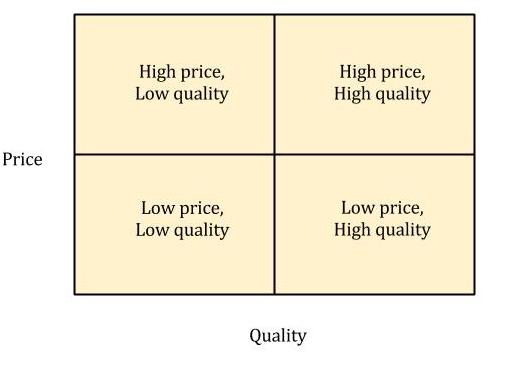
Up until this year drug store pharmacies had clear competition for each vector, quality of service and price. Launched in 2016, Capsule Pharmacy’s value proposition included consistent inventory, shortened wait times, and better access to medication information. And for years vertical search offerings online, such as WellRx or Q1Medicare.com, offered a quick scan by drug, category, or discount program to find the best price. These are classical positionings in the business world; low price, high volume, and basic service means thin margins but leads to larger market share. Distinctive services can allow companies to justify a higher price and be profitable but with fewer customers. Now, with mega corporate partnerships, traditional drug stores most compete more effectively on both service and price.

 Businesses are typically well positioned to succeed if they are in the bottom left (think Walmart) or the top right (think One Medical). In pharma there appears to be a shift towards the value-for-money segment, the bottom right.
Businesses are typically well positioned to succeed if they are in the bottom left (think Walmart) or the top right (think One Medical). In pharma there appears to be a shift towards the value-for-money segment, the bottom right.

Perhaps this is the shakeup that the Pharmaceutical industry has needed. Operating health services with a profit motive as the primary impetus can only lead to worse health outcomes for patients. With nontraditional industry actors motivated by the health of their employees shaking up the status quo, we can more easily hold traditional industry players to account.

Makers, makers everywhere! The top six features of the 2018 Maker Faire

I thoroughly enjoyed my time nerding out at the 2018 New York City Maker Faire. From grooving on the dance floor to cheering on the battlebots, there was fan fair and creativity in the air. The initiatives spanned every size and scale. A 40 foot mechanical clawed arm, controlled with a right-hand sensor-laden glove was picking up a totaled car, not unlike the Blade Runner 2049 villainess directing remote attacks on Officer K. On the other end of the size spectrum, a flexible chip maker, MellBell Electronics, showed how their product could be used in everything from wearables to interactive 2D visuals. There was something for everyone. Below is a short list of some of my favorite Faire features.

From big…
…to small.
Making the future.

Top things I loved about the Maker Faire

 Girls learning how to drill… Girls learning how to drill…

1. The spike in young girls…

STEM for girls initiatives have visibly turned the tides! Whereas four years ago the Maker Faire displayed a sea of prototypical boy engineers, this year’s Faire had little ladies of all backgrounds, getting hands-on with building.


 …from Disney princesses in work boots. Our 21st century role models have arrived. …from Disney princesses in work boots. Our 21st century role models have arrived.

2…and the role models there to meet them

Importantly, there was a heroine aesthetic being donned by many of the women instructors. One stand introducing kids to hand drills was run by Disney princesses in work boots. They were aptly named Beauty and the Bolt. Another activity had Princess Leia and Rey leading instruction.


3. The number of Johnny 5 inspired robots

Every anthropomorphized consumer bot seems to look like Wall-E, who had clear influences from the Short Circuit humanoid robot, Johnny 5. I approve of this trend.

4. The Tesla coil made musical

Speaking of the past inspiring the future, oneTesla had the most epic demo of how a Tesla coil can be used to make lightning that both lights a wireless light bulb and plays music simultaneously. It was a light show, concert, and tech demo all in one. I don’t foresee Nikola Tesla’s vision of fully wireless electricity transfer coming to pass at scale, but this is not a bad alternative use case.

 Lightning jumped from the coil on the right to the light bulb on the left, all to an electronic beat. Lightning jumped from the coil on the right to the light bulb on the left, all to an electronic beat.

5. The next gen 3D printer

It’s nice to see equipment manufacturers beginning to combine capabilities for similar, but equally necessary tools for a makerspace. Specifically, one stand presented a combination CNC-3D printing machine, thus marrying related tooling with distinct software.

6. The sky is the limit thinking

It was fantastic to see the International Space Station represented alongside their many collaborators, including Magnitude.io. Magnitude.io’s prototype smallsats are blazing trails for educational accessibility. Where CubeSats have dramatically increased space access at a reduced cost, thanks to their 10 cm cubic size, Magnitude.io displayed concepts the size of a pack of gum.

 There’s a smaller game in town than CubeSats. Magnitude.io has launched CanSats and is developing even smaller sats. There’s a smaller game in town than CubeSats. Magnitude.io has launched CanSats and is developing even smaller sats.


The future is happening, and the brilliant minds of all ages and backgrounds present at the 2018 Maker Faire are leading the charge.

From individual to societal data: taking on bigger, badder problems

We have all heard the saying that “knowledge is power”. And in today’s modern economy, data is the new knowledge, which makes data power. We see it evidenced in the collective $1.3T market capitalization of Google and Facebook, whose pixels and cookies track us all over the internet. These massive data collectors began with an focus on individuals. Now, as we collect data about communities, societies, and supply chains, those holding the data will have growing power to impact not just individuals, but whole populations. 

The power of system-level data

Not only are today’s innovators collecting data about individuals, but they are collecting data about populations and processes. For example, Biobot Analytics hopes to transform sewers into public health observatories for whole communities by sampling wastewater from strategic points in a sewer system. Such collective samples can reveal issues as significant as an opioid epidemic, in neighborhoods as small as a few thousand people. Data tracking also promises to improve the fidelity of supply chain processes. Blockchain has been seen as a high potential technology for stemming the circulation of counterfeit drugs as well as upstream labor abuse.

This begs the question, how great is this latent potential? Are we reaching an inflection point where we no longer need to play whack-a-mole, and can finally clean up the messy problems that have previously upended communities, especially in the area of public health?

With great power comes great responsibility

Certainly the intentions of these technologies are to protect citizens, from counterfeit drugs, from themselves in the case of opioid detection. The question becomes how to ensure that the intended benefits manifest and unintended consequences do not.

We have all also heard the saying that power corrupts. Knowing this, we are forced to ask the question, how might the power of data be used corruptly in our own society? If recent technology deployments are any indication (e.g. AI blocking female doctors from the women’s locker room), we must ask, will we ultimately just re-manifest the problems of society using data?

We’ve observed the rise of “Big Brother” social monitoring in places like China, where social infractions as banal as jaywalking are caught by sophisticated monitoring, and have repercussions. Outside of monitoring, we’ve seen the weaponization of predictive algorithms in prison sentencing, resulting in worse outcomes for minorities. 

Given these patterns, we must imagine how cases like opioid overuse detection could be handled in the worst case. If an opioid crisis is detected, how might treatment differ in a poor versus a rich neighborhood? Will the doctors be the police targets in the wealthy neighborhoods, and the residents targeted in the poor places?

Writing society’s story

This — bias perpetuation — does not have to be how the story goes. Data is being used to empower many under-resourced communities. For example, an AI predictive model was able to increase the successful identification of corroded pipes in Flint Michigan from 20% to 97%, enabling the city to afford remediation of an additional 2,000 homes. Data can powerfully determine how we direct our limited resources to otherwise overwhelming problems. 

Knowledge is power, and while deep knowledge afforded by data can help solve problems by exposing them, it does not guarantee that those acting upon them have the best solutions. Impact is dependent on the social systems we operate in — how these analytical tools are used and how their analyses are received. We must ensure that those who can access and act upon community data are as effective at testing their own assumption and biases as they are at pinpointing social problems. 

Has Amazon become eBay? The new normal for e-marketplaces

There’s a market place with real-time bidding, where all the suppliers with identical products vie to sell their goods to a group of buyers, all with varying willingness to pay. Which market am I speaking of? Is it the stylized market place from Econ 101, the modern financial markets, or today’s primary e-commerce model? In fact, it is all three.

We’ve heard of regression to the mean with stock prices. The past decade has witnessed a regression to the mean of economic models. The difference between the market places academics describe and the ones financiers and commercial platforms implement has rapidly evaporated. In sum, the world has become eBay. 

The great irony in this turn of events is that eBay is one of the few markets where the auction model failed. Although eBay was a classical market, with multiple people selling identical or equivalent items, buyers did not want auctions. So why did eBay’s core model fail where so many others have since succeeded? Two words: buyer experience.

The Wharton course selection process followed a similar arc to that of eBay. Selecting your lineup for the semester used to be the stuff of day traders’ dreams. Speculation and back door deals were required to accumulate enough points and make the right trades to get your dream class lineup. But with the time and energy vortex it created for students, professors decided to swap in a simple system of ranked preferences, that students could set and forget until their course schedule was determined. Both the old and the new systems were based on economic theories, but the new one worked for everyone at a dramatically reduced cost. The selection process went from weeks of game theory strategizing to days of just choosing which courses you were most interested in. Similarly, eBay’s Buy it Now option made it so that you could literally buy peace of mind, knowing that your item was on its way. Now that’s exactly what buyers do 80% of the time on eBay.

Where eBay failed to deploy a streamlined buyer experience to auctions, e-commerce giants and financial markets have succeeded. They ensured that just because they make their markets competitive, doesn’t mean they need to be a hassle. And all with one weird trick: making the sellers compete, not the buyers.

Jet.com was the first e-commerce player to dream the dream of emulating financial markets: one price to rule them all. Jet aggregated all sellers of a single item under one listing, hiding the buyer and just showing the best price. The computer does the comparison for the shopper, bringing them one step closer to a two-click purchase. Amazon quickly riffed on this, showing a list of other sellers for a given item alongside that seller’s user rating. And the bandwagon effect was unleashed. Specialized sellers like Newegg, which formerly focused on technology products, have deployed the same tech to sell across categories, aggregating sellers and drop shipping inventory for a seamless user experience. Other markets are not far behind the curve. Technology has made it so easy to adjust prices that the bidding for hotels and airlines on aggregators like Kayak and Priceline is continuous.

All fields of technology-based commerce appear to be converging to an economists dream: a series of real-time auctions. But is the economists’ dream everyone’s dream — do we want the whole world to be a real-time auction market place? No doubt there is a dark side to a system evaluating actors primarily on price competition. Amazon’s opening the floodgates of international vendors to the U.S. has created a whole underground economy of fake reviews for low quality knockoffs, for example. In other areas, considering price alone has resulted in a number of negative externalities, such as the rash of taxi driver suicides in markets Uber has taken over. As eBay has taught us, without keeping an eye on consumer experience, no market model is sustainable. And as Silicon Valley has taught us, forgetting that these systems affect real people can cause social dislocation. Time will tell how consumers vote with their clicks. 


Breaking boundaries: the spread of tech-enabled access to art

Is all art for everyone? Are works that sell for millions in auction houses and street murals in urban playgrounds equally deserving of access for all? Increasingly technologists are signaling “YES” with clever products that not only introduce access to art, but call for active engagement. 

Accessibility 1.0: distributive access

Accessibility 1.0, much like Web 1.0, focused on just getting the content distributed. These are online portals that make users able to see and learn about art, like Khan Academy’s art history content. Accessibility 1.0 focuses on the democratization of knowledge, much like Project Gutenberg, which has famously provided access to over 57,000 free eBooks.

Accessibility 2.0: putting the AR in art

Accessibility 2.0 is underway, with a new generation of tech-enabled art evangelists. They want historic art and art from your every day experience to be equally as accessible, physically and psychologically.

As augmented reality has become just an app download away, marketers and philanthropists alike have identified the opportunity to make art look and feel more tangible. Using Art.com‘s ArtView feature you can get a preview of what a piece looks like on your living room wall. 

AR initiatives such as CMU’s Art Management & Technology Laboratory have also begun developing similar functionality for educational purposes; such initiatives can project historic paintings, statues, and structures, allowing for people to actively explore.

Accessibility 3.0: enabling creativity

Accessibility 3.0 has rolled out almost simultaneously. To its vanguards, accessibility means both being able to see and interact with art, as well as being able to make it.

Prisma is an exemplary app that transforms any ordinary photo into an impressionist piece a la Picasso or surrealist Salvador Dali at the touch of a screen. While mega companies are waiting at the wings to buy user behavior data, the technology allows a new level of personal expression in user generated content.

GalaPro is also opening another arts door to the disabled: theater. This new app interprets performances for deaf, blind, and non-English-speaking audiences, by providing audio descriptions, captioning, and dubbing. Twelve Broadway theaters now offer GalaPro.  One show, Children of a Lesser God, features hearing, hard of hearing, and deaf actors. The show itself features full subtitles throughout using the same technology from GalaPro.

This rapid evolution of accessibility tools, providing knowledge and the opportunity for self-expression, makes art accessibility feel more achievable than ever. Invisible lines are being crossed and blurred and soon will be erased from our augmented view.

My eyes are down here: how marketers are adapting to smart phone usage

As I strolled the streets of Chelsea one chilly Saturday morning, I noticed a sidewalk ad – literally, stenciled on the sidewalk. Huh, I though, gorilla marketing takes a twist.

But why did I notice this ad that blends in with old bubble gum and uses the most basic of color pallets? I realized it was because I was on my smart phone! With 50%+ global penetration of internet usage, largely driven by smart phones, the sidewalk has become better marketing real estate than a 40 foot billboard by the highway.

Second world cities have beat first world marketers to adapting to this monumental change in consumer behavior – the text neck. In Santiago, the cross walk lights are built into the curb cuts now.

And Chinese city Chongqing has set up “no phone” pedestrian lanes, so fast and slow walkers are equally accommodated – something I’d love to see rolled out in Herald Square.

Next time you are out and about, make sure you watch where you are going.