The CEO of Netflix issued a letter to shareholders in January warning that the greatest threat to its growth is not from traditional media companies, but from video game Fortnight. In short, CEO Reed Hastings is signalling that the boundaries of the Netflix competitive set are not limited to direct competitors, but are inclusive of anyone competing in the attention economy.
In our technology-infused day and age, the attention economy has become a fierce battleground. Initially, most addictive, arms-reach entertainment could fill the cracks, folding around one another. People have typically browsed Facebook on commercial breaks or tweeted while watching a live event. However, two trends are forcing stiffer competition for attention. First, consciousness about screen time. Screen time has gone from a neutral to a threatening and uncertain term. Its perceived deleterious effects on our brains and social skills has led to a wave of pushback, from studies professing its harms, to new built-in features in phones for self-regulation. At the same time, video games like Fortnight have taken a page from traditional consumer marketing playbooks, engineering their games to be more “snackable”; each Fortnight round lasts only 15 minutes, easily nudging players into a “just one more” mentality. This segment of time is just tantalizing enough yet substantial enough to lead players and observers to look up and realize hours have passed, hours that are no longer available for other TV and streaming options.
The finite resource of our time is forcing choices as the number of options only increases. And the Fortnight vs. Netflix battle is yet another example of the brave new economy we are operating in, where capabilities are what scale rather than discrete consumer offerings. Fortnight and Netflix are highly skilled at capturing attention. Other companies, like Amazon and Uber, are breaking into new markets by leveraging their logistics capabilities and distribution, with Prime Video and Uber Eats. Unfortunately for Netflix, their capabilities only scale to compete in the most finite market of all: the market for time.
Clearly legislators have been reading my blog and were touched by the story of my healthcare emergency this past 4th of July. My experience embodied the every-man and moved our government to action. The result? Mandated price transparency for hospital services. Yes, hospitals nationwide are now required by federal law to reveal their once-secret master price lists. However, while I know our Senators were trying to help a millennial out with out-of-pocket costs, there’s a real risk of unintended consequences. In fact, prices might just go up.
As a parallel, let’s take the case study of CEO pay in the 1990s. In 1993, the Democratic Congress under Bill Clinton passed a change to tax law that capped companies’ tax deductions for executives’ compensation to $1 million per executive per year. Concurrently, starting in 1992, The SEC began requiring standardized disclosure of compensation in proxy statements in hopes of making it more difficult to disguise pay that didn’t incentivize managers, or was excessive. Yet this move to transparency and incentives alignment backfired; by 2000, the average CEO pay had nearly quintupled to $19 million.
What explains this massive increase? In short, the practice of benchmarking CEO pay. CEO base pay was never cut, because CEO pay became increasingly based on benchmarked lists limited to top-paid CEOs in that field. This selection bias in comparison sets resulted in a rising tide for all CEO packages. At the same time, because the tax amendment did not penalize performance-based pay, compensation committees started offering a growing number of stock options as an incentive to CEOs. Options could only become valuable as the companies performed well. And in the late 90s, as the stock market rose and pushed all options “in the money”, total compensation rose in lockstep.
Will a similar comparison bias happen for medical costs? Or will payors temper rising costs with their buying power? Only time will tell.
2018 was an epic year for security hacks, from Marriott to Facebook. Following on the tails of the 2017 Equifax hack that exposed half of American social security numbers, now hackers can pair that up with passport numbers and birthdates with a quick purchase on the ever-growing dark web.
While most Americans don’t trust institutions to protect their data, they also don’t seem to care. For me, it was easy enough to take basic password precautions, using 1password or the like to keep passwords varied and random. But now, after listening to Reply All’s interviews with hackers — boasting about destroying people’s credit and lives with ease — I’ve been scared straight into taking responsibility for my cyber-safety. There are three resources that are free, low hanging fruit to reduce your presence on the internet and deter hackers.
1. Google Voice
You may have noticed that two factor authentication these days often involves a text message. Unfortunately hackers know this too, and are now in the habit of targeting phone companies to get targeted numbers transferred to them to enable their cyber hacks. (Details in The Snapchat Thief episode of Reply All). This is where Google Voice comes in handy! You can either port your number over to Google Voice, or start using a Google Voice number as your two-factor authentication number. As a bonus, you can get a Google Voice number for free with a Google account.
If you don’t like fiddling with your phone every time you need a second factor authentication, you could also pay $36 a year for 1password. 1password both securely stores passwords and provides the second factor authentication by automatically pasting the temporary code to your clipboard – Crtl-V and you’re done.
2. Hidden from the Internet workbook
The aforementioned Reply All episode included many helpful security links in the show notes, including this handy workbook. This excerpt from Hidden from the Internet walks through how to freeze your credit (remember that Equifax breach?) and remove your personal information from public databases. There are an eye-popping number of such databases, but the author highlights the top 10 that will have the biggest trickle-down effect of wiping your info from the internet.
3. DuckDuckGo
DuckDuckGo’s Chrome plugin and search engine offer three fantastic benefits. First, they force sites to use encrypted connections when available. Second, they automatically block tracker networks from spying on you across the internet. Lastly, they tell you how private each site you visit is with a grade, based on how they treat your data — a grade which is boosted by the first two measures. Thus, a privacy rating could move from a D to a B with some automatic protections enabled by DuckDuckGo. I previously used Ghostery for this, which has similar functionality, but it had more manual design, the search was less accurate, and the mobile app was super slow.
Picking the low hanging fruit
Of course I know these measures wouldn’t protect me from a committed hacker, but at least it’s a deterrent for the lazy ones. Not taking these steps is like leaving your front door unlocked. Taking them is simply adding a button lock that could be picked. At the very least, with less of my info on the internet, I’ll get less spam and marketing!
It is immensely human to want to be understood, and a great skill to be able to make oneself understood by wide-ranging audiences. This end-of year post is a hats-off edition for those who take complex, multifaceted topics that otherwise appear unknowable and clearly describe the inner workings of our world in layman’s terms. Four communicators in four fields have been especially influential and necessary.
Four fields have outsized impact on our working present and future: finance, management, science and technology. With the 10 year anniversary of the financial crisis just past, the importance of financial liquidity as the lifeblood of our economy is palpably understood by our businesses. And if strong financial conditions offer a tailwind, good management readies a business to benefit in the near-term. At the same time, science and technology are changing the nature of work day by day. Previously manual jobs like automotive assembly now require a technical literacy that demands that each person arm themselves with the latest technical knowledge. Thus, a knowledge of finance, management, science and technology makes for one capable business leader.
Four experts in these four fields have continually contributed to the public’s ability to grasp big and small ideas with clarity. And the winners are…
Best financial communicator: Felix Salmon of Axios
Felix Salmon’s daily articles on Axios and weekly podcast, Slate Money, complement each other with punchy clarity and practical insights that are both local and global. He speaks directly to the lightly-financially literate American and to the globe, as he covers trends in other large economies as well as struggling economies. He reads what would be tea leaves to most and makes financial indicators approachable. His frequent podcast refrain is to interrupt jargon-laden explanations from co-hosts and say “explain that in English.” Britain-born, he proves we don’t always need to be divided by a common language.
Best management communicator: Adam Grant, author
Adam Grant is an organizational psychologist who has written three books on how to drive personal and professional success. Beyond his famed insights from Give and Take, which show that generosity towards others can drive your own success, he’s gone on to create a podcast called WorkLIfe,in which he interviews entrepreneurs, employees, and companies to unearth practical advice to improve our work lives. He is a prolific tweeter and poster on LinkedIn, where he offers bite-sized daily advice for the business leaders of today.
Best science communicator: Neil deGrasse Tyson, astrophysicist
Neil deGrasse Tyson’s Astrophysics for People in a Hurry has been on the New York Times Best Seller list for the better part of 2018, a testament to his famed ability to generate both wonder and create scientific understanding among his audiences. He has a foundational interest in encouraging curiosity and methodical discovery, which makes the everyman feel he or she can, with careful pursuit, know the unknown.
Best technology communicator: Wired, technology magazine
All of Wired Magazine deserves recognition for making complex topics with broad social implications, from the blockchain to ag-tech, easily digestible (no pun intended), with the implications unpacked. Wired humanizes and empathetically portrays the thinking and motivations of the entrepreneurs seeding some of the mega tech trends that are rippling through society.
In summary…
Thank you for an insightful 2018 to the brilliant communicators who have synthesized the most important mechanics and trends in the four fields that are the pillars of modern business. Cheers to you!
Partnoy’s key takeaways boil down to three points:
We should wait as long as possible to act, to ensure we have the maximum possible information.
To be able to wait as long as possible, you need to be able to execute quickly.
Doing things quickly comes with a cost to quality, which you can mitigate by becoming and expert.
Partnoy provides the reasoning, methods, and frameworks for taking on the challenging task of slowing down to achieve better results.
1. Why wait?
Because it is optimal. Partnoy posits that humans are hardwired to react quickly, as part of our inbuilt fight or flight instincts. Modern society taps into this wiring, tempting us to react instantly to its many demands. Yet we are often better off resisting both our biology and our technology. Waiting as long as possible ensures that you have the maximum possible information available to inform your next decision.
2. Making time to wait means executing quickly
In the ideal world, you would spend much less time executing and re-executing. You would optimize outcomes by minimizing execution time. OODA is an effective framework for developing a strategy without reacting too hastily.
The Observe, Orient, Decide, Act (OODA) framework requires the decision-maker to observe the changing environment and process the disorder occurring before deciding how to act. One can act fast without necessarily acting first. Act too quickly, and you may provoke a problem that would have otherwise gone away. Further, if you spend too much time acting (e.g. building a presentation), you have less time to observe (e.g. calibrate the actual project needs and goals).
3. To keep quality high during fast execution, become an expert
Novices and experts are two extremes on the experience spectrum. Whereas experts can act quickly based on the muscle memory of prior experience, novices may be better off not acting at all. For example, time pressure does not impact grandmaster chess players in the way it impacts novice chess players. Under time constraints, grandmasters make few mistakes whereas novices make many.
However, there are times when even experts should wait. Importantly, novel circumstance can still arise in one’s sphere of expertise. Medical professionals face this challenge often.
The considered take
Partnoy is one of the few voices in the modern world telling us to wait. We’re in an era of high-speed internet, one-click orders, two-day shipping, high-frequency trading….the list goes on. Partnoy counters our culture by making the case that waiting is optimal.
I appreciate that Partnoy makes the important distinction that artful delay and procrastination are not the same thing. This means that you need to define what “waiting as long as possible” means in your own context. In many businesses, on time is late and early is ontime. So, for example, waiting until the final hour to submit an application online, and then hitting a computer glitch, could leave you out of luck.
Partnoy also underscores that rushing when you are not an expert will not produce good results — making it all the more important to accurately assess where you are at in a skill set and allocate execution time accordingly. So how does one become an expert? A few ideas:
Spend a lot of time thinking through how to do something in a deliberate manner, so that when the time arrives, you can execute quickly.
Use checklists, which can force you to pause, be more systematic, and reduce errors.
Pursue deliberate practice so that you are trained in the skill you care about.
As Partnoy summed it up, the essence of modern intelligence may be knowing when to think and act quickly and when to think and act slowly.
Does the fact that you are on the corner mean that you can corner the market?
Previously, on Christmas Tree Arbitrage …
Since our 2016 article on Christmas tree arbitrage opportunities in local markets, we added the backstory of supply & demand based on planting and harvest cycles affected by prior recessions. This year, we peal back two more layers of the onion: the entry of e-commerce into the market, and the temporal aspect of pricing.
Decades ago Christmas tree shopping in New York was simply a story of street corner competitors. Then came the chain stores, like Whole Foods and Home Depot. And now, enter stage left the biggest player of them all: Amazon. Yes, this season e-commerce is in the Christmas tree market.
Amazon is testing a new thesis on tree shopping: delivery to your door trumps walking to the corner. Aesthetic items used to be squarely in the “try before you buy” category, which only brick and mortar can provide. But our consumer behaviors continue to evolve with the proliferation of e-commerce options, and Amazon thinks the time is now to give e-trees a try.
As Christmas tree prices have remained somewhat elevated following last year’s shortage, Amazon’s pricing of $109 + free delivery is actually a steal! Whole Foods is playing an even more competitive pricing game (likely riding the Amazon wholesale cost advantage), with pricing starting at $35 for a 6-foot tree on Black Friday Weekend. Compare this to the guy on the corner selling $120 trees, and it may be worth the extra avenue of carrying making your husband carry your freshly cut pine – and it’s an excuse to walk off the turkey!
But perhaps you want to optimize for distance walked more than price, and are interested in supporting tree farmers directly. In that case, you can also save some money by buying your tree from your corner vendor in mid-to-late December, rather than early December, when tree demand is highest.
Personally, even at ~20% off, I’m not convinced that buying a Christmas tree blind is a better experience than bundling one up that I’ve examined, checked the moisture levels of, and chatted with a farmer about. I want to know the sustainability policy of his or her farm, and that my tree is locally sourced, 100% organic, free range, cruelty free, and fair trade. I want to be reassured that it had a loving upbringing with a good family. And even if Amazon got all that right, if they are really serious about the e-tree game, I’d want a generous return policy, so that I can order three trees in different sizes, compare them, and return the extras.
Governor Cuomo came out swinging back against New Yorkers who have criticized the tax breaks associated with the Amazon HQ2 deal – which will bring half of a second headquarters to Long Island City, New York. Where The New Yorker calculated the tax break to equate to each New Yorker Venmoing Jeff Bezos $348, Cuomo compared the deal to getting 90% of the taxes we would have otherwise foregone. So which is it? Well, both. New York has won a battle but is losing a war, a war that it did not need to enter. More specifically, we have set a negative precedent in a repeated game, where states are shooting themselves in the foot with a tit-for-tat strategy, trying to out-discount each other to woo over corporations.
Planet Money framed the dynamic best in a case study of Kansas vs. Missouri. Kansas City sits squarely across both states. And year after year, one corporation or another has pit the two states against one another as they choose which side of the city to operate in. “The states want to keep these companies. So they’re slashing taxes. And they are digging themselves deeper into a hole. That tax revenue is going to pay for stuff like roads and schools and police.” King and Vanek Smith reported education budget cuts in Kansas in the order of magnitude of tax breaks offered to AMC Theaters, Applebees, and the like. This particular state rivalry has resulted in losses for both, consistent with tit for tat game theory. In a tit for tat game, participants always mirror the last actions of their counterpart. So if the state across the way holds their taxes stable, you can too, but if the rival state offers a tax cut, you automatically do as well. Cooperation results in the best outcome for everyone, and confrontation results in net loss over time for each player.
Another game that the Amazon HQ2 competition resembled is the dollar auction. By calling cities to compete for the second headquarters, it appeared to have triggered loss aversion as 238 municipalities invested monetarily and psychologically into the dog and pony show. The aforementioned Kansas City, Missouri’s Mayor wrote 1,000 Amazon product reviews to attract Amazon’s attention. Chicago hired William Shatner to voiceover their promo video. And tax incentive offers abounded. In short, it appears that cities across the nation were drawn into a version of the dollar auction, a type of auction where bidders are willing to pay more than a dollar to win…a dollar. This is because the consequence of not winning the auction is to pay the amount you bid (read: the amount you spent on marketing and political showboating). This potential loss triggers the sunk cost fallacy for many. Sufferers of the sunk cost fallacy continue playing a losing game because they have already invested time and money into the game, despite the lack of evidence that they will make a return on any additional investment.
Cuomo’s argument boils down to two points: every state gives incentives, so New York has to, too; and yet New York is so attractive a place to be that it did not have to offer incentives nearly so big as what others did. Well, there’s an obvious tension between those arguments. New York is indeed enticing enough to attract all the other west-coast tech giants to build big offices: Google, Facebook, and Microsoft. They didn’t get big tax breaks to come here. But we’ve certainly set the stage for them to come with the begging bowls in hand in the future. As a city of 8 million diverse and talented inhabitants, a bidding war is not a game New York has to play.
My new puppy has brought home a few important things to me in the last month, and not just the balls I ask him to fetch. Learning to train him has illustrated some of the most foundational principals of effective management. Below are the top five training points for building up your working relationships with those you manage, whether human or canine.
1. Build effective communication
Before you can expect a dog to behave well, you need to be able to identify the cues they are giving you as to their needs. Are you annoyed that they are barking? What might they be trying to communicate to you? Perhaps they are hungry or haven’t gotten enough exercise that day. Noticing what your dog needs and providing that clears away concerns that may prevent them from being receptive to your guidance. When you have met your dog’s needs, you can also communicate your needs by praising the right behaviors (like chewing chew toys) and disincentivizing the wrong behaviors (like chewing shoes).
If you’re experiencing friction with an employee, have you taken cues from them as to their work style? Have you established communication norms? Have you provided clear feedback about what is working for you and what is not? (Pro tip: try creating a Management Readme on Readme.bio for each of your teammates, to more quickly orient yourself to everyone’s work style preferences.)
2. Break it down
Further to the communication point, it often is not enough to just say “be better” at XYZ, as such asks are not specific, and do not delineate a path forward. My dog initially struggled with “leave it”. I started with a simple piece of paper towel in my hand (which he normally loves to chew). He successfully left it. But I made the mistake of jumping right to putting it on the floor and walking away. He chewed it immediately. It was too big a leap for him. I’d skipped across the incremental steps that would have built up his focus. Similarly, explaining a piece of a process to colleagues and then jumping to the end, without breaking out the steps in between, makes it likely that you will lose people in the process. For managees, throwing them in the deep end with minimal prep is much more overwhelming than incrementally increasing responsibility.
I invested time in learning about dog training so that I could figure out how to lead him to the behaviors I wanted to see. Similarly, managers much invest the time to specify what precisely they want to see in terms of actions and outcomes, and work with their team to identify how to get there in the needed time frame.
3. Be consistent
Being consistent and predictable to those you manage helps them to figure out how to work best with you. My dog now start making little noises at 7am every day, as he knows that’s when we take him out to do his morning business, get fed, and play. He doesn’t make noises at night, as he knows we intend to sleep all the way through it. Similarly, managees can meld to your schedule and style if you are consistent. If you always block off 8-9am to review final work, they will plan to provide you content for review at that time. If you praise people for thoughtful project planning or being vocal during meetings, you can expect to see more of that.
4. Have patience
Dogs take months and even years to be fully trained even in a single behavior. Expect them to make mistakes, and be forgiving yet persistent. Even smart dogs take a lot of positive reinforcement to solidify a habit. Humans need the same! It is perfectly normal to need to repeat yourself over and over, in different settings, so be accepting of this reality.
5. Invest
Dogs grow into behaviors, not out of them. If you continue to invest in building the right behaviors in the first year, you will reap the benefits for a lifetime. Your puppy will grow into an impressive dog who is a loyal companion. It goes without saying that people are also worth the investment! Your managees will prove resilient, and can grow leaps and bounds with the right support.
For those who just started new jobs this past summer or fall, you may be closing in on the end of your first quarter. As someone who came from a liberal arts background and spent college summers working at non-profits or on my own initiatives, I recall my first corporate job being something altogether different than any setting or challenge I had encountered to date. Standing on the threshold of my first office, I realized that the system I was joining was a whole new kettle of fish. Whether you’re joining a new sector or a new company, the way you prepare and get smart for a new role is distinct to the business context and requires some focused, diligent attention. This summary walks through the key actions for leading your own transition.
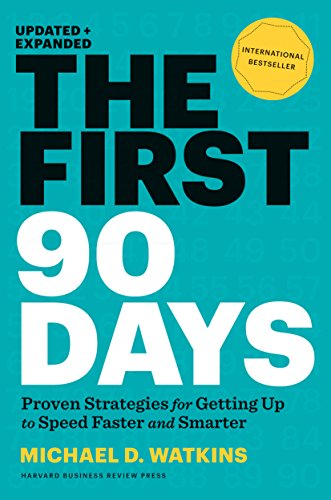
Michael Watkins’ The First 90 Days: Proven Strategies for Getting Up to Speed Faster and Smartergives guidance on how to position yourself for success in a new role. While the target audience is new managers, he identifies challenges common to all new employees and provides a structure for recognizing and addressing the types of challenges that come with differing organizational contexts.
First off, why 90 days? The author posits that the first quarter is a good time to get judged, as people’s impressions and perceptions are starting to solidify. The faster you can get up to speed and move from a “transition” period to having ongoing positive impact, the better. Watkins recommends taking the following steps.
The index-card summary
Out with the old assumptions and habits, in with the new skills
Understand your business context
Manage up: show your boss you can achieve their priorities
Collaborate with your team
Identify influencers
The detail
Out with the old assumptions and habits, in with the new skills
Leave behind old assumptions and habits tied to your old role. A new company has its own culture, dynamics, and norms. Focus on attuning your mindset and your skillset to your new role. Recognize that you will need to perform at a higher standard than your last role.
To begin, construct a learning agenda in which you identify competencies to upgrade and skills to gain. Develop a learning schedule in which you summarize your learning needs. Then, figure out the best way to learn, including questions that you need to ask. Create a support network with mentors to support your transition.
Understand your business context
Identifying the business context you are operating in will aid you in identifying what will be valued in terms of activities and outcomes. Common business situations include Startup, Turnaround, Accelerated Growth, Realignment, and Sustaining Success — or STARS. Each situation will have a different emphasis on learning vs. doing, offense vs. defense, etc. and, thus, will differ in what must be done to secure an “early win”.
Manage up: show your boss you can achieve their priorities
You will need to establish credibility with your new boss. This means taking on your boss’ objectives and definitions of success as your own. You can then define goals relevant to your role and find opportunities to demonstrate your ability to achieve success by pursuing a few early wins.
As you identify a path forward, it is your responsibility to keep your boss posted and ensure that expectations are communicated. No surprises is the best policy in working with your boss. You must also adapt to your boss’ style rather than assuming you can change them. Your relationship with your boss is your responsibility. By aligning on your priorities and defining your strategy, you can create a shared vision and establish a clear direction of progress.
Collaborate with your team
You must align you strategy and vision with your teammates. Assess their strengths and weaknesses, in a non-judgemental fashion. Establish the right structure for speed and effectiveness. Identify personal and team timelines for analysis and action planning. Don’t make decisions before you are ready.
Develop a common language of communication. This will speed up action and remove misunderstandings.
Identify influencers
In an ideal scenario, you win the respect of people whom your boss respects. Beyond your immediate teammates, identify and understand the influence of indirect stakeholders, who may impact your goals.
The quick take
I like that this book focuses on what is in your control, and the importance of being proactive as well as receptive to the new environment. It’s worth underscoring that the most important thing you control is your mindset. What I am less convinced by are the tactical tips about quickly identifying all facets of success and converting them into an action plan. Watkins makes it all sound easy. The reality is, it isn’t always easy. In a new work environment, particularly the large ones, I’ve often found my senses on overload, not knowing what’s true vs. what’s marketing, and finding advice from different veterans inconsistent or even at odds. In the end we all have to make our own foundations by choosing how we define success in the context of our careers, beyond just a single job.
The Millennial generation, often decried for not wanting to take individual responsibility, is sending its reply loud and clear: “You first”.
The year is 2018. Recent hits like “We Ain’t ever Getting Older” have topped the charts by hitting a resonant chord with youths who want to push off adulthood. Any yet, the Millennial generation being referenced has fully graduated into the workforce. And in this very same moment, corporations and their key individuals are being called to account, often by Millennials — and the call is being heard. A wave of corporations and governments have been taking responsibility in a manor not previously seen in the Millennial lifetime.
From the Reagan era through the Financial Crisis, the silent message has been that corporations can do as they please, and expect to suffer a slap on the wrist at worst for infractions against society. Today, in the throws of the #MeToo movement, individuals are not only being called out, but called to account, with nearly 100 perpetrators now dethroned. Whereas no traders went to jail for fraud after the 2008 Financial Crisis, Elon Musk was immediately taken to task by the SEC for manipulating the stock market, losing his board position at Tesla for 3 years alongside a $20 million fine. This trend begs the question, are the masses successfully calling corporations and regulators to finally take responsibility for the excesses of the free market? And if so, what, in the last couple of years, has suddenly given corporations and the government the moral backbone it has seemingly lacked for decades? Perhaps the very generation that is said to avoid responsibility is demanding responsibility from the entities that govern it.
Have millennials brought about a new era of capitalism and government oversight? Certainly there is evidence on the corporate front. Where politicians have shied away from hot button issues, corporations have increasingly taken a stand for what they believe will benefit society. For example, following yet another school shooting, Delta’s CEO publicly stated “Our values are not for sale”, cutting ties with the NRA. There were political consequences: the Georgia legislature promptly punished the company by repealing a $40 million tax break. Yet Delta’s public perception improved. The brand was enhanced globally for its stance, and its stock price was left unaffected.
Google Finance
Is Millennial purchasing power to thank for this growing trend? More and more, Millennials express their views by voting with their wallets. Responsive corporations are largely seeing a net to fully positive financial bump from taking social action. Nike’s Colin Kaepernick ad, supporting the ostracized football star in his protest against police violence, resulted in a 31% jump in online sales, a much stronger performance than typical Labor Day sales. While the government does not seem interested in better regulating itself on this issue, perhaps it will better regulate equally unjust corporate behaviors.
Is government primed to take the same social cues as corporations are, and increase restrictions of antisocial corporate behaviors? As with corporate acts of social responsibility, customers have shown their support of impactful government regulation with their wallets. Google’s share of the European ad market jumped on May 25th, thanks to their swift and clear compliance with GDPR data protection policy vis-a-vis their competitors. In the case of Elon Musk and the SEC noted above, perhaps the SEC is seeing the social proof that if corporations can win public support by taking responsibility, perhaps they can to.
Are corporations finally starting to play a longer-term game than this quarter’s profits, thanks to consumer pressure? Industries such as entertrainment are rapidly asserting newfound standards even in the face of guaranteed financial loss, for fear of the impact to public opinion, now heavily steared by Millennial social media presence. Roseanne Barr’s racist tweek led to the immediate cancelling of her TV series relaunch. Several theater companies canceled the plays of Israel Horovitz following a multitude of sexual misconduct allegations. While such allegations against Horovitz had been raised decades before, only now are theater companies dealing with the issue in ernest.
Is it a coincidence that the voice of corporate social responsibility is being heard and acted upon so visibly today, across industries and sectors? Has something changed that makes the voice of the public more consequential than in earlier years? Perhaps a hot job market combined with a multitude of brand choices are forcing corporations to compete like never before for market share, mind-share, and talent. Perhaps the sense of heightened political vulnerability with the dramatic switch from Obama to Trump, undergirded by continued social dissatisfaction, has motivated government to keep powerful companies somewhat more accountable, at least for the most visible issues. Whatever the cause, the dramatic nature of this tonal shift stands in stark contrast to the status quo even a few years ago.
In the lifetime of Millennials, corporations have been deemed to have personhood, with rights to free speech, including political spending. At an individual level, such rights come with responsibilities. Corporate responsibility, in the last few decades, has largely been limited to shareholder obligations. At the corporate level, it is only in the last few years that individuals are being held accountable by leadership. Millennials, have instilled a new brand of social responsibility, that includes what companies owe to the public. Without it, companies put their clients and talent pool at risk. Even with the alarming amount of economic dislocation, many have found hope for capitalism, as corporations are starting to take responsibility rather than avoid it.














 MBA in the City