Organizational Groundhog Day: Why we see the same ‘mistakes’ across our careers

If you’ve been working a while, you’ve probably had more than one corporate déjà vu moment. Maybe it’s a group dynamic gone sideways or a CEO’s self-inflicted wound. They leave you head-scratching about why, despite all the MBAs and consultants (guilty of being both!), we keep ending up in the same pickles. 

This year I decided to step back and take a broader look at organizational dynamics, to see whether their intricacies broadly weave into a few patterns. I reached out to the modal edges of my network. Ok, still mostly MBAs and consultants, but all with 20-45 years of cross-industry work experience, ranging from small to multinational and from startup to mature companies. While current roles skewed towards tech, experience spanned civil engineering and international development, venture capital and law, with titles ranging from manager to Vice President.

I asked these wise business leaders at the zeniths of their careers to look back on their collective experience and consider the same three questions: “What are mistakes you see happen in organizations over and over again? What is causing them? What can you do to change the pattern?”

What emerged isn’t just a simple list, distilled from 22 perspectives. Certainly there are meta themes. But what stood out more was how every interview felt both individual and systemic at the same time. Each deep diagnosis framed not just the endemic challenges each leader was squaring up to, but also what values they held and aimed to deliver. On the whole, when individual choices meet organizational evolution, certain ‘mistakes’ will manifest like clockwork. 

Organizational growing pains: some ‘mistakes’ are inevitable

Sitting down with a seasoned engineer who’d experienced every size and maturity of business, I received a stoical reframing of my premise: There are no mistakes. “Mistakes” we observe are not made in error. Rather, they are “structural artifacts” of an organization’s current stage of growth and maturity. If you group all companies into three simple buckets, here’s what you can expect.

  • 🐣 Small businesses: These entrepreneurs are building the plane while flying it. They make mistakes out of sheer inexperience, learning the “nuts and bolts” because there’s no one else to do the work.
  • 📈 Rapid growth companies: Welcome to the competitive wild west. You need to scale up to meet demand, but then keep outdoing yourself to stay profitable. Rapid growth, chasing the next innovation can be messy. Reaching new levels of scale that require new leadership expertise can also drive churn, contributing to the chaos.
  • 🧓 Large, stable companies: These behemoths are set in their ways, sporting policies and procedures for every scenario, having seen it all over decades. While this might feel like “boring” adulting, it’s how they operate globally at scale. But it’s also how you fall asleep at the wheel and become irrelevant.

Basically, a company making “mistakes” might just be living its truth. And that might bump up against your own goals, values, or preferences. 

Of course, these company maturity categories are artificially clean and binary. And the magnitude and frequency of “mistakes” can still vary significantly. One can certainly take the rough with the smooth, but also try to temper the rough patches. So let’s have a walk through the topics that popped across interviews. What are the most common  — let’s call them problems — and how might we remedy them?

🎶 I got 99 problems but grouped them into 4

The following short list is by no means exhaustive. Consider it the 80/20 of org “watch-outs.” 

Group 1: People problems

Most common: Bad hiring, bad management

Typical culprits: Small businesses, rapid growth companies

Typical causes: Inexperience, time pressure

“Founders are really bad at hiring. They tend to hire someone for roles they are bad at. It’s hard to hire someone for something you don’t know how to do.” – Venture Capital Investor

“I previously worked with [recruiting] during an aggressive expansion. The company was thinking about the ideal way to hire, number of interviews, what you can learn. One issue is hiring incorrectly. It has a profound and long-lasting impact. They stay long and bring on other people who aren’t right too.” – Senior Director, large tech company

The take-aways

1. Invest in hiring and onboarding 

“I valued [my former company’s] time, thought, and structure put into hiring decisions. And it’s a standardized process that helps compare candidates…The moment you let people do their own thing, it’s impossible to hire well.” – Senior Director, large tech company

“Most people don’t think about how to make the person confident and competent in the role. And then check in with that person and give feedback.” – Vice President, mid-sized tech company

2. Expect managers to enable talent at every level 

“[Direct reports] need direction, guidance, coaching, mentoring, apprenticeship. But they don’t need to be micromanaged…You should let them unleash their talent.” – Partner, top global consulting firm

“57% of people have left a job because of a manager. People should take more stock of the people issues vs. just speed.” – Career coach and Founder

“A lot of people hire someone external without creating an environment for success, and it takes too long for them to figure out how to get things done. New hires don’t have enough internal authority to push things through. A sponsor should enforce metrics around the change they want.” – Senior Strategy Manager, large tech company

Group 2: Focus problems

Most common: Unclear mandates, high reactivity 

Typical culprits: Rapid growth companies; large, stable companies

Typical causes: Market pressures, catering to leadership, high novelty or complexity

“I see a lot of reactive solutions. Something gets shrill, the geist of the moment. e.g. change of administrations, AI. There’s nothing wrong with reacting. Sometimes we move too fast to come up with something brand new, and we over-react. And [reactive solutions are] not built for longevity.” – Head of Strategy & Operations, large tech company

“R&R is a challenge [in my function]. It’s unclear who the owner and who the decision-maker is. By default you think it’s the highest ranking person, but that’s not always the case. Otherwise you just keep having working sessions. – Product Strategy and Operations Executive, large tech company

The take-aways

1. Ensure top-down clarity on strategic direction

“The order of decision-making should be strategy, organization, people; not people, organization, strategy…A lot of times people propose org changes that are solving for people. Or you see you’re working around the strategy.” – Vice President, large tech company

“[All companies need] a clear, well written plan. This includes strategy, mission, vision. There’s also the outcomes you want to measure to know if you’re successful. Some companies don’t have one or both. Some have both but are poorly written and executed. Lots of people don’t include what they won’t do. Companies do poorly at setting goals and [conveying] why they matter.” – Director, large tech company

2. Be targeted and deliberate in assigning shared ownership

“If everyone’s doing the same thing it’s not clear what you’re driving. There are areas that it would be really powerful to have shared goals. But in other places we can move faster as separate units. We [need to be] intentional about when we take approach A vs. B.” – Director, large tech company

“People tend to focus on their area of responsibility over how that area of responsibility affects something bigger. They focus on in-quarter metrics over long-term trends… [But big-picture thinking is] fundamental to maintaining the health of the business…In part it’s a question of empowering individuals. In part it’s signalling to people that that’s how they should be operating.” – Managing Director, large tech company

Group 3: Process problems

Most common: Slow decision-making, limited accountability 

Typical culprits: Large, stable companies

Typical causes: Org complexity

“The way our orgs are designed, with [multiple functional leads] all reporting to different people means there are too many decision-makers… The advantage is a higher degree of excellence…[but the tradeoff] is multiple layers of direction and [dispersed] accountability.” – Senior Product Leader, large tech company

“[Different divisions] have different motivations… There are too many goals to be aligned.” – Senior Software Engineer, large tech company

The take-aways

1. Match the process to the objective and risk
“We see a lot of one-way door decisions. That affects the speed we can tackle problems. Many one-way door decisions are expensive to change or impact brand reputation if you make the wrong call. We could move much faster if we identified decisions [with] two-way doors, with fewer executive reviews and alignment [needed]…You can simply identify ‘what decisions could I reverse today?’…People reviewing work set the tone, including giving coaching [on what they] don’t need to review.” – Senior Product Leader, large tech company

“Centralization vs. decentralization: When do you want to focus on consistency, speed, and execution (centralization), using top-down mandates vs. when do you want people to figure it out and do it their own way, since you don’t know the right way, and eventually make it consistent…Make that decision consciously.” – Strategy & Operations Executive, large tech company

2. Set R&Rs and accountability frameworks

“We have a very matrixed organization. It’s not clear who’s on the hook… It’s a structural challenge. You’ll get people in the room that weigh in that aren’t accountable, so shouldn’t be an extra opinion. That’s most large companies. That causes slowness. [Correcting for this] has to be intentional by top leadership. They have to regularly check in that it’s the right structure to achieve their goals.” – Director, large tech company

“In the kickoff meeting, we don’t set up a decision-maker, they just say we’re all working on it. You see a meeting with a dozen [approvals] required. We need to be more explicit. We need a leader to… assert [R&Rs and] ownership. The owner then has to tell people who’s doing what…It comes back to ownership.” – Strategy & Operations Executive, large tech company

Group 4: Culture problems 

Most common: Low psych safety, siloed communication

Typical culprits: Rapid growth companies; Large, stable companies

Typical causes: Loss aversion, deified leadership

“A mistake I see made a lot is people playing pretend. Not acknowledging reality, pretending things are good when they are not.” – Technical Professional Services Head, large tech company

“[People have a] perception of leadership that they have all the answers.” – Founding Partner, impact investing startup

“Any time the team grows, there’s a breakdown in communication. Every time you shift to no longer being in the room together, comms shift. There’s angst around hierarchy, around process and suddenly needing it.” – Career coach and Founder

The take-aways

1. Model imperfection and risk-taking 

“Everyone in the chain has to feel their leadership is supportive. If one person feels safe but the next stop up doesn’t feel safe, it won’t work. People need to see examples to believe it. Leadership has to model how they’ve made mistakes and asked for and received leadership support. There needs to be a way to reward and highlight the behavior.” – Director, large tech company

“In early stage companies they explore, but when you hit a certain size, it’s too difficult to allow freedom, because that introduces risk. And risk appetite goes down with time…Find the members of leadership that are incrementally more open than the rest, and push them to find creativity. Use that as a test case to prove. It’s an incremental approach.”  – Founding Partner, impact investing startup

2. Normalize open communication and collaborative feedback

“The Achilles heel for orgs is an inability to distinguish between accountability and blame. Accountability is an opportunity to look at something that isn’t working and try to figure out how to problem-solve together…. Vs. blame. That creates an environment where people are unwilling to identify problems.” – Director, large tech company

“People are more agreeable in group settings to give a sense of niceness and organizational cohesion. This is the root of many problems. Having backbone and being willing to disagree is important for organizational health, so people feel like they can raise important concerns… [I have seen] people disagree in backchannels or silent discontent. Then you miss the perspectives of people. [We need to] create a safe space where people feel they can vocalize opinions… You can say why you don’t agree with it, offer data, ask for more input from that person.” – Senior Product Leader, large tech company

Final notes: Expect the expected

The above org problems are less about individual human fallibility and more about the inherent design, stage of development, and maturity curve of the organization itself. Among the four problem groupings, each org type has their “favorites”. Rapid growth companies have more people problems due to hiring at a rapid clip. Large, stable companies have more process challenges due to system complexity and risk aversion. All can suffer from communication breakdowns.  

So if you are experiencing corporate déjà vu, you’re not crazy. You’ve seen this movie before. It’s a classic plot, and still worth a watch. But don’t just get out your popcorn – this is a choose-your-own-adventure. Know thyself, and choose which org type you want to be in. 

And if you are in an org that you feel is missing the mark, I’ll leave you with one last inspirational quote:

“I think people believe some problems are too big for them to fix. Then they focus on the controllable. But there are instances where you’ve got to step beyond that, and take responsibility for difficult issues. It is a form of risk aversion to say that’s beyond what I can tackle. There needs to be a balance between what you can control and tackling the [big] issues.” – Managing Director, large tech company

Sometimes, it may be worth being bold and pushing for change. Either way, wherever you are, be the most adaptable, resilient ‘you’ you can be. As Justice Ketanji Brown Jackson would say, “Bloom where you’re planted.”

Is empathy scaleable? A question for large anything, from orgs to LLMs

I stand as a manager where smart colleagues in a slowing industry want to know how they can do well while doing good, amidst the techlash. I am also a few degrees of separation from many important decision-makers in the tech industry. From my Stanford class (2007), that’s not hard to do — an Instagram founder and the Open AI CEO both roamed my dorm hallways. Nice, thoughtful people, creating what some now consider weapons of mass destruction.

I see constant battles of competing frames, all with elements of truth. ChatGPT the assistant vs. ChatGPT the job thief. Downsizing to sustain a company versus downsizing to boost investor profits. As I look around at tech industry leaders, and see their lofty visions and decisions met with backlash and criticism, I’m left wondering what good stewardship looks like. It is definitely not the summation of responding to all individual pushes and pulls; that is a recipe for wholesale discontent.

And us humans, with all our complexity, can hold competing ideas in our head at the same time. We might recite one belief on a Tuesday and a clashing belief on a Thursday, depending on mood and context. So is there any way to get it “right” — get to holistic “right” answers that will displease many, while also treating everyone “right” in the process? Put another way, can empathy scale at the same time as organizations and systems do?

Meeting the needs of many

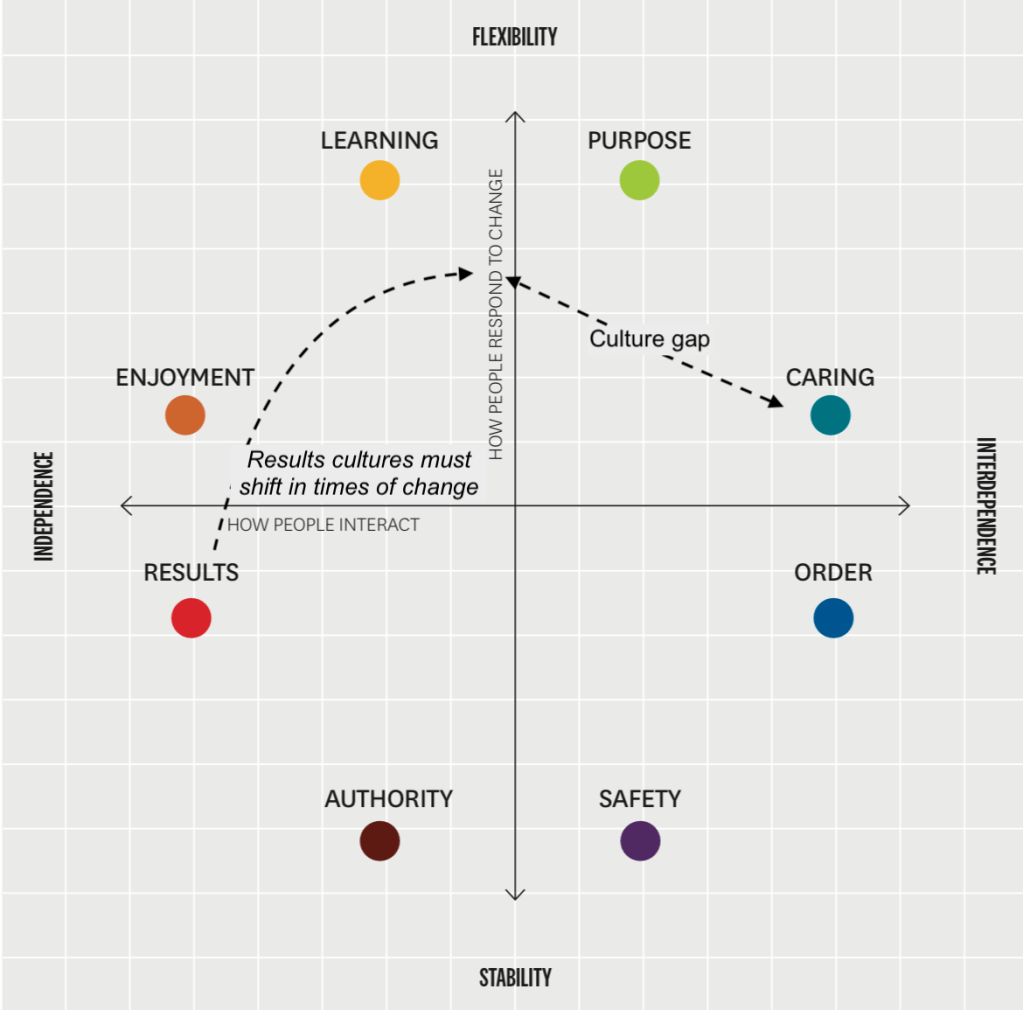
As I considered how scaled decision-making can balance logic and empathy, I reflected on a model of corporate culture developed at Harvard Business School and Spencer Stuart. It describes eight types of business cultures. Results cultures, which value achievement and winning, are in conflict with Caring cultures, which focus on relationship and trust. This seems a close proxy to my logic + empathy values and left me wondering: what is my ideal culture, and can it even exist? Is there a way to minimize or manage the Results/Caring “culture gap” (i.e., the distance between two conflicting cultures)?  Can I get to the best answer for everyone, even when there is implied tension between optimizing for outcomes and optimizing for people?

Source: Harvard Business Review analysis developed at HBS and Spencer Stuart; MBA in the City analysis

Below I explore the question of empathy at scale, drawing on insights from philosophy, psychology, and technology. The TL;DR is 1) it depends on what you mean by empathy; 2) by commonly used philosopher definitions, empathy is not scalable, but 3) perhaps that’s for the best.

The debate and definitions

It turns out social psychologists and philosophers have already sparred on this question for a while. Professor Paul Bloom, psychologist and author of Against Empathy: The Case for Rational Compassion, framed the question as, “What kind of intellectual and sentimental attitudes should we have towards people?” He opens his argument with an important distinction: empathy is the ability to understand and share the feelings of another person — not to be confused with compassion, the desire to alleviate their suffering. Buddhist monk Matthieu Ricard similarly flags that empathy caries a sentimentality, whereas compassion allows for some distanced. (I guess we know how Matthieu would answer the trolley problem.)

But does emotional distance serve the greater good or just ourselves, protecting us from the emotional strain? There’s evidence on both sides. Professor Paul Slovic compared how much people cared about one suffering person versus that same person in a group and found that people cared less about the original person as the group grew. Our brains seem to be managing our capacity, so that we aren’t completely drained by the sheer volume of people to empathize with. Our psychological immune systems seem to prevent us from caring too deeply about each individual in a large group.

But perhaps this brain protective mechanism is, in fact, for the greater good. Bloom argues that limiting empathy can actually protect more vulnerable populations, because empathy is not immune to bias. We tend to empathize more with people who are similar to us, and less with people who are different. Imagine how this could shape decisions that affect a large group of people — problematic to say the least.

So, it seems our greatest moral teachers are warning us away from empathy; its short-sighted nature can misdirects us to focus on the suffering of one rather than the many. It’s why we care more about a mass shooting than we care about the other 99.9% of other gun homicides. When it comes to designing rules and legislation, we want something better than empathy. As philosopher Sam Harris puts it, “we want laws that are wiser than we are; a system that corrects for our suite of moral illusions or biases that lead us to misallocate real resources.”

Star Trek’s Spock is famed for considering “the needs of the many” with emotionless logic. Spock’s species achieves this by suppressing emotion, because theirs are much stronger than human emotions.

The challenge is, good rules are very, very hard to make. So how do we take on this challenge at scale? This is the core question for organizations, as well as for the burgeoning AI industry.

Empathy in organizations and Artificial Intelligence

In the end, I do think logic and empathy can be married; the Results/Caring “culture gap” can be bridged by leaning into cultural moments of Purpose or Learning. For example, if you are pursuing a business reorganization, while it may be the logical move, the transition will be most successful if you include a Learning approach, testing elements of the reorg, and reaffirm shared Purpose — both of which can help demonstrate Caring by valuing feedback and fostering solidarity. This flexible approach could also enable bringing as many sub-cultures along as possible as well.

Source: Harvard Business Review, analysis developed at HBS and Spencer Stuart; MBA in the City analysis

While operationalizing empathy in a practical, scaled way is a constrained process in organizations, the question becomes very different when we start outsourcing decisions to Artificial intelligence (AI) systems. AI is clearly capable of overcoming some human constraints. But is empathy one of them? Becoming emotionally drained is a unique human constraint; we see this in personalized learning, where AI tutors express infinite patience with pupils. AI could be trained to understand and respond to a wide range of emotions; perhaps AI can learn to scale beyond the personal assistant use-case to organizational assistance, and digest large volumes of feedback in an empathetic but balanced way.

The main dampener to this vision is that AI systems have not overcome every human limitation; they can still encode bias. And worse than humans, they generally lack emotional intelligence and can be easily manipulated. So at this point, it would be extremely risky with unquantifiable downside to trust decisions that require empathy or compassion to AI. As many an edtech expert has postulated, we need humans in the loop for all AI systems to evaluate their decisions and recommendations. The Partnership on Responsible AI recommends integrating inclusive participation across all stages of a development lifecycle (vs. participation only at the end, the more common practice).

Does empathy scale?

“I’ve learned that you can have it all, but not all at the same time.”

– Michelle Obama

FLOTUS’ words have stayed with me since I first read them — she warned that Millennials and younger generations often wants everything all at once. While I want both logic and empathy at all times, I accept that their tension will sometimes force trade-offs.

There may not be a single “right” answer for all people, organizations and stakeholders, but we can manage a balance of logic and empathy by keeping humans in the loop, especially in the tech industry. Identifying integration points ahead of time and what targeted input you need can improve both organizational and AI decision-making.

Top 10 mental models for the workplace

 Source: Litmos
Source: Litmos

“Our life is frittered away by detail. Simplify, simplify.” — Henry David Thoreau

Mental models allow us to simplify our complicated world. They are abstracted truths that, in finding the through-line of many instances, despite losing detail they are actually more true than any individual instance. They are powerful drivers of our behavior that help us quickly choose what to focus on and how to make decisions. So it’s worth taking a conscientious look at the ones that have baring on our day-to-day, and consider how we want to employ them.

Based on the Farnam Street list of 109 mental models, I have selected the top 10 that I have most often needed to revisit in innovation and strategy consulting work. They roughly fall into the categories of planning, process, and people – the raw ingredients of any initiative or organization. Below is a brief description of each, and why they are perennially relevant.

1. Planning

Whether planning for your company or your client, managing complexity and collecting the right level of input to make informed decisions is a critical skill. And it is also a complex thing to try to optimize. Here are a few mental models that help guide my focus and sense check my thinking.

The map is not the territory

A map is intentionally designed to be a reduction of what it represents, and is not to be confused with a full representation of reality. As George Box famously noted, “All models are wrong but some are useful.” To preserve the utility of maps, we must guard against over-simplifications that loses touch with reality. For example, average is a myth when it comes to clothing or car seats – acknowledging this has spurred the universal design movement, which demands a much deeper understanding of users than summary data can provide. Which leads us to our next mental model…

Seeing the front

The military has a leadership norm of “personally seeing the front” before making decisions. When decision-makers establish a ground truth first-hand, they avoids losing touch by over-relying on data that fails to capture the nuances of real life. As Jared Belsky would put it from a business leader’s perspective, “Get out of your ivory tower and into the stores.” Then you can test and validate your ideas, assumptions, and plans directly.

Second-order thinking

Second-order thinking involves thinking beyond the immediate effects of an action to the knock-on effects. This kind of holistic thinking needs to be balanced against the typical interpretation of Occam’s razor, which posits that the simplest explanation is most likely the correct one. Occam’s razor is not a call to give up critical thinking, but does call us to put more weighting on simpler explanations.

Tendency to overgeneralize from small samples

Overgeneralization occurs when we take a small number of instances and come to a general conclusion from it, even if we have no statistically sound basis for it. This is tricky to navigate if you are in situations with naturally low numbers of instances. In these cases, I try to validate my conclusion from multiple angles, and am highly open to updating my thinking as new information becomes available.

2. Process

A plan cannot manifest without an effective process to execute it. At the same time, process has many opportunities for minor or major misalignment that can limit both team outcomes and progress towards larger goals. Below are several key process-related mental models that, if applied well, can drive task success, systems improvement, and individual growth.

Feedback loops

A feedback loop occurs when an input originates from within the system itself, not from outside the system. Feedback loops can be positive, negative, or neutral, and can often be greatly impacted by any one actor who decides to intervene by changing one of the key inputs. This means that you can change the course of a relationship, with a coworker or client, using the right strategic interventions. It’s also why first impressions matter so much, as that impression is easily reinforced.

Regression to the mean

In a normally distributed system, while you might observe deviations from the average, performance will tend to return to the average with an increasing number of observations. This is most visible day-to-day with unconscious habits. Say you want to break your habit of checking e-mail too often. You may make a short-term effort to look at e-mail less, but unless you learn a whole new habit (say, by having e-mail blackout periods or switching to Slack), you may find yourself drifting back to sub-optimal behavior patterns.

Tendency to want to do something

Most humans have the tendency to need to act, even when no action is needed or additive. Action can give the illusion of productivity and progress, perhaps shielding our ego from the fear of failure. At the end of the day, though, we are better off focusing on results. Which links to our next mental model…

Velocity

Velocity is how fast something gets somewhere — speed plus direction. An object that moves two steps forward and then two steps backward has moved with speed but with no velocity. Focusing on velocity can be a tricky disposition to manage in light of its competing mental model “Tendency to want to do something.” Thus, if you are uncertain as to whether actions will be additive, it is important to try to take considered actions that produce data that inform whether you are moving in the right direction.

3. People

All the planning and process in the world doesn’t amount to a hill of beans without getting people on board with you. Working well with people is most of the magic of successful initiatives. The following mental models are two considerations to keep in mind when getting in the flow with your team or client.

Influence of stress

Stress causes both mental and physiological responses and typically amplify our biases. Stress can also cause us to be hasty and revert to unhelpful habits. Thus, it is important to be sensitive to people’s stress levels, and to try to either reduce stress or introduce conditions that improve the quality of team engagement during stressful circumstances.

Circles of competence

Circles of competence are niche areas of specialization that people develop. Understanding your circle of competence enables you leverage your strengths, identify opportunities for improvement, and learn from others. Many a successful CEO has cited this as a top skill that enabled them to manage a global company. The same is true on a micro level, within a small team.

Leveraging mental models

The world can often seem very complicated because, well, it is! But not all of that complexity is relevant. Being able to more quickly filter out the noise and cut to the heart of the matter is a critical skill in an world of increasing information density. The mental models above provide tools to help evaluate plans and processes, and optimize how you work with people.

From Adam Grant to Susan Cain: What introverted leadership looks like

The article is for all the introverts out there who have risen to a leadership position. Looking at your peers, you may intuitively notice as you look laterally and above you what the data show: 96% of leaders self-report as extroverts. You may be wondering if you can succeed and be effective as a leader, given your personality type. Let’s look at what at the science has to say.

First, can you fake it til you make it?

Your first course of action may be to consider, can I just act like an extrovert until I become one? The science of personality suggests that this would likely be an uphill battle. The Big 5 personality traits (which have more research backing than the Myers-Briggs framework) have been shown to have strong consistency over time, with only moderate changes over many years. The Extroversion/Introversion trait is highly stable; it can vary somewhat over time, but not significantly. So your best bet is to figure out how to play to your own strengths as an introvert.

The research summary that follows re-frames leadership from having “correct and incorrect” styles to “pros and cons” that pair with personality type. There is a way to play to your sweat spots and craft your environment for success.

The research

You may remember the best-selling book Quiet: The Power of Introverts in a World that Can ́t Stop Talking. Authored by Wall Street lawyer turned author, Susan Cain, who took the reader through her seven years of aggregated research on the strengths that introverts wield and the cultural dynamics that they navigate. Adam Grant has recently brought back to the fore some of the key findings on what type of people introverts manage best. Below is a summary of the key points for business leaders to consider.

In Index Card Summary style, the three key lessons to keep in mind, and that I walk through below are:

1. Introverts and extroverts make equally good leaders, but are more effective at leading different types of people.

2. Yet the extrovert bias is real and present in corporate America.

3. Effective leaders who are careful to avoid similarity bias will craft environments for each personality type to thrive in.

1. Introverts and extroverts make equally good leaders, but are more effective at leading different types of people

Cain and Grant both cite introverts as being uniquely good at leading initiative-takers. Their inclination to listen to others and lack of desire to dominate social situations makes introverts more likely to hear and implement suggestions. By encouraging the talents of their teams, they can more easily motivate them to be even more proactive. The challenge for introverts is to manage misguided or less proactive employees.

2. Yet the extrovert bias is real and present in corporate America

As Cain shared with Business Insider, “Extroverts are routinely chosen for leadership positions and introverts are looked over, even though introverts often deliver better outcomes. They’re not perceived as leadership material.” The modern American archetype of a leader is a talkative alpha who is comfortable in the spotlight – the more a person talks, the more attention they receive, and the more powerful they are perceived to be. The result is that introverts are seen as poor leaders by 65% of executive leadership. They also earn ~20% less and manage half as many people as extroverts, according to Truity Psychometrics.

3. Effective leaders who are careful to avoid similarity bias will craft environments for each personality type to thrive in

Adam Grant posits that the dynamism of modern business environments makes proactive employees critical, and introverted leaders tend to encourage and cultivate such employees. The most effective teams are composed of a good mix of introverts and extroverts, and it is highly possible to create a symbiotic environment for both. Leadership can craft and distribute tasks based on people’s natural strengths and temperaments. For example, extroverts can more effectively manage information overload, high pressure, and multi-tasking, while introverts are better at solving complex problems through patience, clarifying, and persistence. Projects and their timelines can be crafted and distributed accordingly.

We need introverted leaders

Being an introvert does not make you a bad leader – in fact there are many strengths you can play to. The challenge is that you won’t be able to learn everything by example from your extroverted peers. Don’t focus on changing your personality – the science says this would be draining and would yield limited results. Your version of successful leadership will activate a more proactive workforce and enable you to tackle long-range problems.

To think of a classic introvert/extrovert duo, Bill Clinton and Al Gore immediately come to mind. One ascended to the presidency for 8 years, carried in part by his charisma. The other was perceived as dry and dispassionate on the campaign trail, but went on to be a pivotal leader in the modern climate change movement. Looking at Cain’s descriptions of personality characteristics, these aren’t surprising outcomes: perhaps Clinton is the action-oriented and rewards-sensitive extrovert, while Gore is the slower and more deliberate introvert, less attracted to wealth and fame. Which is a more effective leader? That, I would argue, is the wrong question.

 Source: YouTube
Source: YouTube