How bad is it? A methodology for managing mistakes

The cost of perfection is infinite. So how do you right-size your efforts when you have a high quality bar but limited resources?

We’ve all had the impulse to work on something for just a little bit longer. Perhaps late at night or after some rapid edits, you have the nagging pull to check your work for the fifth or sixth time. Perfectionist polishing has its own magnetic field. Whether its fear of finishing or fear of failure, we can feel foibled by our own human fallibility. I have been known to struggle against my physical limitations — eyes bleary, brain no longer absorbing all the details. My body tightening at the thought that after all this effort, I still might — *gasp* — make a public mistake!

The burn and burden of perfectionism can arise in any org, leaving many asking, “At what cost?” Besides weighing you down with excess mental baggage, these moments consume focus, crowding out space for broader impact beyond the one deliverable. Is it worth your health, your sanity, to pursue the impossible goal of perfection? Eventually I realized that my answer is no. I committed to rationalizing my efforts. Afterall, not all errors are created equal. Mistakes are inevitable. It was up to me to learn how to deal with them. So I came up with some heuristics. It began with learning to assess the impact of a mistake. And it ended with learning to calibrate to my context. I dig into both steps below.

Step 1: Understand the impact of your mistake

Early in my career, I attacked every error with the same level of ferocity, whether it was a formatting error or a forecasting error. When I finally realized I need to draw boundaries, CGP Grey ‘s taxonomy of mistakes provided a starting point. Grey takes a structured look at mistakes, defining types and matching the best responses to each:

CGP Grey’s “Menagerie of Mistakes” (from timestamp 14:15) categorizes the big and the small, starting with glitches — mistakes that are good at blending into the background. Source: CGP Grey was WRONG

Glitches and Blunders

Glitches are mistakes that are good at hiding in plain sight. Blunders are embarrassing, visible, but still harmless mistakes (think Bushisms). Glitches and blunders become more common the more you have to do — putting on a sweater backwards before you rush to work, calling someone by the wrong name after you’ve just met a dozen new team members. These are worthy of grace, of laughing it off.

Errors of all varieties

Errors range from the trivial to the significant, and are more varied in how people perceive size, importance, or even if there’s an error at all. Grey playfully names their species, including:

  • Error Trivialis
  • Bad Takeus
  • Technically Correctus
  • Error Factualus
CGP Grey’s “Menagerie of Mistakes” (from timestamp 14:15) describes different error types. Source: CGP Grey was WRONG

Notably, every error requires a judgment call, weighing the cost of fixing the error vs. the benefit of moving on. Unless, that is, you make a catastrophic error — one that fundamentally breaks what you’ve made. They demand a do-over, a recall, or some equivalent.

Step 2: Calibrate to your context

Grey’s mistake taxonomy leaves the critical last mile to the audience, using one keyword to back out of any specific guidance: “perceived.” As political strategist Lee Atwater famously stated, “Perception is reality.” As such, I’ve learned to consider what I perceive, what my stakeholders perceive, and how to mediate between the two. Said another way, three pieces of context guide my error response: my objective, the work’s development stage, and organizational expectations.

Know your objective

Your primary goal should inform what kinds of mistakes are acceptable. If you’re a history teacher, for example, factual errors would undermine the entire endeavor, whereas technically correct errors (e.g. omissions) are necessary to manage class time constraints.

My objective in this blog post is to help ease the mental burden of navigating uncertain expectations in one’s career. Thus, while I can’t afford a bad take, I may well make some trivial errors without impacting this post’s clarity, accessibility, or truthiness. In setting your own boundaries and standards, you tap into your own intrinsic motivation — which leads to better work.

Adjust to the stage of development

As work goes from concept to finished product, it’s rarely worth aiming for perfection until the clear shape of what you are driving towards emerges. In copy editing, for example, editors target attention towards one focal problem to solve per editing round — nailing the story, then nailing the flow, then word choice. Trying to do all three at once tends to fragment attention and drive anxiety born of ineffective strain. Rather than wasting attention, I’ve learned to focus it and let go of certain errors before their time has come to be addressed.

Calibrate to your organization’s expectations

Almost more important than whether you correct a mistake is agreeing with those impacted about how to manage mistakes. As we noted above, mistake tolerance is highly subjective and varies by industry, organization, and team. Some optimize for speed and fast feedback, allowing mistakes to abound in support of rapid iteration. Some are highly image-conscious and demand perfection as a proxy signal for competence and trustworthiness. Notably, the latter is not a sustainable strategy; such organizations are often marked by high turnover (e.g. management consulting).

Regardless of your org culture, set expectations. Have discussions early and often about what your colleagues need and expect from you. Understand how much they want to co-create versus review polished work. Convey where you are in the development process. Gauge whether your teammates can engage with ideas before they are fully fleshed out. Whether you agree or not with your colleagues preferred approach, knowing is half the battle.

Mistakes will be made

Cringy as mistakes may feel, Grey gives us a reality check: “If you make things, there will be errors.” Unless lives depend on it, there is no truly “right” or “wrong” approach to managing mistakes. What matters is that you have one.

Is empathy scaleable? A question for large anything, from orgs to LLMs

I stand as a manager where smart colleagues in a slowing industry want to know how they can do well while doing good, amidst the techlash. I am also a few degrees of separation from many important decision-makers in the tech industry. From my Stanford class (2007), that’s not hard to do — an Instagram founder and the Open AI CEO both roamed my dorm hallways. Nice, thoughtful people, creating what some now consider weapons of mass destruction.

I see constant battles of competing frames, all with elements of truth. ChatGPT the assistant vs. ChatGPT the job thief. Downsizing to sustain a company versus downsizing to boost investor profits. As I look around at tech industry leaders, and see their lofty visions and decisions met with backlash and criticism, I’m left wondering what good stewardship looks like. It is definitely not the summation of responding to all individual pushes and pulls; that is a recipe for wholesale discontent.

And us humans, with all our complexity, can hold competing ideas in our head at the same time. We might recite one belief on a Tuesday and a clashing belief on a Thursday, depending on mood and context. So is there any way to get it “right” — get to holistic “right” answers that will displease many, while also treating everyone “right” in the process? Put another way, can empathy scale at the same time as organizations and systems do?

Meeting the needs of many

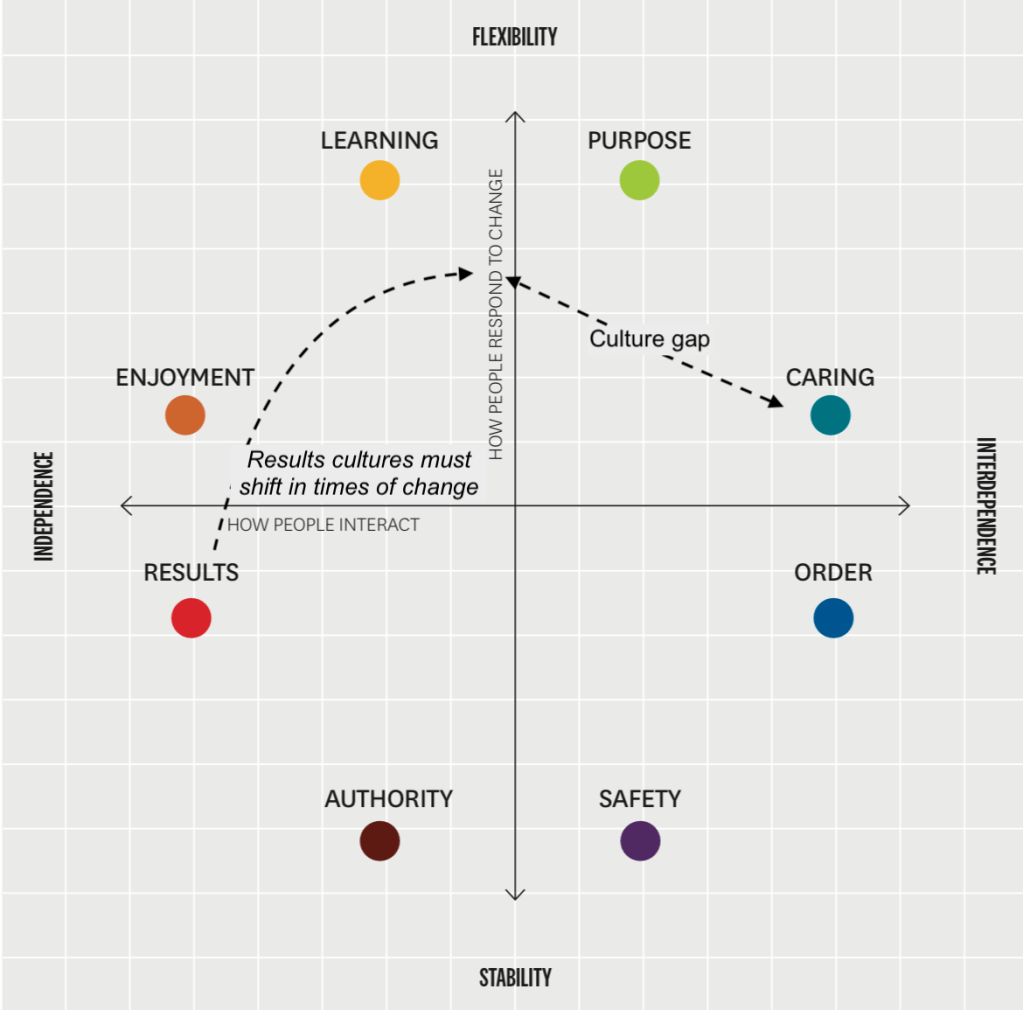
As I considered how scaled decision-making can balance logic and empathy, I reflected on a model of corporate culture developed at Harvard Business School and Spencer Stuart. It describes eight types of business cultures. Results cultures, which value achievement and winning, are in conflict with Caring cultures, which focus on relationship and trust. This seems a close proxy to my logic + empathy values and left me wondering: what is my ideal culture, and can it even exist? Is there a way to minimize or manage the Results/Caring “culture gap” (i.e., the distance between two conflicting cultures)?  Can I get to the best answer for everyone, even when there is implied tension between optimizing for outcomes and optimizing for people?

Source: Harvard Business Review analysis developed at HBS and Spencer Stuart; MBA in the City analysis

Below I explore the question of empathy at scale, drawing on insights from philosophy, psychology, and technology. The TL;DR is 1) it depends on what you mean by empathy; 2) by commonly used philosopher definitions, empathy is not scalable, but 3) perhaps that’s for the best.

The debate and definitions

It turns out social psychologists and philosophers have already sparred on this question for a while. Professor Paul Bloom, psychologist and author of Against Empathy: The Case for Rational Compassion, framed the question as, “What kind of intellectual and sentimental attitudes should we have towards people?” He opens his argument with an important distinction: empathy is the ability to understand and share the feelings of another person — not to be confused with compassion, the desire to alleviate their suffering. Buddhist monk Matthieu Ricard similarly flags that empathy caries a sentimentality, whereas compassion allows for some distanced. (I guess we know how Matthieu would answer the trolley problem.)

But does emotional distance serve the greater good or just ourselves, protecting us from the emotional strain? There’s evidence on both sides. Professor Paul Slovic compared how much people cared about one suffering person versus that same person in a group and found that people cared less about the original person as the group grew. Our brains seem to be managing our capacity, so that we aren’t completely drained by the sheer volume of people to empathize with. Our psychological immune systems seem to prevent us from caring too deeply about each individual in a large group.

But perhaps this brain protective mechanism is, in fact, for the greater good. Bloom argues that limiting empathy can actually protect more vulnerable populations, because empathy is not immune to bias. We tend to empathize more with people who are similar to us, and less with people who are different. Imagine how this could shape decisions that affect a large group of people — problematic to say the least.

So, it seems our greatest moral teachers are warning us away from empathy; its short-sighted nature can misdirects us to focus on the suffering of one rather than the many. It’s why we care more about a mass shooting than we care about the other 99.9% of other gun homicides. When it comes to designing rules and legislation, we want something better than empathy. As philosopher Sam Harris puts it, “we want laws that are wiser than we are; a system that corrects for our suite of moral illusions or biases that lead us to misallocate real resources.”

Star Trek’s Spock is famed for considering “the needs of the many” with emotionless logic. Spock’s species achieves this by suppressing emotion, because theirs are much stronger than human emotions.

The challenge is, good rules are very, very hard to make. So how do we take on this challenge at scale? This is the core question for organizations, as well as for the burgeoning AI industry.

Empathy in organizations and Artificial Intelligence

In the end, I do think logic and empathy can be married; the Results/Caring “culture gap” can be bridged by leaning into cultural moments of Purpose or Learning. For example, if you are pursuing a business reorganization, while it may be the logical move, the transition will be most successful if you include a Learning approach, testing elements of the reorg, and reaffirm shared Purpose — both of which can help demonstrate Caring by valuing feedback and fostering solidarity. This flexible approach could also enable bringing as many sub-cultures along as possible as well.

Source: Harvard Business Review, analysis developed at HBS and Spencer Stuart; MBA in the City analysis

While operationalizing empathy in a practical, scaled way is a constrained process in organizations, the question becomes very different when we start outsourcing decisions to Artificial intelligence (AI) systems. AI is clearly capable of overcoming some human constraints. But is empathy one of them? Becoming emotionally drained is a unique human constraint; we see this in personalized learning, where AI tutors express infinite patience with pupils. AI could be trained to understand and respond to a wide range of emotions; perhaps AI can learn to scale beyond the personal assistant use-case to organizational assistance, and digest large volumes of feedback in an empathetic but balanced way.

The main dampener to this vision is that AI systems have not overcome every human limitation; they can still encode bias. And worse than humans, they generally lack emotional intelligence and can be easily manipulated. So at this point, it would be extremely risky with unquantifiable downside to trust decisions that require empathy or compassion to AI. As many an edtech expert has postulated, we need humans in the loop for all AI systems to evaluate their decisions and recommendations. The Partnership on Responsible AI recommends integrating inclusive participation across all stages of a development lifecycle (vs. participation only at the end, the more common practice).

Does empathy scale?

“I’ve learned that you can have it all, but not all at the same time.”

– Michelle Obama

FLOTUS’ words have stayed with me since I first read them — she warned that Millennials and younger generations often wants everything all at once. While I want both logic and empathy at all times, I accept that their tension will sometimes force trade-offs.

There may not be a single “right” answer for all people, organizations and stakeholders, but we can manage a balance of logic and empathy by keeping humans in the loop, especially in the tech industry. Identifying integration points ahead of time and what targeted input you need can improve both organizational and AI decision-making.

The Index Card Summary of “The Five Dysfunctions of a Team”

The Five Dysfunctions of a Team is Patrick Lencioni‘s New York Times Best Seller for a reason: any team member can see themselves in this list of foibles.

Each of the five dysfunctions require leadership interventions to solve. Below is a brief summary of what that entails.

The Index Card Summary

1. Building trust

What. The foundation of a functional team is trust: confidence that peer intentions are good, that there is no reason to be protective around the group. Trust minimizes second-guessing and makes it easier to ask for help.

How. Create shared experiences over time, and understand unique attributes of team members. Team-building exercises, discussing team effectiveness, 360 feedback, and team leader role modeling can all drive the psychological safety and honesty needed to engender trust.

2. Addressing conflict

What. All relationships require productive conflict to grow. Without direct, content-focused conflict, teams can be handicapped by back-channeling and personal attacks that doom people to revisiting issues endlessly without resolution.

How. Acknowledge that conflict is productive; agree that impassioned debate is welcome. Ask for permission to address conflicts for the good of the team.

3. Driving commitment

What. Commitment requires both clarity and buy-in. Desire for consensus and/or certainty can weaken commitment and delay decision-making which, in turn, can paralyze teams and weaken their confidence.

How. Drive alignment through tight information cascades, close to the time decisions are made. Reduce ambiguity by setting intermediate deadlines. Address fears with contingency plans or worst-case-scenario analysis. Normalize decisiveness starting in low-risk environments. Leaders must also role model commitment by being ok with wrong decisions, asking for commitment, and reducing emphasis on certainty or consensus.

4. Welcome accountability

What. Peers need to welcome peer call-outs on actions that might negatively impact the team or actions others should model and amplify.

How. Leaders can enable and normalize peer accountability through setting agreed upon standards and goals, encouraging peer feedback, and giving collective team rewards for collectively modeling the right behaviors.

5. Focus on results

What. Time-bound, outcome-based performance drives business success. Yet it can often be crowded out by team or individual status or focus on survival.

How. Define specific target results that you publicly commit to, and reward only supporting actions; tie compensation to outcomes. Leaders must also reinforce a focus on results; if the team leader shows they value and reward other things, teams will react accordingly.

Disconnects and Through-lines

Unpacking the “How”

While Lencioni provides excellent tactical suggestions for tackling the numerous team dysfunctions, he spends too little time exploring where to start. While ‘absence of trust’ is named as the foundational problem, I think the easiest place to start is at the top, with the most visible problem: ‘inattention to results.’ Once you have specific results targets, you can drive accountability, which then motivates commitment, and so on down the pyramid.

Addressing the foundational dysfunctions, ‘fear of conflict’ and ‘absense of trust,’ is admittedly more challenging. In large organizations especially, cross-functional teams may not even conceive of themselves as teams and, thus, may see little benefit to engaging in conflict and little need to build trust. In those instances leaders play an even more critical role. Leaders with a longer-range view will be mindful of the personal costs of these more insidious dysfunctions: energy poorly spent, low morale, and high unwanted turnover.

Across the five dysfunctions, communication and leadership sit at the center of many proposed solutions. Spending more team time together drives trust, can root out conflict and reduce confusion. Documenting decisions and desired results and rapidly sharing and reinforcing them keeps teams in sync. And leadership modeling the right behavior and taking challenges head-on can inspire healthy team culture. These are all reasonable tactics to pursue, but side-step the issue that so much rests on leadership, especially the larger an organization gets.

Addressing the “Why”

Lencioni claims that “teams succeed because they are exceedingly human.” But realistically, it is equally why they fail. Humans are full of bias and are often more focused on their individual experience over organizational goals. Thus, even if an organization starts with a high-functioning team culture, it’s hard to scale; heterogeneity via sub-cultures is normal the larger an organization gets, and cultural drift is equally normal through turnover, changing external contexts, and organizational evolution. With this in mind, it makes more sense to think of high functioning teams as a practice to commit to rather than an end state. Like so much of life, it’s a journey, not a destination.

Source: aspitzer.com

Scaling company culture with AI: an interview with George Swisher, CEO of LiiRN

Can AI help foster cohesive community in an organization? LiiRN thinks so.

Source: Simplilearn

Creating a healthy work environment that scales is something of a holy grail for all growing companies. As internal networks become more dispersed and organizational structures grow more complex, it becomes easier for communication disconnects to occur. How can companies continue to cultivate a shared vision and culture, and give employees a chance to define and improve both? LiiRN CEO George Swisher thinks the answer is AI-driven.

Swisher founded LiiRN, a people-centric, AI-powered transformation software, in 2018. The AI platform has a two-fold purpose: to help leaders make decisions based on employee feedback, and then allow employees to participate in enacting those decisions. The LiiRN platform collects customized survey data on leadership performance and company priorities. The AI synthesizes upward feedback, converts it into leadership performance ratings, and identifies quantitative and qualitative trends and findings to inform decision-making. The platform also invites self-nominated change-agents to shape and drive forward company-wide initiatives.

In an interview with Swisher, he shared how AI can drive rather than reduce personal connection, and help business leaders to listen to and lean on their people.

What problem are you solving with LiiRN?

LiiRN aims to help companies drive change through people versus processes. Many leaders working to design strategy end up working with small populations of people, doing surveys or doing stakeholder interviews. But trying to drive a huge change with the input of a small group of people is a disservice to both the firm and the company. People are fearful of change when they don’t understand it. So a few years ago I thought, what if I had the ability as an individual consultant to work with all hundred thousand employees in real time? The impact would be tremendous.

And so the idea was to launch a software that could do that, that could physically touch people as if it was someone you knew and who understood the big program that was going on out there and help the employee relate. When you drive change from the bottom up instead of from the top down, you avoid the education and awareness gaps that come with large scale change.

Companies can use our technology as kind of a middleware between the leadership and staff, to find the gaps between what leadership thinks and what the people on the ground are actually seeing and thinking. Our voting feature makes people feel like they’re part of the decision-making process. If you can do that for a company, say, that’s 100,000 employees, you’re able to help 100,000 employees feel like they’re contributing to a decision that the leadership is making. You get people who are more empowered, and I think that’s a big emotional feature of how you activate people. It automates some of the change management processes and helps leadership make decisions and investments that their company believes in. With ongoing feedback collection, you can create a dynamic feedback loop, to continually shape the change journey.

What are some of the most common pain points the leaders you work with encounter?

New leadership teams are sometimes nervous to listen to data and to draw conclusions if it can be interpreted in multiple different ways. It’s one of the reasons that we have moved to partnering with consulting firms with expertise in software-based data analysis. We use the data to quantify how many people activate and why. Typically, we see north of 30% of the total population raising their hand to be on a work stream in a specific change management area.

If you have lower adoption, we use the data we collect to understand why. We track when people opt out or say “I don’t understand what you’re asking and talking about.” This feedback surfaces whether the real issue is understanding and awareness, versus the willingness of people to participate. Alternatively, the data can also show if people think the initiative is misguided or has implementation risk. Leaders gain transparency through the software’s data analysis.

It sounds like you’ve found ways for AI to create more human interactions. What are the limitations to leaning on AI? In what ways can AI tools be anti-social, and how do you mitigate those risks?

If you’re going to trust the output of our system, you have to know it’s based on the right input. Potential biases to data come in so many different forms. Ideally, if we look at, for example, who is in the sample population that you’re getting information from, we’d account for any skewing as we analyze it. We have limited control, of which population, the stakeholder at the enterprises chooses to invite into our software. So if they choose to only involve the US population and use that information to influence the way they make decisions for their Asia-based population, for example, that clearly creates a lot of challenges, given the cultural differences. We work to screen out and limit bias with some of our onboarding screens and some of the setup and training that we do. We promote as much as we possibly can an approach of widening the sample size, to make sure that you’re involving as large a population as possible that is as diverse as possible. But there’s definitely limitations to it. It’s hard to solve it when you’re collecting what others choose to input.

Also, if there is a high concentration of a certain demographic in a company, we can’t control for who they’ve hired. So if they’re only getting information from a specific group of people that’s the majority of their population, it clearly sways the input that we’re getting and the resulting outcomes. So for us, I think we’re trying to maintain a middle ground where we highlight who companies are asking for input from and how it impacts the output. 

We’re focused on making our data inputs more comprehensive by integrating with more internal systems in our upcoming work. HR systems can provide added layers of data, like performance management data and learning data; systems like NetSuite provide more business performance data. The more that we can integrate, the more our machines can learn, and the more we can build better cases for the viability of the decision we’re recommending.

Change management in the context of technology often raises the specter of worker displacement. How can technology-based change management tools like yours help us prepare for an unknown future of work?

What I learned personally moving from a tech-enabled service businesses working with big enterprises to being a full software company is that technology isn’t replacing us. There is a fear of tech advancing too fast. But I think the bigger question is how do we reskill and retrain ourselves? And how will we hold the enterprises of the world responsible for managing change? Even if there are people who will be losing jobs, which is never a good thing, we have the opportunity to say, “Well how do we rethink what workers are doing and what new skills they need to adapt? And how can we help them do that?” Yes, we’ve introduced self checkout into the grocery store. But if we’re going to replace those people, what are the skills they have that we can still benefit from? They may be really great at customer service and customer success — can you retrain them to help people shopping inside the store, to create a personalized experience? Flipping the way that you look at it can help people understand the opportunity. Then we all advance. But a lot of companies don’t think that way when they’re developing or implementing automation technology.

It’s a large number within consumer retail and manufacturing — upwards of 70% of some of the largest companies and employers in the world — whose jobs will be automated away in the next 10 years. The magnitude of that is scary. Unless you retrain people to think about it as an opportunity and change the way that they’re actively pursuing alternatives, we’re going to have problems. Being a coder isn’t the answer for everyone.

Top 10 mental models for the workplace

 Source: Litmos
Source: Litmos

“Our life is frittered away by detail. Simplify, simplify.” — Henry David Thoreau

Mental models allow us to simplify our complicated world. They are abstracted truths that, in finding the through-line of many instances, despite losing detail they are actually more true than any individual instance. They are powerful drivers of our behavior that help us quickly choose what to focus on and how to make decisions. So it’s worth taking a conscientious look at the ones that have baring on our day-to-day, and consider how we want to employ them.

Based on the Farnam Street list of 109 mental models, I have selected the top 10 that I have most often needed to revisit in innovation and strategy consulting work. They roughly fall into the categories of planning, process, and people – the raw ingredients of any initiative or organization. Below is a brief description of each, and why they are perennially relevant.

1. Planning

Whether planning for your company or your client, managing complexity and collecting the right level of input to make informed decisions is a critical skill. And it is also a complex thing to try to optimize. Here are a few mental models that help guide my focus and sense check my thinking.

The map is not the territory

A map is intentionally designed to be a reduction of what it represents, and is not to be confused with a full representation of reality. As George Box famously noted, “All models are wrong but some are useful.” To preserve the utility of maps, we must guard against over-simplifications that loses touch with reality. For example, average is a myth when it comes to clothing or car seats – acknowledging this has spurred the universal design movement, which demands a much deeper understanding of users than summary data can provide. Which leads us to our next mental model…

Seeing the front

The military has a leadership norm of “personally seeing the front” before making decisions. When decision-makers establish a ground truth first-hand, they avoids losing touch by over-relying on data that fails to capture the nuances of real life. As Jared Belsky would put it from a business leader’s perspective, “Get out of your ivory tower and into the stores.” Then you can test and validate your ideas, assumptions, and plans directly.

Second-order thinking

Second-order thinking involves thinking beyond the immediate effects of an action to the knock-on effects. This kind of holistic thinking needs to be balanced against the typical interpretation of Occam’s razor, which posits that the simplest explanation is most likely the correct one. Occam’s razor is not a call to give up critical thinking, but does call us to put more weighting on simpler explanations.

Tendency to overgeneralize from small samples

Overgeneralization occurs when we take a small number of instances and come to a general conclusion from it, even if we have no statistically sound basis for it. This is tricky to navigate if you are in situations with naturally low numbers of instances. In these cases, I try to validate my conclusion from multiple angles, and am highly open to updating my thinking as new information becomes available.

2. Process

A plan cannot manifest without an effective process to execute it. At the same time, process has many opportunities for minor or major misalignment that can limit both team outcomes and progress towards larger goals. Below are several key process-related mental models that, if applied well, can drive task success, systems improvement, and individual growth.

Feedback loops

A feedback loop occurs when an input originates from within the system itself, not from outside the system. Feedback loops can be positive, negative, or neutral, and can often be greatly impacted by any one actor who decides to intervene by changing one of the key inputs. This means that you can change the course of a relationship, with a coworker or client, using the right strategic interventions. It’s also why first impressions matter so much, as that impression is easily reinforced.

Regression to the mean

In a normally distributed system, while you might observe deviations from the average, performance will tend to return to the average with an increasing number of observations. This is most visible day-to-day with unconscious habits. Say you want to break your habit of checking e-mail too often. You may make a short-term effort to look at e-mail less, but unless you learn a whole new habit (say, by having e-mail blackout periods or switching to Slack), you may find yourself drifting back to sub-optimal behavior patterns.

Tendency to want to do something

Most humans have the tendency to need to act, even when no action is needed or additive. Action can give the illusion of productivity and progress, perhaps shielding our ego from the fear of failure. At the end of the day, though, we are better off focusing on results. Which links to our next mental model…

Velocity

Velocity is how fast something gets somewhere — speed plus direction. An object that moves two steps forward and then two steps backward has moved with speed but with no velocity. Focusing on velocity can be a tricky disposition to manage in light of its competing mental model “Tendency to want to do something.” Thus, if you are uncertain as to whether actions will be additive, it is important to try to take considered actions that produce data that inform whether you are moving in the right direction.

3. People

All the planning and process in the world doesn’t amount to a hill of beans without getting people on board with you. Working well with people is most of the magic of successful initiatives. The following mental models are two considerations to keep in mind when getting in the flow with your team or client.

Influence of stress

Stress causes both mental and physiological responses and typically amplify our biases. Stress can also cause us to be hasty and revert to unhelpful habits. Thus, it is important to be sensitive to people’s stress levels, and to try to either reduce stress or introduce conditions that improve the quality of team engagement during stressful circumstances.

Circles of competence

Circles of competence are niche areas of specialization that people develop. Understanding your circle of competence enables you leverage your strengths, identify opportunities for improvement, and learn from others. Many a successful CEO has cited this as a top skill that enabled them to manage a global company. The same is true on a micro level, within a small team.

Leveraging mental models

The world can often seem very complicated because, well, it is! But not all of that complexity is relevant. Being able to more quickly filter out the noise and cut to the heart of the matter is a critical skill in an world of increasing information density. The mental models above provide tools to help evaluate plans and processes, and optimize how you work with people.

From Adam Grant to Susan Cain: What introverted leadership looks like

The article is for all the introverts out there who have risen to a leadership position. Looking at your peers, you may intuitively notice as you look laterally and above you what the data show: 96% of leaders self-report as extroverts. You may be wondering if you can succeed and be effective as a leader, given your personality type. Let’s look at what at the science has to say.

First, can you fake it til you make it?

Your first course of action may be to consider, can I just act like an extrovert until I become one? The science of personality suggests that this would likely be an uphill battle. The Big 5 personality traits (which have more research backing than the Myers-Briggs framework) have been shown to have strong consistency over time, with only moderate changes over many years. The Extroversion/Introversion trait is highly stable; it can vary somewhat over time, but not significantly. So your best bet is to figure out how to play to your own strengths as an introvert.

The research summary that follows re-frames leadership from having “correct and incorrect” styles to “pros and cons” that pair with personality type. There is a way to play to your sweat spots and craft your environment for success.

The research

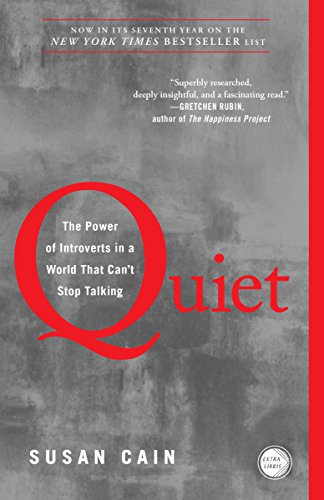
You may remember the best-selling book Quiet: The Power of Introverts in a World that Can ́t Stop Talking. Authored by Wall Street lawyer turned author, Susan Cain, who took the reader through her seven years of aggregated research on the strengths that introverts wield and the cultural dynamics that they navigate. Adam Grant has recently brought back to the fore some of the key findings on what type of people introverts manage best. Below is a summary of the key points for business leaders to consider.

In Index Card Summary style, the three key lessons to keep in mind, and that I walk through below are:

1. Introverts and extroverts make equally good leaders, but are more effective at leading different types of people.

2. Yet the extrovert bias is real and present in corporate America.

3. Effective leaders who are careful to avoid similarity bias will craft environments for each personality type to thrive in.

1. Introverts and extroverts make equally good leaders, but are more effective at leading different types of people

Cain and Grant both cite introverts as being uniquely good at leading initiative-takers. Their inclination to listen to others and lack of desire to dominate social situations makes introverts more likely to hear and implement suggestions. By encouraging the talents of their teams, they can more easily motivate them to be even more proactive. The challenge for introverts is to manage misguided or less proactive employees.

2. Yet the extrovert bias is real and present in corporate America

As Cain shared with Business Insider, “Extroverts are routinely chosen for leadership positions and introverts are looked over, even though introverts often deliver better outcomes. They’re not perceived as leadership material.” The modern American archetype of a leader is a talkative alpha who is comfortable in the spotlight – the more a person talks, the more attention they receive, and the more powerful they are perceived to be. The result is that introverts are seen as poor leaders by 65% of executive leadership. They also earn ~20% less and manage half as many people as extroverts, according to Truity Psychometrics.

3. Effective leaders who are careful to avoid similarity bias will craft environments for each personality type to thrive in

Adam Grant posits that the dynamism of modern business environments makes proactive employees critical, and introverted leaders tend to encourage and cultivate such employees. The most effective teams are composed of a good mix of introverts and extroverts, and it is highly possible to create a symbiotic environment for both. Leadership can craft and distribute tasks based on people’s natural strengths and temperaments. For example, extroverts can more effectively manage information overload, high pressure, and multi-tasking, while introverts are better at solving complex problems through patience, clarifying, and persistence. Projects and their timelines can be crafted and distributed accordingly.

We need introverted leaders

Being an introvert does not make you a bad leader – in fact there are many strengths you can play to. The challenge is that you won’t be able to learn everything by example from your extroverted peers. Don’t focus on changing your personality – the science says this would be draining and would yield limited results. Your version of successful leadership will activate a more proactive workforce and enable you to tackle long-range problems.

To think of a classic introvert/extrovert duo, Bill Clinton and Al Gore immediately come to mind. One ascended to the presidency for 8 years, carried in part by his charisma. The other was perceived as dry and dispassionate on the campaign trail, but went on to be a pivotal leader in the modern climate change movement. Looking at Cain’s descriptions of personality characteristics, these aren’t surprising outcomes: perhaps Clinton is the action-oriented and rewards-sensitive extrovert, while Gore is the slower and more deliberate introvert, less attracted to wealth and fame. Which is a more effective leader? That, I would argue, is the wrong question.

 Source: YouTube
Source: YouTube

Cheers to the best communicators of 2018

It is immensely human to want to be understood, and a great skill to be able to make oneself understood by wide-ranging audiences. This end-of year post is a hats-off edition for those who take complex, multifaceted topics that otherwise appear unknowable and clearly describe the inner workings of our world in layman’s terms. Four communicators in four fields have been especially influential and necessary.

Four fields have outsized impact on our working present and future: finance, management, science and technology. With the 10 year anniversary of the financial crisis just past, the importance of financial liquidity as the lifeblood of our economy is palpably understood by our businesses. And if strong financial conditions offer a tailwind, good management readies a business to benefit in the near-term. At the same time, science and technology are changing the nature of work day by day. Previously manual jobs like automotive assembly now require a technical literacy that demands that each person arm themselves with the latest technical knowledge. Thus, a knowledge of finance, management, science and technology makes for one capable business leader.

Four experts in these four fields have continually contributed to the public’s ability to grasp big and small ideas with clarity. And the winners are…

Best financial communicator: Felix Salmon of Axios

Felix Salmon’s daily articles on Axios and weekly podcast, Slate Money, complement each other with punchy clarity and practical insights that are both local and global. He speaks directly to the lightly-financially literate American and to the globe, as he covers trends in other large economies as well as struggling economies. He reads what would be tea leaves to most and makes financial indicators approachable. His frequent podcast refrain is to interrupt jargon-laden explanations from co-hosts and say “explain that in English.” Britain-born, he proves we don’t always need to be divided by a common language.

Best management communicator: Adam Grant, author

Adam Grant is an organizational psychologist who has written three books on how to drive personal and professional success. Beyond his famed insights from Give and Take, which show that generosity towards others can drive your own success, he’s gone on to create a podcast called WorkLIfe, in which he interviews entrepreneurs, employees, and companies to unearth practical advice to improve our work lives. He is a prolific tweeter and poster on LinkedIn, where he offers bite-sized daily advice for the business leaders of today.

Best science communicator: Neil deGrasse Tyson, astrophysicist

Neil deGrasse Tyson’s Astrophysics for People in a Hurry has been on the New York Times Best Seller list for the better part of 2018, a testament to his famed ability to generate both wonder and create scientific understanding among his audiences. He has a foundational interest in encouraging curiosity and methodical discovery, which makes the everyman feel he or she can, with careful pursuit, know the unknown.

Astrophysics for People in a Hurry

By Neil de Grasse Tyson

Best technology communicator: Wired, technology magazine

All of Wired Magazine deserves recognition for making complex topics with broad social implications, from the blockchain to ag-tech, easily digestible (no pun intended), with the implications unpacked. Wired humanizes and empathetically portrays the thinking and motivations of the entrepreneurs seeding some of the mega tech trends that are rippling through society.

In summary…

Thank you for an insightful 2018 to the brilliant communicators who have synthesized the most important mechanics and trends in the four fields that are the pillars of modern business. Cheers to you!

5 things my dog taught me about management 

My new puppy has brought home a few important things to me in the last month, and not just the balls I ask him to fetch. Learning to train him has illustrated some of the most foundational principals of effective management. Below are the top five training points for building up your working relationships with those you manage, whether human or canine.

1. Build effective communication 

Before you can expect a dog to behave well, you need to be able to identify the cues they are giving you as to their needs. Are you annoyed that they are barking? What might they be trying to communicate to you? Perhaps they are hungry or haven’t gotten enough exercise that day. Noticing what your dog needs and providing that clears away concerns that may prevent them from being receptive to your guidance. When you have met your dog’s needs, you can also communicate your needs by praising the right behaviors (like chewing chew toys) and disincentivizing the wrong behaviors (like chewing shoes).

If you’re experiencing friction with an employee, have you taken cues from them as to their work style? Have you established communication norms? Have you provided clear feedback about what is working for you and what is not? (Pro tip: try creating a Management Readme on Readme.bio for each of your teammates, to more quickly orient yourself to everyone’s work style preferences.)

2. Break it down

Further to the communication point, it often is not enough to just say “be better” at XYZ, as such asks are not specific, and do not delineate a path forward. My dog initially struggled with “leave it”. I started with a simple piece of paper towel in my hand (which he normally loves to chew). He successfully left it. But I made the mistake of jumping right to putting it on the floor and walking away. He chewed it immediately. It was too big a leap for him. I’d skipped across the incremental steps that would have built up his focus. Similarly, explaining a piece of a process to colleagues and then jumping to the end, without breaking out the steps in between, makes it likely that you will lose people in the process. For managees, throwing them in the deep end with minimal prep is much more overwhelming than incrementally increasing responsibility.

I invested time in learning about dog training so that I could figure out how to lead him to the behaviors I wanted to see. Similarly, managers much invest the time to specify what precisely they want to see in terms of actions and outcomes, and work with their team to identify how to get there in the needed time frame.

3. Be consistent

Being consistent and predictable to those you manage helps them to figure out how to work best with you. My dog now start making little noises at 7am every day, as he knows that’s when we take him out to do his morning business, get fed, and play. He doesn’t make noises at night, as he knows we intend to sleep all the way through it. Similarly, managees can meld to your schedule and style if you are consistent. If you always block off 8-9am to review final work, they will plan to provide you content for review at that time. If you praise people for thoughtful project planning or being vocal during meetings, you can expect to see more of that.

4. Have patience 

Dogs take months and even years to be fully trained even in a single behavior. Expect them to make mistakes, and be forgiving yet persistent. Even smart dogs take a lot of positive reinforcement to solidify a habit. Humans need the same! It is perfectly normal to need to repeat yourself over and over, in different settings, so be accepting of this reality.

5. Invest

Dogs grow into behaviors, not out of them. If you continue to invest in building the right behaviors in the first year, you will reap the benefits for a lifetime. Your puppy will grow into an impressive dog who is a loyal companion. It goes without saying that people are also worth the investment! Your managees will prove resilient, and can grow leaps and bounds with the right support.