
What it really means to be responsible for your own career

Guest post by James Wallace of extroverteddeveloper.com

You are responsible for your own career.

We’ve probably all heard that phrase before. You may have even seen some advice about what it means. I’ve found that most of that advice revolves around networking and visibility or self-advocacy.

Instead, today I’m going to write about what this means when it comes to decision-making.

Making decisions that serve your career

I am from a time in the computing industry when folks had offices and cubicles. We worked in pretty quiet environments and had a considerable amount of space compared to today. While generally I think it’s been a terrible descent into open office madness as an industry, I knew it was here to stay. So the question arose: How am I going to be successful and grow in my career in this new environment?

The evidence is pretty clear that open offices have been detrimental to overall knowledge worker effectiveness. (Hmm, I wonder if that’s why so many want to work from home?) And companies have largely left it up to individual employees to figure out how they’re going to thrive in an open office. That’s what I mean in this post when I say, your career is in your hands.

You might be thinking that when the companies took away our cubicles, it was then their responsibility to buy us headphones so we could continue concentration-heavy work. Some did. Most didn’t. So now what? What should you do if you find yourself in an open office environment, distracted by all the noise around you? By now I think the industry has landed on an answer: You should buy the best noise-isolating headphones you can afford. Why? Because it will increase your productivity, and a single promotion more than pays for the headphones.

Owning your career in a remote work world

We’ve entered a new era of change in our industry: the rise of remote work. Just like with cubicles before, there are some benefits, but also many costs to being fully remote. Who should bear the brunt of those costs?

In the office, the company provides the best possible internet service it can get. Further, it provides a fail-over internet service, just in case the first connection goes down, because everyone knows how important internet connectivity is for everything we do.

Now that you’re home, is the internet still as important? Is it more important, since it’s the lifeline you maintain back to the company? It seems to me that something so important, where if it goes down you can’t do your job, should be taken very seriously. As such, I have dual internet service providers at home: a fast fiber connection and a fail-over cable connection, along with an in-home enterprise grade wifi network. Because I was remote for 6 years, and the internet is how I made money for my family. The decision to make these investments was easy.

The next thing that’s dramatically different in a remote world: whiteboards have effectively disappeared. I have personally found collaborating at a whiteboard to be very beneficial. Turns out, there’s some great virtual whiteboard apps (Jamboard from Google, Whiteboard from Microsoft, etc.) that work great with an iPad and a iPencil. Another benefit of the latest iPad Pro is that it has very nice camera tracking, freeing you from having to worry about whether you’re in frame when on a video call. So… should you drop $1,000 on an iPad and iPencil to get team whiteboarding capability back? I did.

Invest in yourself and your own productivity, and if the company will reimburse you, great! If not, they’ll reimburse you with a promotion.

Out with the old: How to make resolutions you’ll keep

We’ve all heard that the journey is more important than the destination. And the most important part of the journey is the next step. But how does this apply to New Year’s resolutions? Below is a simple guide to nixing the lofty end-goals and re-centering around continuous improvement.

Your brain on resolutions

Run a marathon. Learn beginner guitar. A classic resolution names exactly the outcome you want. It gives you a mountain to climb, literally or metaphorically. While it’s nice to have a vision to work towards, these kinds of goals can often have negative psychological effects.

First, lofty goals can dampen your self-esteem. When you set a goal, you place yourself in an immediate state of failure, by definition. And since most resolutions relate to self-improvement, this may provoke feelings of inadequacy. Second, we are particularly susceptible to “false hope syndrome” when making resolutions. A variant of the planning fallacy, we can assume that achieving a goal will be easier or faster to achieve than is realistic. When reality sets in, we give up or experience de-motivation.

False hope syndrome is characterized by a person’s unrealistic expectations about the likely speed, amount, ease and consequences of changing their behavior.”

Mark Griffiths, Psychology Professor, Nottingham Trent University

Third, a narrowly-defined goal may lead to de-motivation once we achieve the goal. We can mentally disconnect the goal from its underlying aspiration or principle. That’s why most dieters quickly regain all their lost weight, and then some. People who decide to adopt a healthy lifestyle, by contrast, often sustain success.

But how do you hold yourself accountable for self-improvement without a resolution? By changing your mindset to focus on the journey. That means prioritizing continuous improvement over specific milestones.

“No plan survives first contact with the enemy.”

Tim Harford, Author of Adapt: Why Success Always Starts with Failure

From resolutions to themes

For the last few years I have swapped out resolutions for annual themes. C.G.P. Grey describes themes as something you want more of in your life, a principle that you will use to make decisions. For me, last year was the “Year of Intentionality.” I wanted to do fewer things better. I wanted to avoid weaker interests that might crowd more important areas of my life. This theme gave me the grace to “Marie Kondo” my life. I said “thank you and goodbye” to the things that I like doing but didn’t have space for. And pandemic not withstanding, this was my most successful New Year’s resolution yet.

C.G.P. Grey explains how to make an annual theme that supports your growth.

From planner to navigator

It’s an unpredictable world out there. Having detailed life plans that you regularly scrap or revise can feel like a waste. Of course an initial plan can provide a valuable starting place. Plans can help you test assumptions and approaches. And the goal you are mapping towards can give you an inspiring vision and a sense of urgency. But the scale of the plan directly relates to the probability of success. A plan to get from your couch to the front door is more likely to succeed than a plan to get from your couch to Times Square, which depends on whether your E train became an F or your Q became a 2 train.

“Plans are useless, but planning is indispensable.”

General Dwight D. Eisenhower

If resolutions are truly meant to help improve your life, themes are much better suited to the job. They provide clear decision-making principles that enable you to plan your next step, no matter what life throws at you. And because the locus of control is with you, in a year’s time, you will look back and see visible growth.

The Zoom serenity prayer

In the new normal of remote work, we are still adapting to the intense amount of screen time that has replaced our in-person interactions. Perhaps you don’t feel like happy hours are as happy when you’re sitting an extra hour at your computer. Or you miss the simple phone calls that have suddenly turned video. For those who empathize, I offer the Zoom serenity prayer:

God grant me the serenity
to accept the Zoom calls I cannot change;
courage to cancel the video calls I do not need;
and wisdom to know the difference.

Boundaries are harder than ever to set in these crazy times, but also more important than ever for our mental health and productivity. Take CGP Grey’s word for it.

Have your own remote work serenity prayer? Please share on Twitter @mbainthecity!

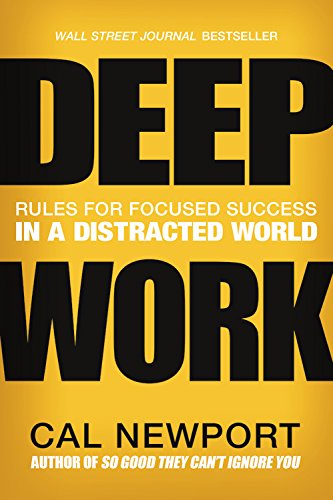
The Index Card Summary of “Deep Work”

Does it ever feel like your brain is overheating from fragmenting attention between too many things, flitting back and forth between tasks, with sometimes little progress to show for it? Well you’re not alone, and Cal Newport is going to be our Dr. Phil of attention, helping us to improve our quality of work and quality of life. The following summary of Deep Work walks through his advice on how to build our ability to engage deeply with our activities.

The Premise

Newport argues that in the modern economy there will be three types of winners: 1) those with access to capital, 2) those that are the best in their fields, and 3) those who work well with increasingly complex machines. The most viable route to economic success for must of us will be Path #3.

To work well with ever-evolving machines, you must be a great learner who can do deep work, i.e. focus intensely. Fun fact: intense focus triggers the same brain cells repeatedly and builds up myelin, which bulks up that neural pathway. Sort of like body building for your brain.

 Deliberate practice of a task bulks up the myelin in the related neural pathways

Deliberate practice of a task bulks up the myelin in the related neural pathways

The approach

1) The measure of deep work is time spent x intensity of focus. That’s what you want to maximize!

2) Deep work can be done bimodally (days to months as a time); rhythmically (several blocks of time each day); or like a journalist (whenever you can squeeze time in on the go)

Note on Technique: for those with less control over your schedule and less recent practice with deep work, the Pomodoro Technique may work best for blocking off deep work sessions followed by shallow work sessions or breaks. For example, 40 minutes of deep work followed by 20 minutes of shallow work 6 times a day can still achieve the target of 4 total hours of deep work per day. These shallow work periods may end up as over-flow buffers initially as you train yourself up to longer, unbroken periods of time.

You need to have 10 consecutive unbroken deep periods of a given time increment, as short as 10 minutes, before you start building up to longer periods.

3) Set up a systematized ritual – create a time bound, distraction free environment with all the right materials and enough food/energy

4) Avoid frequent task switching, as this leaves “attention residue”, a state of semi-attention as you’re still thinking about the last task when you start a new one

5) Choose to work on “the wildly important”

6) Collaborate with others in a way where you still break off for independent deep work

Pitfalls and solutions

1) Switching to an easier thought task – avoid this by structuring the path forward

2) Looping, i.e. reviewing what you know already – avoid this by consolidating gains upon which to build

3) Shallow activities – cut these out without excessive apology

4) E-mail – lay out a ‘path to closure’ to open-ended e-mails by laying out all steps to completion in one fell swoop

Note on E-mail: we’ve all rattled off quick replies that we know will generate three or more back-and-forths. Nip this in the bud by laying out everything you know will be discussed, including your availability for meetings requested, or any further information you will need. Add “no reply expected” or “I will consider your reply a confirmation” to minimize future e-mail traffic.

The path forward laid out by Newport is a call to action, with the knowledge that this means dragging our brains kicking and screaming. Our brains are seekers of distraction yet, paradoxically, convey the most satisfaction to us when we hit the “flow state” associated with deep work. Like eating your greens or hitting the gym, your body and mind will thank you for the deep work exercise you put it through. So pull out that weekly schedule or that Pomodoro timer, block out that time or set that target daily hours tally. You can start sculpting that focused mind today. (I say this having written this post with only one coffee break and two 5 minute side chats in between. We’re all a work in progress 🙂