The Index Card Summary of “Think Bigger: How to Innovate”

As a former innovation consultant, who designed initiatives, competitions, and recommended approaches for diverse clients, I was intrigued to hear that decision science scholar Sheena Iyengar, famous for her “jam study”, was now teaching, writing, and advising on innovation. I, of course, wanted to compare notes. Iyengar asserts that there are no new ideas, only new combinations of old ideas. True to her word, her methodology combines tried and true methods.

The Think Bigger Methodology

In Think Bigger: How to Innovate, Iyengar proposes a practical, six-step method to generate innovative solutions:

  1. Choose the [right] problem. Start by focusing on the problem, not the solution. Defining the right problem is a goldilocks challenge: to yield impactful, innovative results, you need a problem that balances specificity with broad enough relevance.
  2. Break down the problem. Address each component of the problem separately; this will enable combinatory options in Step 5.
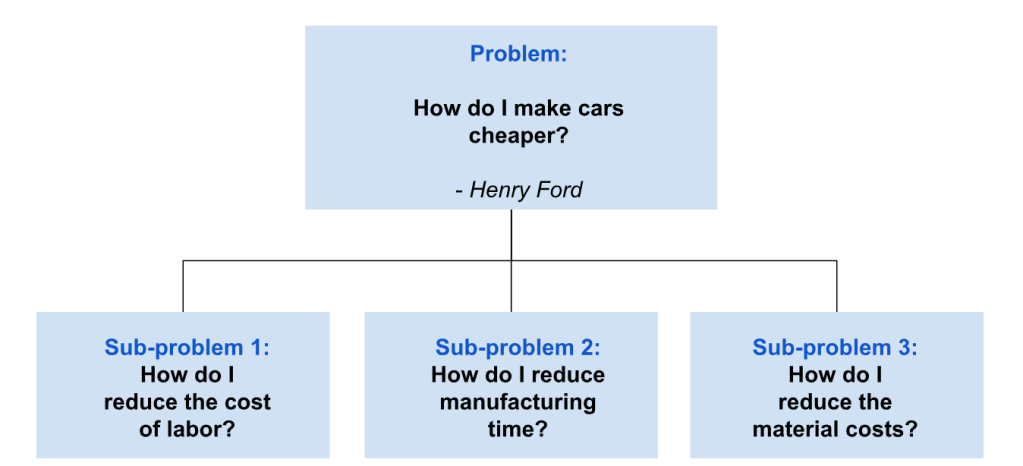
Iyengar uses Henry Ford’s auto manufacturing innovation as a case study for the Think Bigger methodology.

3. Consider desires. Identify the motivations and desires of those impacted by the problem — including you, the innovative problem-solver; the target beneficiary; and third party stakeholders.

4. Search existing solutions. Learn from past attempts to address the problem; identify both failures to avoid and insights to use.

5. Create a “Choice Map”. Consider different combinations of wide-ranging solutions to the sub-problems. Select several full solutions to investigate further.

A Choice Map is a mix-and-match menu of sub-solutions, to help identify and test different combinations.

6. Seek validation: Get feedback on targeted aspects of your candidate solutions from others.

Iyengar’s key advice

Source: Nordic Business Forum

In addition to simplifying the innovation process, Iyengar also strives to debunk common misconceptions. To increase efficacy, she advises targeting your efforts as follows:

  1. Get over shiny new object syndrome. The most unusual ideas are rarely perceived as more innovative. Instead, new applications and combinations of old ideas often get the most traction.
  2. Listen to your gut before you listen to the data. Ideas are a dime a dozen. But motivation is finite. Notice the direction of travel of your enthusiasm. Is it trending up, down, or flat as you refine your idea? This “real talk” will help eliminate magical thinking about your level of commitment. You need to feel passion to power through the process successfully.
  3. Spend more time researching solution options than you think you should. In contrast to the Lean Startup paradigm, which now dominates Silicon Valley and recommends racing to a minimum viable product, Iyengar recommends spending more time researching many possible MVP options.
  4. Don’t ask for feedback on the full solution. People are likely to judge your idea before its fully-baked. To effectively refine your concept, ask for selective, narrow feedback on specific aspects you are testing.

Nothing new under the sun

Iyengar arrives at core principles consistent with what I’ve seen work. Essentially, she is an advocate of open innovation and lateral thinking — problem-solving by looking beyond traditional organizational or social boundaries and connecting seemingly outside ideas. Given how tried and true her methodology is, I wondered why she chose to write the book. Iyengar herself highlights that even her Choice Map is largely derived from the GE Trotter Matrix.

I believe Iyengar wrote Think Bigger for three reasons: 1) she believes everyone can be innovative and, thus, sought to create an empowering “user manual” of sorts, 2) she observed common pitfalls among her students that she wants to help others avoid, and 3) she’s an academic — she must publish or perish.

To the first motivation, I agree that anyone can be innovative if they look outside their disciplinary or professional silo. This is part of what drew me to study Public Policy as an undergraduate student — it combines a basket of disciplines oriented around solving a challenging problem: designing rules for society. Political Science, Philosophy, Economics and other disciplines can not take on this challenge single-handedly. But while I agree that solutions to complex problems need to come from outside a single silo, I do not think a solopreneur or small team can crack the code as easily as Iyengar implies.

By optimizing her solution identification process for a single person, Iyengar’s methodology is both empowering and overpromising. Think Bigger reads as if one person can transform a product category, industry — nay, the world! — with little more than a worksheet. Yes, it’s a handy worksheet, and with time a single person can run the research process of identifying promising solutions to the target problem. But this individualistic approach limits output to that of one person / team vs. incentivizing many solvers to tackle the challenge — which is the core of a true open innovation approach.

To the second motivation, Iyengar’s advice certainly can save time and help individuals learn from others’ mistakes. As a decision-psychologist, she is versed in the mental tricks our own minds play on us. However, Iyengar’s own biases color her advice. As a full-time academic, she over-indexes on research, suggesting conducting enough research to produce thousands of potential solution combinations. Acknowledging this overwhelming option set, Iyengar then suggests selecting test solutions using a random number generator. How odd to recommend a big upfront investment, followed by an arbitrary narrowing-down process. Perhaps this is where the third motivation — to publish due to peer-pressure — may be tainting her recommendations as well.

Iyengar closes by reasserting, there are no new ideas, just different combinations of old ideas. This claim sums her book up well. She steels with pride and references, offering handy tools that can spur focused creativity. But they are not quite the cure-all implied.

Out with the old: How to make resolutions you’ll keep

We’ve all heard that the journey is more important than the destination. And the most important part of the journey is the next step. But how does this apply to New Year’s resolutions? Below is a simple guide to nixing the lofty end-goals and re-centering around continuous improvement.

Your brain on resolutions

Run a marathon. Learn beginner guitar. A classic resolution names exactly the outcome you want. It gives you a mountain to climb, literally or metaphorically. While it’s nice to have a vision to work towards, these kinds of goals can often have negative psychological effects.

First, lofty goals can dampen your self-esteem. When you set a goal, you place yourself in an immediate state of failure, by definition. And since most resolutions relate to self-improvement, this may provoke feelings of inadequacy. Second, we are particularly susceptible to “false hope syndrome” when making resolutions. A variant of the planning fallacy, we can assume that achieving a goal will be easier or faster to achieve than is realistic. When reality sets in, we give up or experience de-motivation.

False hope syndrome is characterized by a person’s unrealistic expectations about the likely speed, amount, ease and consequences of changing their behavior.”

Mark Griffiths, Psychology Professor, Nottingham Trent University

Third, a narrowly-defined goal may lead to de-motivation once we achieve the goal. We can mentally disconnect the goal from its underlying aspiration or principle. That’s why most dieters quickly regain all their lost weight, and then some. People who decide to adopt a healthy lifestyle, by contrast, often sustain success.

But how do you hold yourself accountable for self-improvement without a resolution? By changing your mindset to focus on the journey. That means prioritizing continuous improvement over specific milestones.

“No plan survives first contact with the enemy.”

Tim Harford, Author of Adapt: Why Success Always Starts with Failure

From resolutions to themes

For the last few years I have swapped out resolutions for annual themes. C.G.P. Grey describes themes as something you want more of in your life, a principle that you will use to make decisions. For me, last year was the “Year of Intentionality.” I wanted to do fewer things better. I wanted to avoid weaker interests that might crowd more important areas of my life. This theme gave me the grace to “Marie Kondo” my life. I said “thank you and goodbye” to the things that I like doing but didn’t have space for. And pandemic not withstanding, this was my most successful New Year’s resolution yet.

C.G.P. Grey explains how to make an annual theme that supports your growth.

From planner to navigator

It’s an unpredictable world out there. Having detailed life plans that you regularly scrap or revise can feel like a waste. Of course an initial plan can provide a valuable starting place. Plans can help you test assumptions and approaches. And the goal you are mapping towards can give you an inspiring vision and a sense of urgency. But the scale of the plan directly relates to the probability of success. A plan to get from your couch to the front door is more likely to succeed than a plan to get from your couch to Times Square, which depends on whether your E train became an F or your Q became a 2 train.

“Plans are useless, but planning is indispensable.”

General Dwight D. Eisenhower

If resolutions are truly meant to help improve your life, themes are much better suited to the job. They provide clear decision-making principles that enable you to plan your next step, no matter what life throws at you. And because the locus of control is with you, in a year’s time, you will look back and see visible growth.

Who am I? A real question as the physical/digital divide gets blurrier

Who am I? Many a wise man, from Beanie Man to Hugh Jackman in Les Misérables, have asked this question over the years. And with each individual’s growing digital presence, the question becomes more challenging to answer. Not only is a different piece of ourselves presented at work, school, and home. Now different aspects of the self are also presented via the different digital platforms we engage with. We are being shaped by what we consumer, by our digital socialization, and by how we interlink our physical and digital realities.

You are what you consume

Similar to the truism “You are what you eat”, the modern equivalent “you are what you consumer virtually” rings true in this digital age. My inbox has provided a retrospective of my digital self of late. Rather like a string of Facebook Memories, GDPR has surfaced all sorts of websites with Privacy Policy updates that I’d long forgotten, that are vestiges of my digital self from 10-15 years ago. It’s fascinating to see what I was interested in as a teen and reflect upon how those interactions have shaped me today — but equally frightening how many people have my e-mail address!

Projection, personification, and socialization

It is easy to project perceptions and feelings onto increasingly human-like and sophisticated AI, particularly in the realm of voice assistants. With increasing openness to the Alexas and Siris of the world comes a new level of openness to such AI shaping our behavior and thinking. Kids provide clear illustrations of this. Children today may not believe in the tooth fairy, but they believe in Siri and Alexa. Not only do children consider these voice assistants friends; they also see them as a source of encouragement. Think about it – if you ask Siri a question, she answers honestly and admits when she can’t answer. She never gets frustrated, no matter how many questions you ask. If you struggle to express yourself fully, Alexa offers non-judgemental, friendly reactions. Inc. Uncensored cited a story of a child learning English gaining the courage to be vocal through interactive dialogue with Google Assistant.

Connecting the digital and the physical

With our augmented brain, a.k.a. our phones, continuing to connect the dots with our physical selves, we will increasingly see ourselves and the physical items around us as having digital identities as much as physical ones. Apple has already released new features of its ARKit to developers, and look how one creator has already connected digital information to physical items: he’s connected his account data to loyalty cards and passes. This pairing of physical and digital removes not just the logistical separation of information, but also the mental separation.

 Easier to use loyalty cards with AR

Easier to use loyalty cards with AR

There is much to be wary of — or at the very least, to be aware off — as the information age continues to transform not just our daily lives but our beings. I, for one, have found cyborgs in the Sci-Fi universe fascinating and hope to evolve into a hopefully good-natured one myself. This is a space I will be watching – so stay tuned!

 What a friendly-looking cyborg!

What a friendly-looking cyborg!

The Short and Sweet Summary of “Messy: The Power of Disorder to Transform Our Lives “

Index Card Book Summaries: because most practical books can be summarized on an index card

Tim Harford posed a provocative question as to whether orderliness always benefits us. He unearths the human psychology that causes us to seek order while also showing the pitfalls and missed opportunities from being too orderly and the benefits of strategic mess! While Tim does this in 300 pages, I’m happy to share the 3 bullet summary:

1. Messy processes can bread creative and higher quality solutions

2. Trying to force structure on naturally messy processes can result in negative unintended consequences

3. As people have become very automated in their own social interactions, they should look to self-disrupt to re-engage with one another

Point 1 is an obvious one for artists and the avant garde. But in relation to point 3, if we find ourselves in the well worn grooves of work and personal life patterns, how do we tap into the rest of our brains to enliven and draw on the other ideas and connections we can make? More on that in a minute.

Point 2 is particularly dangerous with the automation of legal decisions. I’ve heard of several friends being mistakenly placed on terrorist watch lists, interrupting medical degrees and personal lives. This isn’t to say that machine learning can’t be leveraged to accelerate pattern recognition, but we just need to be careful about the new robo cops on the block receiving too much autonomy.

Back to unpacking Point 3, the subtle call to self-disrupt.  What this will mean in the macro and micro, personal and professional level is really up to you. The humble high achievers out there might be shivering at this business-bantery term and feel the impulse to artfully side step the charge, lest they become too much of a walking resume. But what this really is about is engaging your full self. It’s about snapping out of “shoulds” and survival mode, and tuning into the bigger you. Like the X-Men Apocalypse entourage, but for good. 

If you’re curious for a longer read, here’s the book link!