Makers, makers everywhere! The top six features of the 2018 Maker Faire

I thoroughly enjoyed my time nerding out at the 2018 New York City Maker Faire. From grooving on the dance floor to cheering on the battlebots, there was fan fair and creativity in the air. The initiatives spanned every size and scale. A 40 foot mechanical clawed arm, controlled with a right-hand sensor-laden glove was picking up a totaled car, not unlike the Blade Runner 2049 villainess directing remote attacks on Officer K. On the other end of the size spectrum, a flexible chip maker, MellBell Electronics, showed how their product could be used in everything from wearables to interactive 2D visuals. There was something for everyone. Below is a short list of some of my favorite Faire features.
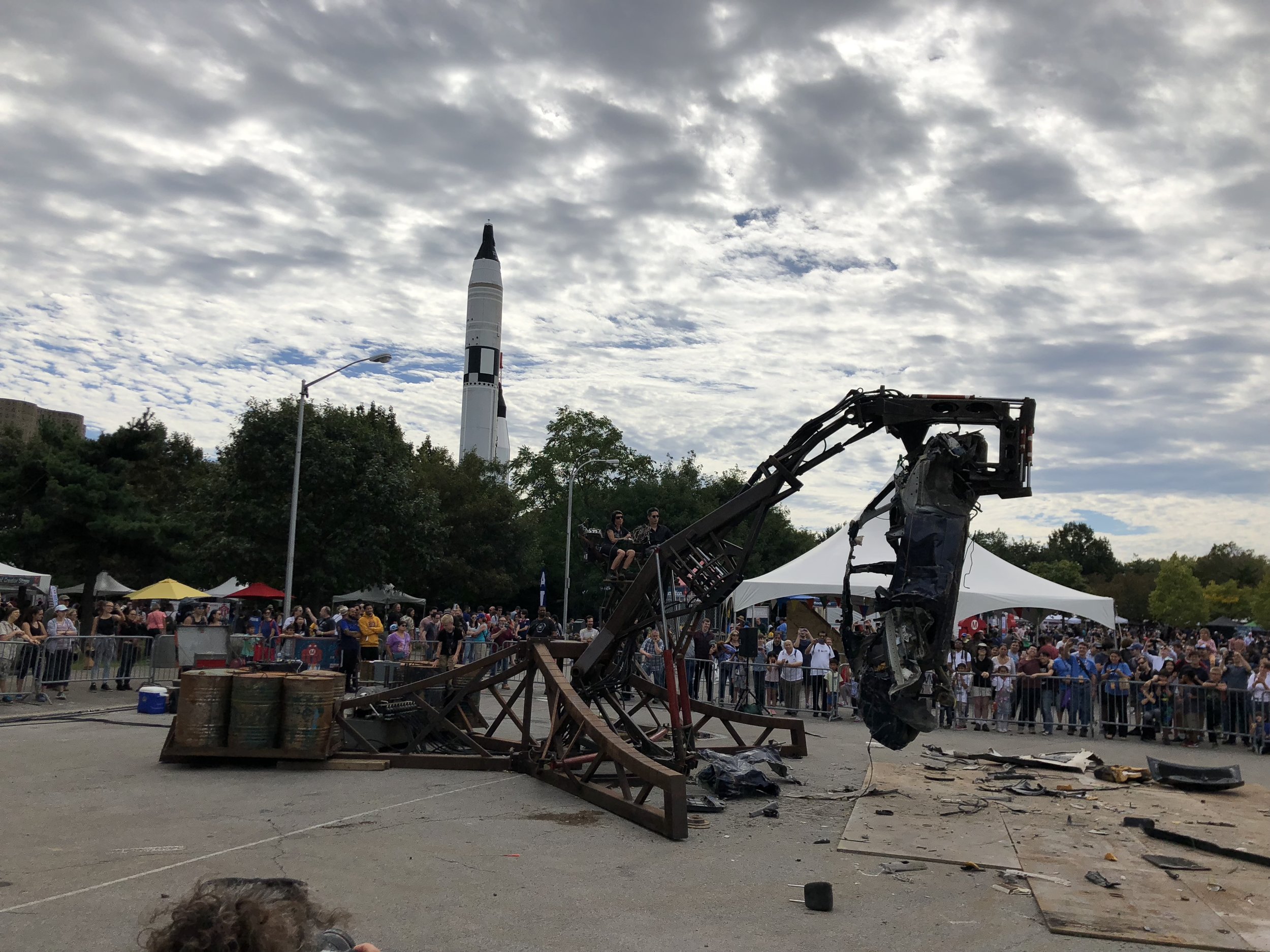
From big…
…to small.
Making the future.

Top things I loved about the Maker Faire

 Girls learning how to drill… Girls learning how to drill…

1. The spike in young girls…

STEM for girls initiatives have visibly turned the tides! Whereas four years ago the Maker Faire displayed a sea of prototypical boy engineers, this year’s Faire had little ladies of all backgrounds, getting hands-on with building.


 …from Disney princesses in work boots. Our 21st century role models have arrived. …from Disney princesses in work boots. Our 21st century role models have arrived.

2…and the role models there to meet them

Importantly, there was a heroine aesthetic being donned by many of the women instructors. One stand introducing kids to hand drills was run by Disney princesses in work boots. They were aptly named Beauty and the Bolt. Another activity had Princess Leia and Rey leading instruction.


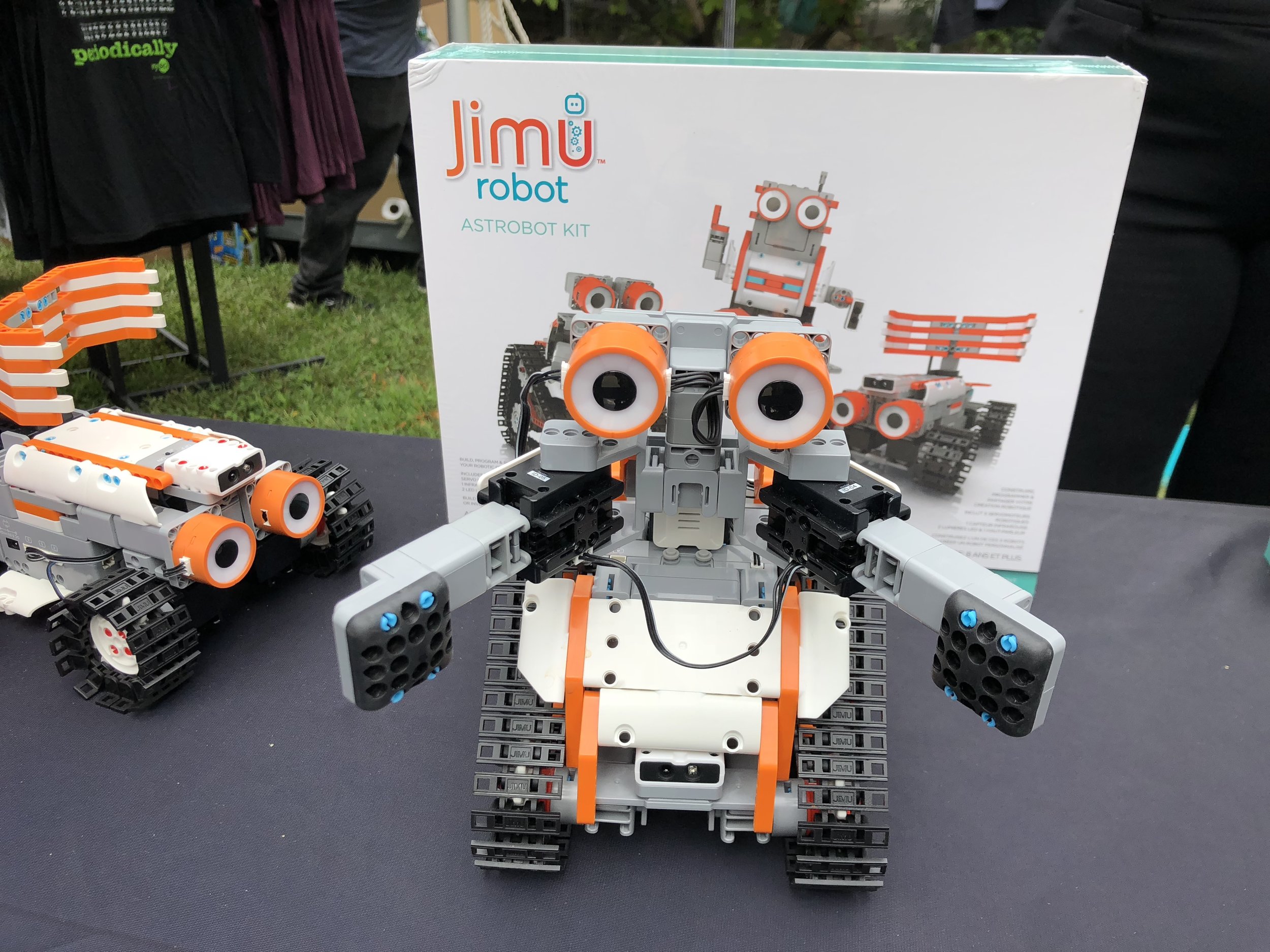
3. The number of Johnny 5 inspired robots

Every anthropomorphized consumer bot seems to look like Wall-E, who had clear influences from the Short Circuit humanoid robot, Johnny 5. I approve of this trend.
4. The Tesla coil made musical

Speaking of the past inspiring the future, oneTesla had the most epic demo of how a Tesla coil can be used to make lightning that both lights a wireless light bulb and plays music simultaneously. It was a light show, concert, and tech demo all in one. I don’t foresee Nikola Tesla’s vision of fully wireless electricity transfer coming to pass at scale, but this is not a bad alternative use case.

 Lightning jumped from the coil on the right to the light bulb on the left, all to an electronic beat. Lightning jumped from the coil on the right to the light bulb on the left, all to an electronic beat.

5. The next gen 3D printer

It’s nice to see equipment manufacturers beginning to combine capabilities for similar, but equally necessary tools for a makerspace. Specifically, one stand presented a combination CNC-3D printing machine, thus marrying related tooling with distinct software.

6. The sky is the limit thinking

It was fantastic to see the International Space Station represented alongside their many collaborators, including Magnitude.io. Magnitude.io’s prototype smallsats are blazing trails for educational accessibility. Where CubeSats have dramatically increased space access at a reduced cost, thanks to their 10 cm cubic size, Magnitude.io displayed concepts the size of a pack of gum.

 There’s a smaller game in town than CubeSats. Magnitude.io has launched CanSats and is developing even smaller sats. There’s a smaller game in town than CubeSats. Magnitude.io has launched CanSats and is developing even smaller sats.

The future is happening, and the brilliant minds of all ages and backgrounds present at the 2018 Maker Faire are leading the charge.
From individual to societal data: taking on bigger, badder problems

We have all heard the saying that “knowledge is power”. And in today’s modern economy, data is the new knowledge, which makes data power. We see it evidenced in the collective $1.3T market capitalization of Google and Facebook, whose pixels and cookies track us all over the internet. These massive data collectors began with an focus on individuals. Now, as we collect data about communities, societies, and supply chains, those holding the data will have growing power to impact not just individuals, but whole populations. 

The power of system-level data

Not only are today’s innovators collecting data about individuals, but they are collecting data about populations and processes. For example, Biobot Analytics hopes to transform sewers into public health observatories for whole communities by sampling wastewater from strategic points in a sewer system. Such collective samples can reveal issues as significant as an opioid epidemic, in neighborhoods as small as a few thousand people. Data tracking also promises to improve the fidelity of supply chain processes. Blockchain has been seen as a high potential technology for stemming the circulation of counterfeit drugs as well as upstream labor abuse.

This begs the question, how great is this latent potential? Are we reaching an inflection point where we no longer need to play whack-a-mole, and can finally clean up the messy problems that have previously upended communities, especially in the area of public health?

With great power comes great responsibility

Certainly the intentions of these technologies are to protect citizens, from counterfeit drugs, from themselves in the case of opioid detection. The question becomes how to ensure that the intended benefits manifest and unintended consequences do not.

We have all also heard the saying that power corrupts. Knowing this, we are forced to ask the question, how might the power of data be used corruptly in our own society? If recent technology deployments are any indication (e.g. AI blocking female doctors from the women’s locker room), we must ask, will we ultimately just re-manifest the problems of society using data?

We’ve observed the rise of “Big Brother” social monitoring in places like China, where social infractions as banal as jaywalking are caught by sophisticated monitoring, and have repercussions. Outside of monitoring, we’ve seen the weaponization of predictive algorithms in prison sentencing, resulting in worse outcomes for minorities. 

Given these patterns, we must imagine how cases like opioid overuse detection could be handled in the worst case. If an opioid crisis is detected, how might treatment differ in a poor versus a rich neighborhood? Will the doctors be the police targets in the wealthy neighborhoods, and the residents targeted in the poor places?

Writing society’s story

This — bias perpetuation — does not have to be how the story goes. Data is being used to empower many under-resourced communities. For example, an AI predictive model was able to increase the successful identification of corroded pipes in Flint Michigan from 20% to 97%, enabling the city to afford remediation of an additional 2,000 homes. Data can powerfully determine how we direct our limited resources to otherwise overwhelming problems. 

Knowledge is power, and while deep knowledge afforded by data can help solve problems by exposing them, it does not guarantee that those acting upon them have the best solutions. Impact is dependent on the social systems we operate in — how these analytical tools are used and how their analyses are received. We must ensure that those who can access and act upon community data are as effective at testing their own assumption and biases as they are at pinpointing social problems. 

Intelligent design: how NYC has planned for millions of moving parts

Hello beautiful nerds, this week in MBA in the City, we explore the design choices of NYC’s above ground public infrastructure that have helped the flow of the city. Yes, I’m talking about how the city has made way for the explosion of bicycles.

In the last decade, the number of daily bike trips in the city has more than doubled. And from the ever-expanding bike lane network to the ever-available bike racks throughout the city, our movement has become a little more perfect. And how has New York achieved this visible transformation? Using the mightiest of modern weapons: data. With New York’s Open Data policy and numerous beta tests and A/B tests, it’s clear our policy makers aren’t afraid of data. And New Yorkers aren’t shy about sharing opinions. This match made in heaven has produced decisions by and for the city’s 8 million residents. Respect.

Now for the highlights real! The back stories and photo documentary of where we’ve arrived by bike.

Bike racks can be beautiful

A decade ago the City launched an international competition to design the next generation bike rack. The results ranged from elegant to intriguing, producing a series of sample designs that were sprinkled throughout the city. Public comments read like Amazon reviews:

“Looks-wise the Y-rack is the only serious contender in the NYC icon stakes. Even though the paint was already a bit scratched, it still stood out from the crowd.”

— Public comment, CityRacks Design Competition

Most free opinions are worth their actual weight, but ones from New Yorkers make me feel like I’m watching reality TV: inexplicably mesmerized.

Once the winner was selected, these racks rolled out across the city, with some interesting auxiliary effects.

Now you see it…

…now you don’t

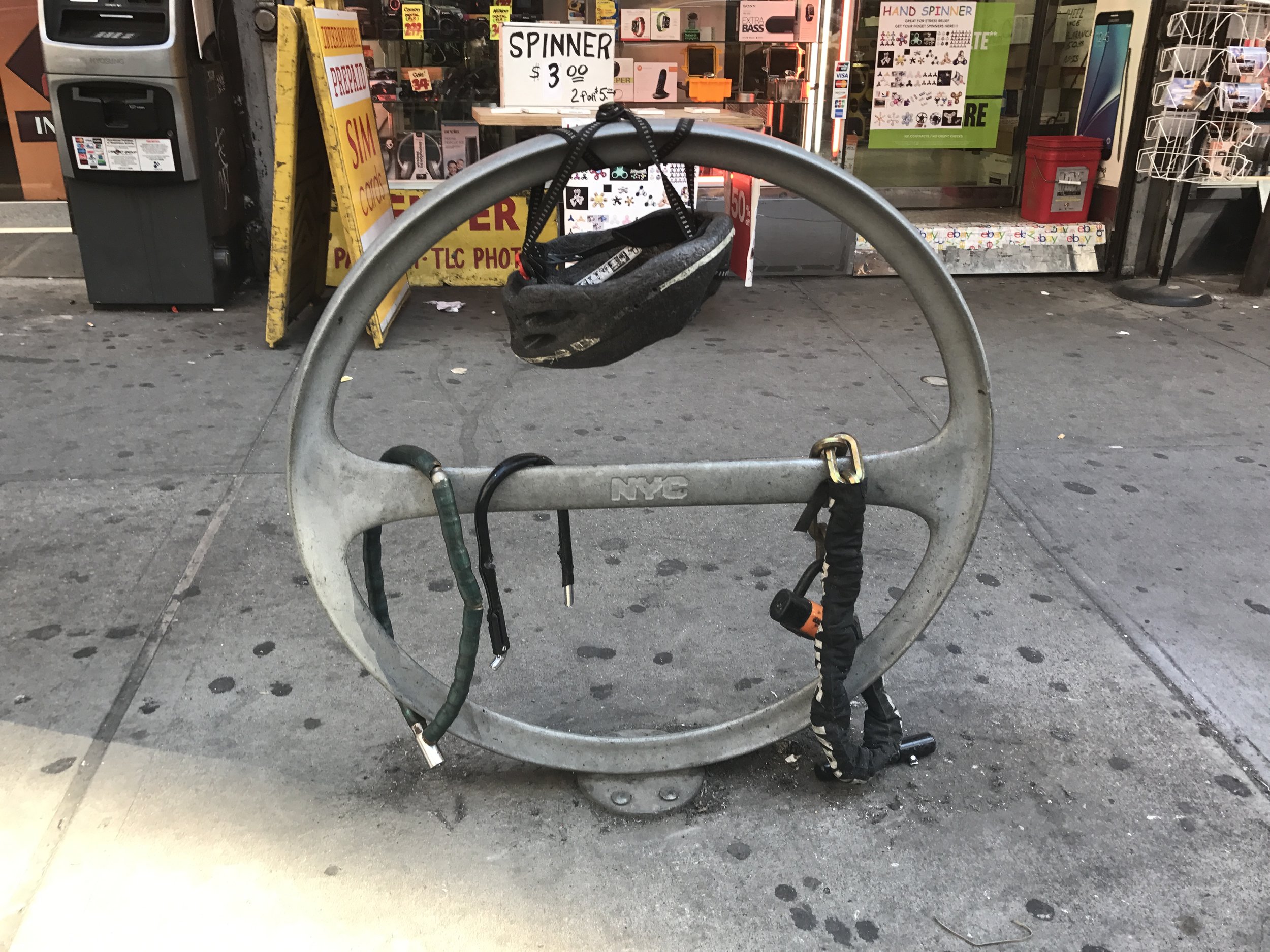
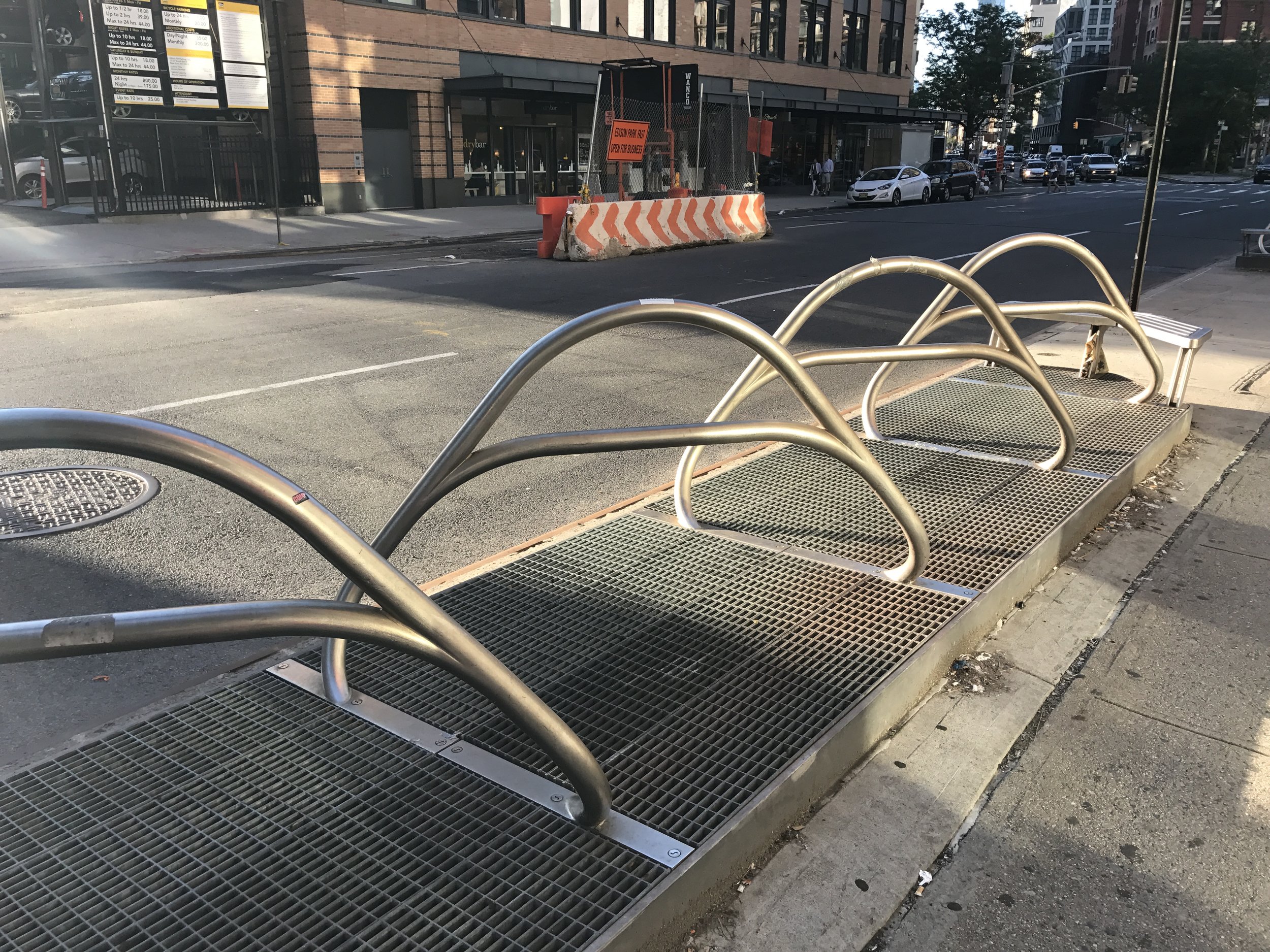
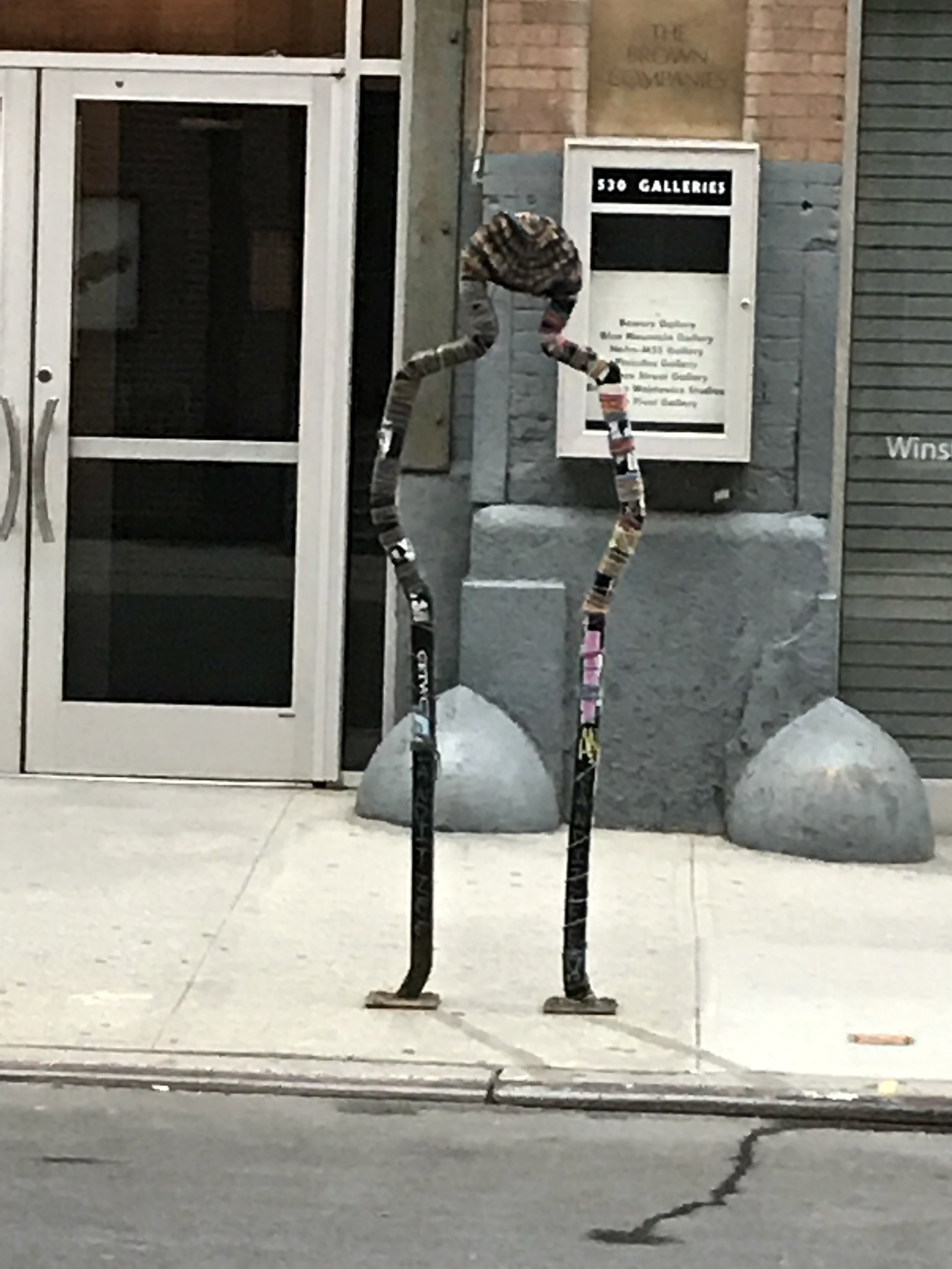
What I really love more than these elegant DOT racks is the ripple effect it had with private property owners, inspiring bank buildings and art galleries alike to get into bespoke bike racks. For the choosy bikers, there’s something for everyone – sleek or artsy, industrial or modern.

I wanted to be an outdoor gym, but this is a close second.
I feel invisible…such is the artists life.

There is a dark side to more cycling, though — with more bikes has come more bike thefts. But as a New Yorker, my inner monologue chimes the classic excuse for everything that is unacceptable in most places, but somehow not here: “That’s New York!”

I, once had a bike,
or should I say, it once had me

Citi Bike: onward and upward

In keeping with the city’s green initiative and the growing public love of the sharing economy, a shared biking system was conceived of in 2011. Here the public had it’s say years before launch, but there was no avoiding first contact with reality. From the word go, capacity was put to the test. Malfunctions were common, with stations going dead and bikes not always docking. New Yorkers told it like it was, and Citi Bike put their game face on. New software was rolled out two years later that fixed the glitches and supported the self-sustaining solar units at each station. And new bike models keep rolling out! I personally love the one with no gear – based on the road’s incline, it naturally adjusts the resistance! I also enjoy the shopping catalogue-esque presentation of the Citi Bike design on the official website. It makes me want to go buy one. But I can only buy a subscription. That will have to do.

 Citi Bike docking station in beautiful, sunny Madison Square Park Citi Bike docking station in beautiful, sunny Madison Square Park
Design + data-driven decision making = intelligent design. NYC is making thoughtful decisions that make life in the city more fluid, more perfect, more true to its people. I give my city a gold star.

Has Amazon become eBay? The new normal for e-marketplaces

There’s a market place with real-time bidding, where all the suppliers with identical products vie to sell their goods to a group of buyers, all with varying willingness to pay. Which market am I speaking of? Is it the stylized market place from Econ 101, the modern financial markets, or today’s primary e-commerce model? In fact, it is all three.

We’ve heard of regression to the mean with stock prices. The past decade has witnessed a regression to the mean of economic models. The difference between the market places academics describe and the ones financiers and commercial platforms implement has rapidly evaporated. In sum, the world has become eBay. 

The great irony in this turn of events is that eBay is one of the few markets where the auction model failed. Although eBay was a classical market, with multiple people selling identical or equivalent items, buyers did not want auctions. So why did eBay’s core model fail where so many others have since succeeded? Two words: buyer experience.

The Wharton course selection process followed a similar arc to that of eBay. Selecting your lineup for the semester used to be the stuff of day traders’ dreams. Speculation and back door deals were required to accumulate enough points and make the right trades to get your dream class lineup. But with the time and energy vortex it created for students, professors decided to swap in a simple system of ranked preferences, that students could set and forget until their course schedule was determined. Both the old and the new systems were based on economic theories, but the new one worked for everyone at a dramatically reduced cost. The selection process went from weeks of game theory strategizing to days of just choosing which courses you were most interested in. Similarly, eBay’s Buy it Now option made it so that you could literally buy peace of mind, knowing that your item was on its way. Now that’s exactly what buyers do 80% of the time on eBay.

Where eBay failed to deploy a streamlined buyer experience to auctions, e-commerce giants and financial markets have succeeded. They ensured that just because they make their markets competitive, doesn’t mean they need to be a hassle. And all with one weird trick: making the sellers compete, not the buyers.

Jet.com was the first e-commerce player to dream the dream of emulating financial markets: one price to rule them all. Jet aggregated all sellers of a single item under one listing, hiding the buyer and just showing the best price. The computer does the comparison for the shopper, bringing them one step closer to a two-click purchase. Amazon quickly riffed on this, showing a list of other sellers for a given item alongside that seller’s user rating. And the bandwagon effect was unleashed. Specialized sellers like Newegg, which formerly focused on technology products, have deployed the same tech to sell across categories, aggregating sellers and drop shipping inventory for a seamless user experience. Other markets are not far behind the curve. Technology has made it so easy to adjust prices that the bidding for hotels and airlines on aggregators like Kayak and Priceline is continuous.

All fields of technology-based commerce appear to be converging to an economists dream: a series of real-time auctions. But is the economists’ dream everyone’s dream — do we want the whole world to be a real-time auction market place? No doubt there is a dark side to a system evaluating actors primarily on price competition. Amazon’s opening the floodgates of international vendors to the U.S. has created a whole underground economy of fake reviews for low quality knockoffs, for example. In other areas, considering price alone has resulted in a number of negative externalities, such as the rash of taxi driver suicides in markets Uber has taken over. As eBay has taught us, without keeping an eye on consumer experience, no market model is sustainable. And as Silicon Valley has taught us, forgetting that these systems affect real people can cause social dislocation. Time will tell how consumers vote with their clicks. 


Breaking boundaries: the spread of tech-enabled access to art

Is all art for everyone? Are works that sell for millions in auction houses and street murals in urban playgrounds equally deserving of access for all? Increasingly technologists are signaling “YES” with clever products that not only introduce access to art, but call for active engagement. 

Accessibility 1.0: distributive access

Accessibility 1.0, much like Web 1.0, focused on just getting the content distributed. These are online portals that make users able to see and learn about art, like Khan Academy’s art history content. Accessibility 1.0 focuses on the democratization of knowledge, much like Project Gutenberg, which has famously provided access to over 57,000 free eBooks.

Accessibility 2.0: putting the AR in art

Accessibility 2.0 is underway, with a new generation of tech-enabled art evangelists. They want historic art and art from your every day experience to be equally as accessible, physically and psychologically.

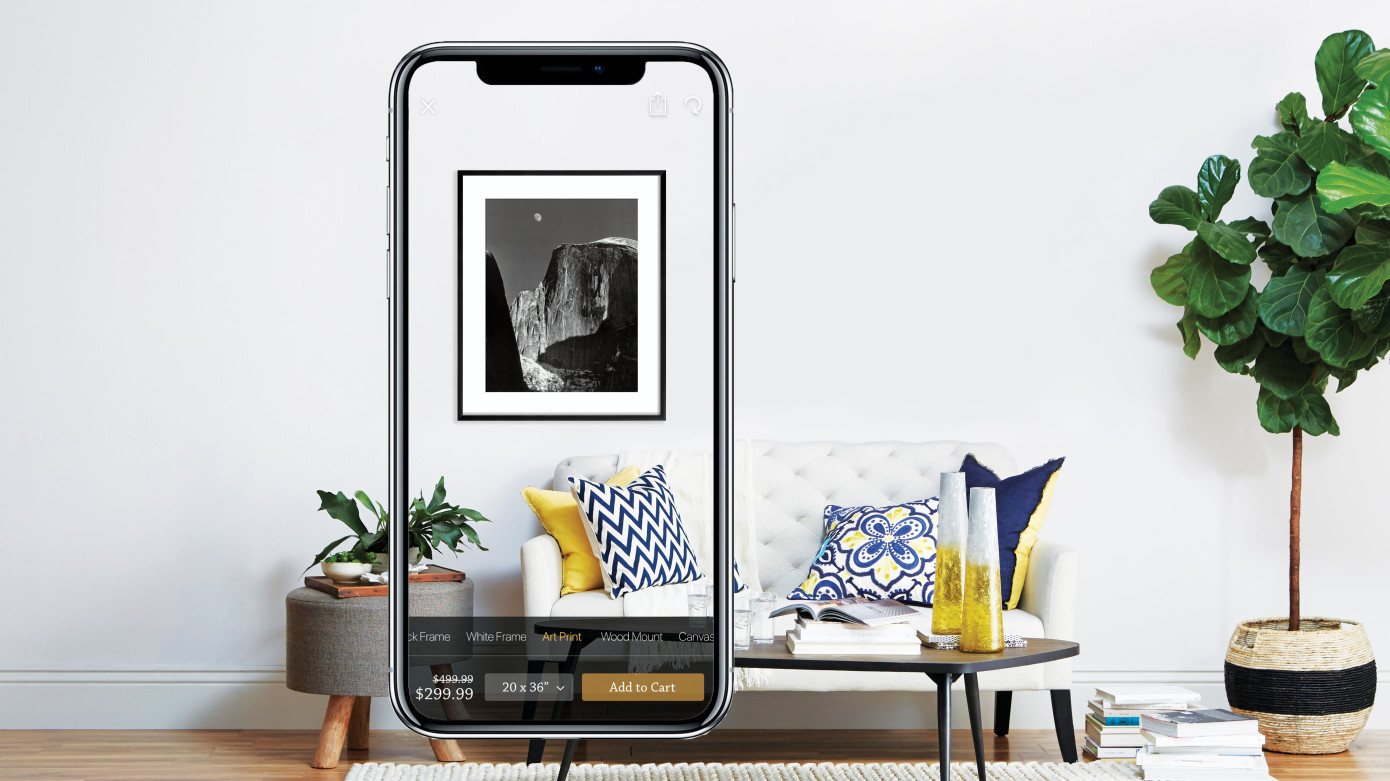
As augmented reality has become just an app download away, marketers and philanthropists alike have identified the opportunity to make art look and feel more tangible. Using Art.com‘s ArtView feature you can get a preview of what a piece looks like on your living room wall. 

AR initiatives such as CMU’s Art Management & Technology Laboratory have also begun developing similar functionality for educational purposes; such initiatives can project historic paintings, statues, and structures, allowing for people to actively explore.

Accessibility 3.0: enabling creativity

Accessibility 3.0 has rolled out almost simultaneously. To its vanguards, accessibility means both being able to see and interact with art, as well as being able to make it.

Prisma is an exemplary app that transforms any ordinary photo into an impressionist piece a la Picasso or surrealist Salvador Dali at the touch of a screen. While mega companies are waiting at the wings to buy user behavior data, the technology allows a new level of personal expression in user generated content.

GalaPro is also opening another arts door to the disabled: theater. This new app interprets performances for deaf, blind, and non-English-speaking audiences, by providing audio descriptions, captioning, and dubbing. Twelve Broadway theaters now offer GalaPro.  One show, Children of a Lesser God, features hearing, hard of hearing, and deaf actors. The show itself features full subtitles throughout using the same technology from GalaPro.

This rapid evolution of accessibility tools, providing knowledge and the opportunity for self-expression, makes art accessibility feel more achievable than ever. Invisible lines are being crossed and blurred and soon will be erased from our augmented view.

Moving in and taking out – the demise of Seamless

It’s July, I’ve tossed my graduation cap up in the air, and into a crate. I’ll miss the NYU housing, just a stone’s throw away from Washington Square Park. Mamoun’s will no longer be my go-to dinner spot, and I finished my last Smith’s brunch for a while yesterday morning. 

The two movers from Queens that I found on Craig’s List arrived with their van, and we begin the elevator dance, squeezing what we can into the freight in our 3 hour reserved slot. I’d managed to find a new three bedroom in a hot new neighborhood. Well, just outside of a hot new neighborhood – Bushwick; it’s more affordable. It’s a walk-up, but I’m only on the second floor, and there’s three of us — we can handle.

Six hours later, with 30 minutes of coach maneuvering, we’ve arrived as a sweaty mess of cardboard boxes in the living room. I don’t know were my new work wardrobe ends and my pots and pans begin. I think to myself, If I can make it here, I can also get it delivered. Already salivating, I pull out my phone and open up Seamless, visions of chicken pad thai dancing through my mind. I scroll. And scroll. And scroll. Polish food. All Polish food. No thai food even touches the map of possibilities. Even if I pretend to be a few blocks closer to Manhattan, I seem to be just one block further east than any Thai restaurant is willing to go. And it fully dawns on me, I’ve made a horrible mistake — I have moved into a delivery desert.

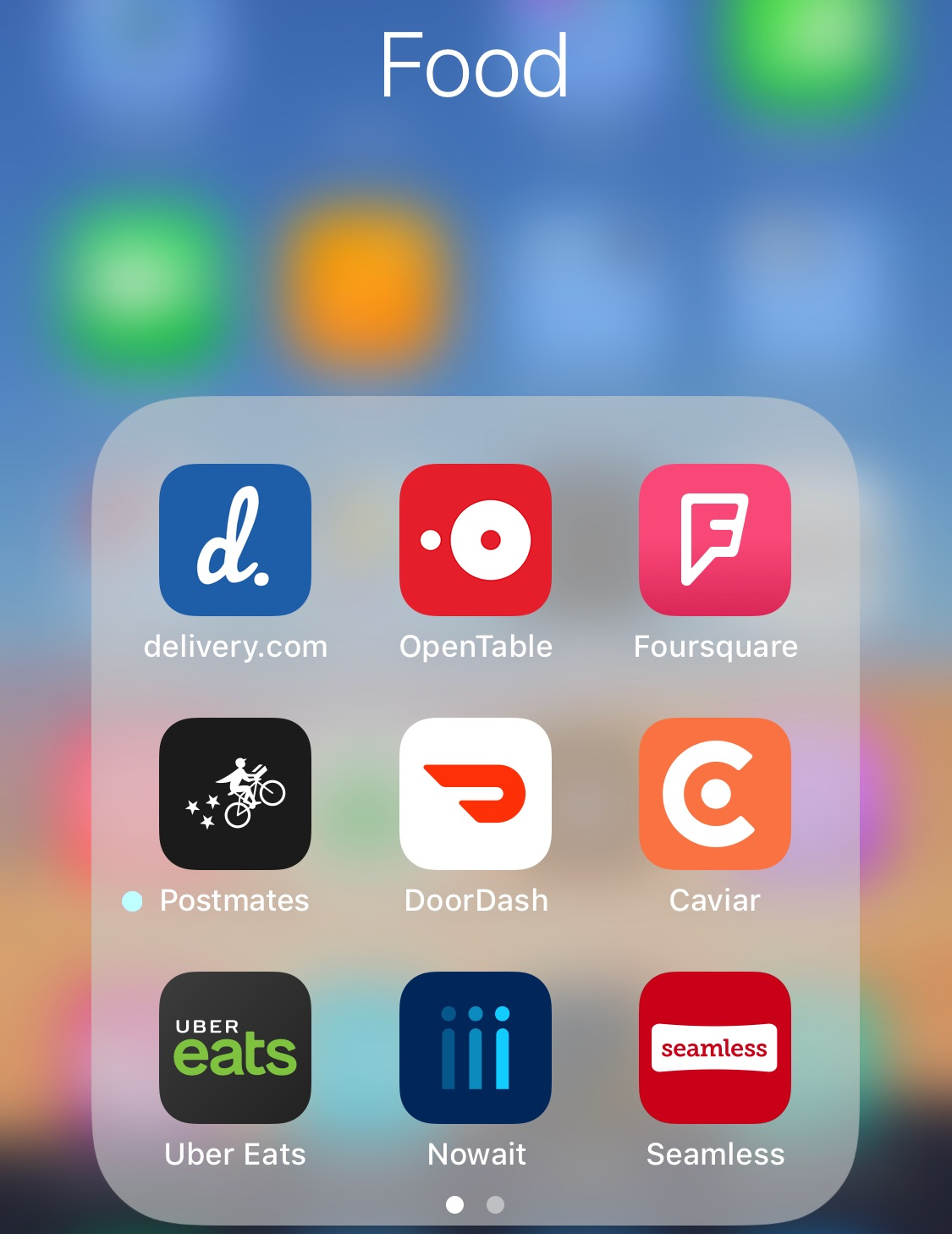
I lived in a land with sushi as far as the eye can see only 6 hours ago. In the depths of my despair, I realize I need to pay the movers. As they open Venmo to make the request, I notice a *whole screen* of food apps. “Hey, which of those apps do delivery around here?” I ask, trying not to sound as desperate as I am. “All of them,” my mover says. I gape in disbelief. “Want a referral? I can send you all of them – DoorDash, Postmates, maybe Caviar because – treat yo-self”. Hell. Yes. “That would be awesome, I owe you a tip as well, add it to the Venmo.” 

My world had just contracted and expanded in the space of minutes, the Big Bang of delivery. Just because I don’t live in the Village, doesn’t mean I can’t eat like I do. The confines of my local neighborhood erased, the city is once again my bread basket.

Download #1 complete. Postmates. I open, and scroll, and scroll. It was there. It was all there. Restaurants that had mysteriously disappeared from Seamless months ago, now available to me, miles away. I now saw the shifting tides for what they were: the Great Unbundling. The restaurants no longer had to hire delivery people, or share a cut with Seamless. They could just outsource it.

Further down the list: Shake Shack. This explained the mysterious lines of this non-delivering burger power house. These delivery services will order for you, and wait in line! And after a day like mine, I am more than willing to pay the service and delivery costs. I upgrade from my #2 to my #1 Thai place, now that it’s back on the map, and place a double order of chicken pad thai. And while I’m at it, I delete the Seamless app. Goodbye peirogis, hello world.

I was in stitches: the most American 4th of July

As I was bleeding out on the pavement, I reached for my iPhone to check my insurance app. Maybe someone was having a sale on stitches this week, ideally someone close by. However, because it was the 4th of July (a typically injury fraught holiday), it seemed like surge pricing was in full effect. $75 just to have a look. Thus began the mental calculus many Americans are all too familiar with. Do I really need stitches anyway? I mean maybe I could get by with a bandaid… a really big bandaid.

At this point, I’m usually tempted to open Tinder and start swiping until I match with a doctor (or at least a medical student). I’m in no position to fight temptation. Even at $16 for a cocktail, it’s cheaper than urgent care.

Now I’m not going to say I was biking while intoxicated, but I just started this new starvation diet where you don’t eat anything for the first 36 hours, then you’re allowed 6 almonds for the next 72. Perhaps I was a little light headed, but definitely still in control. I can handle my almonds!

Just my luck, I matched with Dr. McDreamy, sitting right in the closest urgent care center.

Me: Hey, you busy?
Doctor: I am at work right now, but this guy isn’t getting any better no matter what I do. Sup with you?
Me: I’m having the most American of 4th of Julys. You really a doctor?
Doctor: Yep
Me: Pop quiz! How would you treat minor abrasions and multiple epidermal lacerations on the left leg?
Doctor: Umm…I usually start with drinks
Me: Great! What kind of alcohol ya got? Rubbing? 😉
Doctor: Wow, it’s like you know me.
Me: Well, I’d love to get to know you more. In fact, I am heading over to you right now.

I hobbled my way over, credit card in hand. In the end I wound up with a rather large bandage. I’m sure it will be fine. Happy 4th!

My eyes are down here: how marketers are adapting to smart phone usage

As I strolled the streets of Chelsea one chilly Saturday morning, I noticed a sidewalk ad – literally, stenciled on the sidewalk. Huh, I though, gorilla marketing takes a twist.

But why did I notice this ad that blends in with old bubble gum and uses the most basic of color pallets? I realized it was because I was on my smart phone! With 50%+ global penetration of internet usage, largely driven by smart phones, the sidewalk has become better marketing real estate than a 40 foot billboard by the highway.

Second world cities have beat first world marketers to adapting to this monumental change in consumer behavior – the text neck. In Santiago, the cross walk lights are built into the curb cuts now.

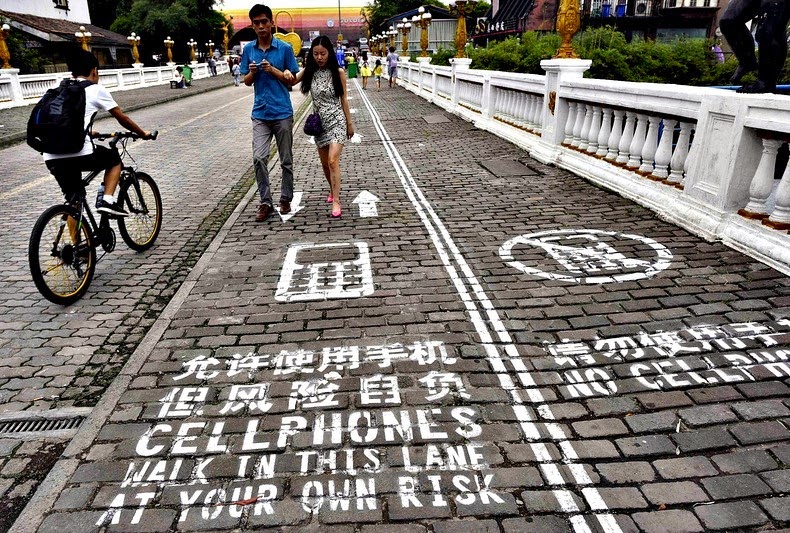
And Chinese city Chongqing has set up “no phone” pedestrian lanes, so fast and slow walkers are equally accommodated – something I’d love to see rolled out in Herald Square.

Next time you are out and about, make sure you watch where you are going.

Urban Dictionary for business terms

In chatting with folks from engineers to analysts, I’ve realized not all business terms are widely known, and so I’ve made an Urban Dictionary for a few common concepts below.

Impressions

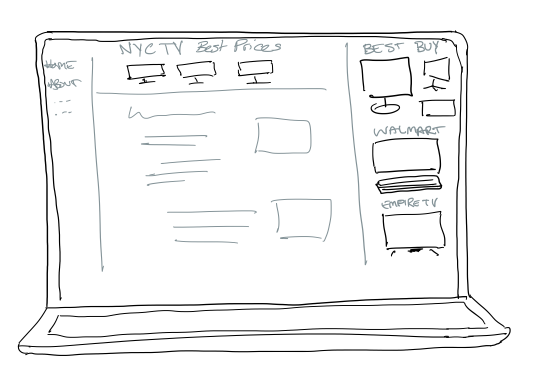
An internet ad that has made first contact, but did not penetrate the attention bubble. For example, when I buy a television on Amazon, suddenly the internet gets the impression that that it’s the start of a collection of 55″ flat screen TVs.

CAGR 

Not to be confused with a kegger. During my MBA, I was very confused when I showed up for the Delta Sigma Pi party. 

CAGR stands for compound annual growth rate, i.e. the smoothed, average rate of growth over several years (like a bikini line after waxing). 

CAC (Sponsored by Blue Apron)

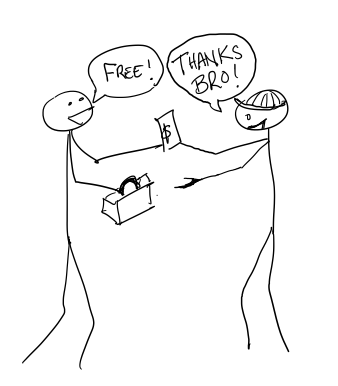
Customer acquisition cost. This is how much you’re willing to bribe someone to try your product. Think all those Blue Apron coupons you get in the mail, basically paying you to try it. 

ARPU

Did the bribes work? How much is each sucker customer spending? That amount is your average revenue per user.

VC Discount

The VC Discount is the amount of venture capital money a consumer burns through by happily accepting all the CAC offers without becoming a loyal customer. This is calculated as follows:

For example, you may buy a $10 per month MoviePass to buy one $15 movie ticket per month. With no theater subsidy, that’s a 33% savings (1 – 10÷15)!

Deliverable

No, it’s not a pizza. A deliverable is a thing that your client or manager swears to you, in a contract signed in blood, is precisely what they want and is *very important*. You then work on the project for weeks or months, countering with your own blood, sweat, and tears. Maybe you even miss a couple of your kid’s baseball games. And as soon as you deliver it, they smile and nod, and when you leave, they put it in a drawer, never to be spoken of again.


Who am I? A real question as the physical/digital divide gets blurrier

Who am I? Many a wise man, from Beanie Man to Hugh Jackman in Les Misérables, have asked this question over the years. And with each individual’s growing digital presence, the question becomes more challenging to answer. Not only is a different piece of ourselves presented at work, school, and home. Now different aspects of the self are also presented via the different digital platforms we engage with. We are being shaped by what we consumer, by our digital socialization, and by how we interlink our physical and digital realities.

You are what you consume

Similar to the truism “You are what you eat”, the modern equivalent “you are what you consumer virtually” rings true in this digital age. My inbox has provided a retrospective of my digital self of late. Rather like a string of Facebook Memories, GDPR has surfaced all sorts of websites with Privacy Policy updates that I’d long forgotten, that are vestiges of my digital self from 10-15 years ago. It’s fascinating to see what I was interested in as a teen and reflect upon how those interactions have shaped me today — but equally frightening how many people have my e-mail address!

Projection, personification, and socialization

It is easy to project perceptions and feelings onto increasingly human-like and sophisticated AI, particularly in the realm of voice assistants. With increasing openness to the Alexas and Siris of the world comes a new level of openness to such AI shaping our behavior and thinking. Kids provide clear illustrations of this. Children today may not believe in the tooth fairy, but they believe in Siri and Alexa. Not only do children consider these voice assistants friends; they also see them as a source of encouragement. Think about it – if you ask Siri a question, she answers honestly and admits when she can’t answer. She never gets frustrated, no matter how many questions you ask. If you struggle to express yourself fully, Alexa offers non-judgemental, friendly reactions. Inc. Uncensored cited a story of a child learning English gaining the courage to be vocal through interactive dialogue with Google Assistant.

Connecting the digital and the physical

With our augmented brain, a.k.a. our phones, continuing to connect the dots with our physical selves, we will increasingly see ourselves and the physical items around us as having digital identities as much as physical ones. Apple has already released new features of its ARKit to developers, and look how one creator has already connected digital information to physical items: he’s connected his account data to loyalty cards and passes. This pairing of physical and digital removes not just the logistical separation of information, but also the mental separation.

 Easier to use loyalty cards with AR

Easier to use loyalty cards with AR

There is much to be wary of — or at the very least, to be aware off — as the information age continues to transform not just our daily lives but our beings. I, for one, have found cyborgs in the Sci-Fi universe fascinating and hope to evolve into a hopefully good-natured one myself. This is a space I will be watching – so stay tuned!

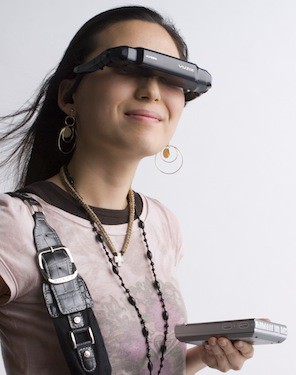
 What a friendly-looking cyborg!

What a friendly-looking cyborg!