Organizational Groundhog Day: Why we see the same ‘mistakes’ across our careers

If you’ve been working a while, you’ve probably had more than one corporate déjà vu moment. Maybe it’s a group dynamic gone sideways or a CEO’s self-inflicted wound. They leave you head-scratching about why, despite all the MBAs and consultants (guilty of being both!), we keep ending up in the same pickles. 

This year I decided to step back and take a broader look at organizational dynamics, to see whether their intricacies broadly weave into a few patterns. I reached out to the modal edges of my network. Ok, still mostly MBAs and consultants, but all with 20-45 years of cross-industry work experience, ranging from small to multinational and from startup to mature companies. While current roles skewed towards tech, experience spanned civil engineering and international development, venture capital and law, with titles ranging from manager to Vice President.

I asked these wise business leaders at the zeniths of their careers to look back on their collective experience and consider the same three questions: “What are mistakes you see happen in organizations over and over again? What is causing them? What can you do to change the pattern?”

What emerged isn’t just a simple list, distilled from 22 perspectives. Certainly there are meta themes. But what stood out more was how every interview felt both individual and systemic at the same time. Each deep diagnosis framed not just the endemic challenges each leader was squaring up to, but also what values they held and aimed to deliver. On the whole, when individual choices meet organizational evolution, certain ‘mistakes’ will manifest like clockwork. 

Organizational growing pains: some ‘mistakes’ are inevitable

Sitting down with a seasoned engineer who’d experienced every size and maturity of business, I received a stoical reframing of my premise: There are no mistakes. “Mistakes” we observe are not made in error. Rather, they are “structural artifacts” of an organization’s current stage of growth and maturity. If you group all companies into three simple buckets, here’s what you can expect.

  • 🐣 Small businesses: These entrepreneurs are building the plane while flying it. They make mistakes out of sheer inexperience, learning the “nuts and bolts” because there’s no one else to do the work.
  • 📈 Rapid growth companies: Welcome to the competitive wild west. You need to scale up to meet demand, but then keep outdoing yourself to stay profitable. Rapid growth, chasing the next innovation can be messy. Reaching new levels of scale that require new leadership expertise can also drive churn, contributing to the chaos.
  • 🧓 Large, stable companies: These behemoths are set in their ways, sporting policies and procedures for every scenario, having seen it all over decades. While this might feel like “boring” adulting, it’s how they operate globally at scale. But it’s also how you fall asleep at the wheel and become irrelevant.

Basically, a company making “mistakes” might just be living its truth. And that might bump up against your own goals, values, or preferences. 

Of course, these company maturity categories are artificially clean and binary. And the magnitude and frequency of “mistakes” can still vary significantly. One can certainly take the rough with the smooth, but also try to temper the rough patches. So let’s have a walk through the topics that popped across interviews. What are the most common  — let’s call them problems — and how might we remedy them?

🎶 I got 99 problems but grouped them into 4

The following short list is by no means exhaustive. Consider it the 80/20 of org “watch-outs.” 

Group 1: People problems

Most common: Bad hiring, bad management

Typical culprits: Small businesses, rapid growth companies

Typical causes: Inexperience, time pressure

“Founders are really bad at hiring. They tend to hire someone for roles they are bad at. It’s hard to hire someone for something you don’t know how to do.” – Venture Capital Investor

“I previously worked with [recruiting] during an aggressive expansion. The company was thinking about the ideal way to hire, number of interviews, what you can learn. One issue is hiring incorrectly. It has a profound and long-lasting impact. They stay long and bring on other people who aren’t right too.” – Senior Director, large tech company

The take-aways

1. Invest in hiring and onboarding 

“I valued [my former company’s] time, thought, and structure put into hiring decisions. And it’s a standardized process that helps compare candidates…The moment you let people do their own thing, it’s impossible to hire well.” – Senior Director, large tech company

“Most people don’t think about how to make the person confident and competent in the role. And then check in with that person and give feedback.” – Vice President, mid-sized tech company

2. Expect managers to enable talent at every level 

“[Direct reports] need direction, guidance, coaching, mentoring, apprenticeship. But they don’t need to be micromanaged…You should let them unleash their talent.” – Partner, top global consulting firm

“57% of people have left a job because of a manager. People should take more stock of the people issues vs. just speed.” – Career coach and Founder

“A lot of people hire someone external without creating an environment for success, and it takes too long for them to figure out how to get things done. New hires don’t have enough internal authority to push things through. A sponsor should enforce metrics around the change they want.” – Senior Strategy Manager, large tech company

Group 2: Focus problems

Most common: Unclear mandates, high reactivity 

Typical culprits: Rapid growth companies; large, stable companies

Typical causes: Market pressures, catering to leadership, high novelty or complexity

“I see a lot of reactive solutions. Something gets shrill, the geist of the moment. e.g. change of administrations, AI. There’s nothing wrong with reacting. Sometimes we move too fast to come up with something brand new, and we over-react. And [reactive solutions are] not built for longevity.” – Head of Strategy & Operations, large tech company

“R&R is a challenge [in my function]. It’s unclear who the owner and who the decision-maker is. By default you think it’s the highest ranking person, but that’s not always the case. Otherwise you just keep having working sessions. – Product Strategy and Operations Executive, large tech company

The take-aways

1. Ensure top-down clarity on strategic direction

“The order of decision-making should be strategy, organization, people; not people, organization, strategy…A lot of times people propose org changes that are solving for people. Or you see you’re working around the strategy.” – Vice President, large tech company

“[All companies need] a clear, well written plan. This includes strategy, mission, vision. There’s also the outcomes you want to measure to know if you’re successful. Some companies don’t have one or both. Some have both but are poorly written and executed. Lots of people don’t include what they won’t do. Companies do poorly at setting goals and [conveying] why they matter.” – Director, large tech company

2. Be targeted and deliberate in assigning shared ownership

“If everyone’s doing the same thing it’s not clear what you’re driving. There are areas that it would be really powerful to have shared goals. But in other places we can move faster as separate units. We [need to be] intentional about when we take approach A vs. B.” – Director, large tech company

“People tend to focus on their area of responsibility over how that area of responsibility affects something bigger. They focus on in-quarter metrics over long-term trends… [But big-picture thinking is] fundamental to maintaining the health of the business…In part it’s a question of empowering individuals. In part it’s signalling to people that that’s how they should be operating.” – Managing Director, large tech company

Group 3: Process problems

Most common: Slow decision-making, limited accountability 

Typical culprits: Large, stable companies

Typical causes: Org complexity

“The way our orgs are designed, with [multiple functional leads] all reporting to different people means there are too many decision-makers… The advantage is a higher degree of excellence…[but the tradeoff] is multiple layers of direction and [dispersed] accountability.” – Senior Product Leader, large tech company

“[Different divisions] have different motivations… There are too many goals to be aligned.” – Senior Software Engineer, large tech company

The take-aways

1. Match the process to the objective and risk
“We see a lot of one-way door decisions. That affects the speed we can tackle problems. Many one-way door decisions are expensive to change or impact brand reputation if you make the wrong call. We could move much faster if we identified decisions [with] two-way doors, with fewer executive reviews and alignment [needed]…You can simply identify ‘what decisions could I reverse today?’…People reviewing work set the tone, including giving coaching [on what they] don’t need to review.” – Senior Product Leader, large tech company

“Centralization vs. decentralization: When do you want to focus on consistency, speed, and execution (centralization), using top-down mandates vs. when do you want people to figure it out and do it their own way, since you don’t know the right way, and eventually make it consistent…Make that decision consciously.” – Strategy & Operations Executive, large tech company

2. Set R&Rs and accountability frameworks

“We have a very matrixed organization. It’s not clear who’s on the hook… It’s a structural challenge. You’ll get people in the room that weigh in that aren’t accountable, so shouldn’t be an extra opinion. That’s most large companies. That causes slowness. [Correcting for this] has to be intentional by top leadership. They have to regularly check in that it’s the right structure to achieve their goals.” – Director, large tech company

“In the kickoff meeting, we don’t set up a decision-maker, they just say we’re all working on it. You see a meeting with a dozen [approvals] required. We need to be more explicit. We need a leader to… assert [R&Rs and] ownership. The owner then has to tell people who’s doing what…It comes back to ownership.” – Strategy & Operations Executive, large tech company

Group 4: Culture problems 

Most common: Low psych safety, siloed communication

Typical culprits: Rapid growth companies; Large, stable companies

Typical causes: Loss aversion, deified leadership

“A mistake I see made a lot is people playing pretend. Not acknowledging reality, pretending things are good when they are not.” – Technical Professional Services Head, large tech company

“[People have a] perception of leadership that they have all the answers.” – Founding Partner, impact investing startup

“Any time the team grows, there’s a breakdown in communication. Every time you shift to no longer being in the room together, comms shift. There’s angst around hierarchy, around process and suddenly needing it.” – Career coach and Founder

The take-aways

1. Model imperfection and risk-taking 

“Everyone in the chain has to feel their leadership is supportive. If one person feels safe but the next stop up doesn’t feel safe, it won’t work. People need to see examples to believe it. Leadership has to model how they’ve made mistakes and asked for and received leadership support. There needs to be a way to reward and highlight the behavior.” – Director, large tech company

“In early stage companies they explore, but when you hit a certain size, it’s too difficult to allow freedom, because that introduces risk. And risk appetite goes down with time…Find the members of leadership that are incrementally more open than the rest, and push them to find creativity. Use that as a test case to prove. It’s an incremental approach.”  – Founding Partner, impact investing startup

2. Normalize open communication and collaborative feedback

“The Achilles heel for orgs is an inability to distinguish between accountability and blame. Accountability is an opportunity to look at something that isn’t working and try to figure out how to problem-solve together…. Vs. blame. That creates an environment where people are unwilling to identify problems.” – Director, large tech company

“People are more agreeable in group settings to give a sense of niceness and organizational cohesion. This is the root of many problems. Having backbone and being willing to disagree is important for organizational health, so people feel like they can raise important concerns… [I have seen] people disagree in backchannels or silent discontent. Then you miss the perspectives of people. [We need to] create a safe space where people feel they can vocalize opinions… You can say why you don’t agree with it, offer data, ask for more input from that person.” – Senior Product Leader, large tech company

Final notes: Expect the expected

The above org problems are less about individual human fallibility and more about the inherent design, stage of development, and maturity curve of the organization itself. Among the four problem groupings, each org type has their “favorites”. Rapid growth companies have more people problems due to hiring at a rapid clip. Large, stable companies have more process challenges due to system complexity and risk aversion. All can suffer from communication breakdowns.  

So if you are experiencing corporate déjà vu, you’re not crazy. You’ve seen this movie before. It’s a classic plot, and still worth a watch. But don’t just get out your popcorn – this is a choose-your-own-adventure. Know thyself, and choose which org type you want to be in. 

And if you are in an org that you feel is missing the mark, I’ll leave you with one last inspirational quote:

“I think people believe some problems are too big for them to fix. Then they focus on the controllable. But there are instances where you’ve got to step beyond that, and take responsibility for difficult issues. It is a form of risk aversion to say that’s beyond what I can tackle. There needs to be a balance between what you can control and tackling the [big] issues.” – Managing Director, large tech company

Sometimes, it may be worth being bold and pushing for change. Either way, wherever you are, be the most adaptable, resilient ‘you’ you can be. As Justice Ketanji Brown Jackson would say, “Bloom where you’re planted.”
The Index Card Summary of “Think Bigger: How to Innovate”

As a former innovation consultant, who designed initiatives, competitions, and recommended approaches for diverse clients, I was intrigued to hear that decision science scholar Sheena Iyengar, famous for her “jam study”, was now teaching, writing, and advising on innovation. I, of course, wanted to compare notes. Iyengar asserts that there are no new ideas, only new combinations of old ideas. True to her word, her methodology combines tried and true methods.

The Think Bigger Methodology

In Think Bigger: How to Innovate, Iyengar proposes a practical, six-step method to generate innovative solutions:

  1. Choose the [right] problem. Start by focusing on the problem, not the solution. Defining the right problem is a goldilocks challenge: to yield impactful, innovative results, you need a problem that balances specificity with broad enough relevance.
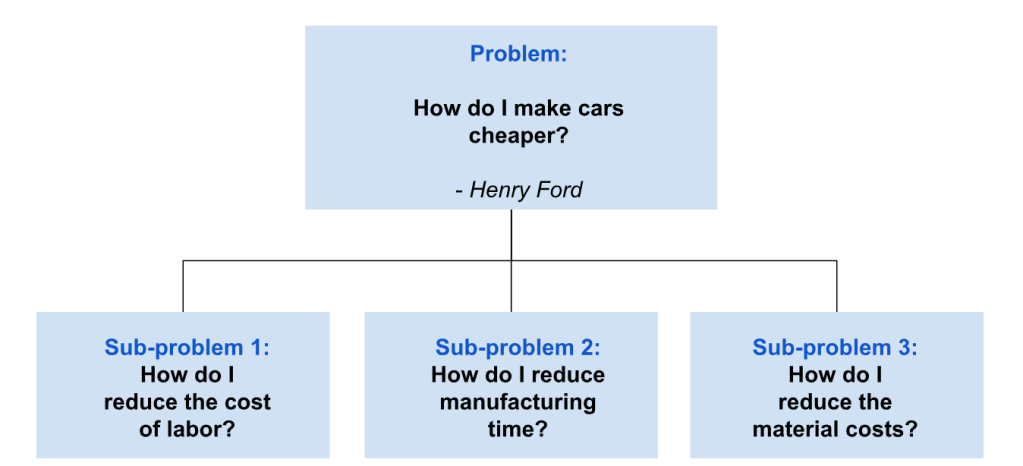
  2. Break down the problem. Address each component of the problem separately; this will enable combinatory options in Step 5.
Iyengar uses Henry Ford’s auto manufacturing innovation as a case study for the Think Bigger methodology.

3. Consider desires. Identify the motivations and desires of those impacted by the problem — including you, the innovative problem-solver; the target beneficiary; and third party stakeholders.

4. Search existing solutions. Learn from past attempts to address the problem; identify both failures to avoid and insights to use.

5. Create a “Choice Map”. Consider different combinations of wide-ranging solutions to the sub-problems. Select several full solutions to investigate further.

A Choice Map is a mix-and-match menu of sub-solutions, to help identify and test different combinations.

6. Seek validation: Get feedback on targeted aspects of your candidate solutions from others.

Iyengar’s key advice

Source: Nordic Business Forum

In addition to simplifying the innovation process, Iyengar also strives to debunk common misconceptions. To increase efficacy, she advises targeting your efforts as follows:

  1. Get over shiny new object syndrome. The most unusual ideas are rarely perceived as more innovative. Instead, new applications and combinations of old ideas often get the most traction.
  2. Listen to your gut before you listen to the data. Ideas are a dime a dozen. But motivation is finite. Notice the direction of travel of your enthusiasm. Is it trending up, down, or flat as you refine your idea? This “real talk” will help eliminate magical thinking about your level of commitment. You need to feel passion to power through the process successfully.
  3. Spend more time researching solution options than you think you should. In contrast to the Lean Startup paradigm, which now dominates Silicon Valley and recommends racing to a minimum viable product, Iyengar recommends spending more time researching many possible MVP options.
  4. Don’t ask for feedback on the full solution. People are likely to judge your idea before its fully-baked. To effectively refine your concept, ask for selective, narrow feedback on specific aspects you are testing.

Nothing new under the sun

Iyengar arrives at core principles consistent with what I’ve seen work. Essentially, she is an advocate of open innovation and lateral thinking — problem-solving by looking beyond traditional organizational or social boundaries and connecting seemingly outside ideas. Given how tried and true her methodology is, I wondered why she chose to write the book. Iyengar herself highlights that even her Choice Map is largely derived from the GE Trotter Matrix.

I believe Iyengar wrote Think Bigger for three reasons: 1) she believes everyone can be innovative and, thus, sought to create an empowering “user manual” of sorts, 2) she observed common pitfalls among her students that she wants to help others avoid, and 3) she’s an academic — she must publish or perish.

To the first motivation, I agree that anyone can be innovative if they look outside their disciplinary or professional silo. This is part of what drew me to study Public Policy as an undergraduate student — it combines a basket of disciplines oriented around solving a challenging problem: designing rules for society. Political Science, Philosophy, Economics and other disciplines can not take on this challenge single-handedly. But while I agree that solutions to complex problems need to come from outside a single silo, I do not think a solopreneur or small team can crack the code as easily as Iyengar implies.

By optimizing her solution identification process for a single person, Iyengar’s methodology is both empowering and overpromising. Think Bigger reads as if one person can transform a product category, industry — nay, the world! — with little more than a worksheet. Yes, it’s a handy worksheet, and with time a single person can run the research process of identifying promising solutions to the target problem. But this individualistic approach limits output to that of one person / team vs. incentivizing many solvers to tackle the challenge — which is the core of a true open innovation approach.

To the second motivation, Iyengar’s advice certainly can save time and help individuals learn from others’ mistakes. As a decision-psychologist, she is versed in the mental tricks our own minds play on us. However, Iyengar’s own biases color her advice. As a full-time academic, she over-indexes on research, suggesting conducting enough research to produce thousands of potential solution combinations. Acknowledging this overwhelming option set, Iyengar then suggests selecting test solutions using a random number generator. How odd to recommend a big upfront investment, followed by an arbitrary narrowing-down process. Perhaps this is where the third motivation — to publish due to peer-pressure — may be tainting her recommendations as well.

Iyengar closes by reasserting, there are no new ideas, just different combinations of old ideas. This claim sums her book up well. She steels with pride and references, offering handy tools that can spur focused creativity. But they are not quite the cure-all implied.

The Index Card Summary of “The Five Dysfunctions of a Team”

The Five Dysfunctions of a Team is Patrick Lencioni‘s New York Times Best Seller for a reason: any team member can see themselves in this list of foibles.

Each of the five dysfunctions require leadership interventions to solve. Below is a brief summary of what that entails.

The Index Card Summary

1. Building trust

What. The foundation of a functional team is trust: confidence that peer intentions are good, that there is no reason to be protective around the group. Trust minimizes second-guessing and makes it easier to ask for help.

How. Create shared experiences over time, and understand unique attributes of team members. Team-building exercises, discussing team effectiveness, 360 feedback, and team leader role modeling can all drive the psychological safety and honesty needed to engender trust.

2. Addressing conflict

What. All relationships require productive conflict to grow. Without direct, content-focused conflict, teams can be handicapped by back-channeling and personal attacks that doom people to revisiting issues endlessly without resolution.

How. Acknowledge that conflict is productive; agree that impassioned debate is welcome. Ask for permission to address conflicts for the good of the team.

3. Driving commitment

What. Commitment requires both clarity and buy-in. Desire for consensus and/or certainty can weaken commitment and delay decision-making which, in turn, can paralyze teams and weaken their confidence.

How. Drive alignment through tight information cascades, close to the time decisions are made. Reduce ambiguity by setting intermediate deadlines. Address fears with contingency plans or worst-case-scenario analysis. Normalize decisiveness starting in low-risk environments. Leaders must also role model commitment by being ok with wrong decisions, asking for commitment, and reducing emphasis on certainty or consensus.

4. Welcome accountability

What. Peers need to welcome peer call-outs on actions that might negatively impact the team or actions others should model and amplify.

How. Leaders can enable and normalize peer accountability through setting agreed upon standards and goals, encouraging peer feedback, and giving collective team rewards for collectively modeling the right behaviors.

5. Focus on results

What. Time-bound, outcome-based performance drives business success. Yet it can often be crowded out by team or individual status or focus on survival.

How. Define specific target results that you publicly commit to, and reward only supporting actions; tie compensation to outcomes. Leaders must also reinforce a focus on results; if the team leader shows they value and reward other things, teams will react accordingly.

Disconnects and Through-lines

Unpacking the “How”

While Lencioni provides excellent tactical suggestions for tackling the numerous team dysfunctions, he spends too little time exploring where to start. While ‘absence of trust’ is named as the foundational problem, I think the easiest place to start is at the top, with the most visible problem: ‘inattention to results.’ Once you have specific results targets, you can drive accountability, which then motivates commitment, and so on down the pyramid.

Addressing the foundational dysfunctions, ‘fear of conflict’ and ‘absense of trust,’ is admittedly more challenging. In large organizations especially, cross-functional teams may not even conceive of themselves as teams and, thus, may see little benefit to engaging in conflict and little need to build trust. In those instances leaders play an even more critical role. Leaders with a longer-range view will be mindful of the personal costs of these more insidious dysfunctions: energy poorly spent, low morale, and high unwanted turnover.

Across the five dysfunctions, communication and leadership sit at the center of many proposed solutions. Spending more team time together drives trust, can root out conflict and reduce confusion. Documenting decisions and desired results and rapidly sharing and reinforcing them keeps teams in sync. And leadership modeling the right behavior and taking challenges head-on can inspire healthy team culture. These are all reasonable tactics to pursue, but side-step the issue that so much rests on leadership, especially the larger an organization gets.

Addressing the “Why”

Lencioni claims that “teams succeed because they are exceedingly human.” But realistically, it is equally why they fail. Humans are full of bias and are often more focused on their individual experience over organizational goals. Thus, even if an organization starts with a high-functioning team culture, it’s hard to scale; heterogeneity via sub-cultures is normal the larger an organization gets, and cultural drift is equally normal through turnover, changing external contexts, and organizational evolution. With this in mind, it makes more sense to think of high functioning teams as a practice to commit to rather than an end state. Like so much of life, it’s a journey, not a destination.

Source: aspitzer.com

The nudge report: A new marketing exploit being tested in retail

On a stroll through Soho, I noticed an unusual sale sign. It wasn’t your typical “40% off!” or “End of year sale!” promising deep discounts on already marked-up products. It was actually the opposite. Yes, it was price anchoring high, but in the most direct way possible:

$75 and under. Not $75 and over. The sign lists the highest price you’ll pay. By anchoring high, the sign is nudging you to spend at least $75 per item. Versus a sign listing the lowest sale price e.g. “99¢ and up”, which nudges you to expect to only pay that bottom price. This bifurcation in price anchoring indicates target market segmentation. The low anchor marketing is for low price, high volume businesses, whereas the high price anchor is likely for high price, low volume businesses. This sign was in front of Athleta, so targeting somewhere between the Under Armor and Lululemon athleisure segments.

It’s a creative new tact, but it utterly failed to entice me. I suppose I’ve been exposed to 40% of Banana Republic signs for all of my independent shopping life, so my brain is primed towards that particular bug. I give this social nudge 2 out of 5 stars. High marks on creative experimentation, low marks on efficacy on an audience of one.

Nature, nurture or neither? The power of titles

What is in a name? That which we call a rose, by any other name would smell as sweet.

— William Shakespeare, Romeo and Juliet

Human resources department across America have been forced to ponder William Shakespeare’s question as the demand for and supply of creative titles has proliferated in our millennial-filled workplaces. Titles like “ninja”, “rockstar”, and “magician” have become common place. This shift in corporate and startup culture alike provokes the question of how much titles influence behavior, and vice-versa. Psychology and history both have something to say about this question.

Titles vs. labels vs. names

Titles are an indication of what an organization ascribes to your role. And it could be argued that names and labels play a similar role of indicating expectations of an individual. So we will explore the history and research of the impacts of each.

What is in a name?

Names hold great significance in the Bible and Torah, indicating family history, identity and personality. Re-naming in both books also indicates a transformation in the person’s life. Still, it is not entirely clear from the stories what to conclude about the roles of nature and nurture, whether the name shapes one’s destiny, or whether one defines the ultimate meaning of their name.

Recent academic research by Steven Levitt of Freakonomics posits that there is no relationship between a person’s name and their life outcomes. This is colorfully illustrated by the stories of Winner and Loser Lane, brothers whose life outcomes were opposite to their birth names. Loser was a winner, a star student and athlete who joined the NYPD. Winner was a loser, living a life oscillating between incarceration and homelessness.

Boxing people in.

Adjacent to names are “labels”, categorizations that we place people in. And labels have been seen to have significant effects on perception. According to the linguistic relativity hypothesis “the words we use to describe what we see aren’t just idle placeholders–they actually determine what we see.” Social psychology research has demonstrated the impact of labeling on social treatment. In a 1963 study, Rosenthal and Jacobson found that teachers labeling students as “smart” or “slow” changed their academic trajectory, positively impacting the IQ of “smart” students by 10-15 points over the course of a year. They called this impact the expectancy effect: once you label someone something, you expect that attribute of them, and you perceive and encourage more of what you expect.

Titles in social contexts.

Popular wisdom posits that job titles are closer to labels – they affect how people treat you inside and outside of a company. With half of Americans gaining their sense of identity from their job title, many individuals are giving power to their titles to impact their sense of importance and self-worth. Yet this does not need to be the case; one’s actions and implicit role can shape perception of titles more than the title itself.

The history of the title “president”

The role of president was intended to be fairly minor at the outset of the American republic. When deciding the title of our founding father, George Washington, The House of Representatives was adamant that he have a simple title. Whereas the Senate proposed “His Highness, President of the United States and Protector of Their Liberties”, the House demanded removal of any attribution resembling monarchy rule. “President” was reasonably diminutive; a local bridge club could have a president. The title simply meant a person who presided over an organization.

Yet over time, the role and how the president has acted has changed the meaning of the title. Today, there is much less distance from the term “king” as was originally expected and intended. In part, the actions that presidents have taken have given them greater authority. FDR’s New Deal created an era of big government, also attributing greater responsibility to the president. Nixon was said to have expanded the power of the president beyond that of any predecessor, expanding decision-making in foreign affairs and exercising greater budgetary and programmatic power. Beyond how presidents have shaped the power of the office, the office came with inherent authority to set priorities and issue rules, which drove a natural evolution of the office. In other words, the office was always intended to have significant power.

Your title, your role

Some are born great, some achieve greatness, and some have greatness thrust upon them.

— William Shakespeare, Twelfth Night

Whether your title confers great responsibility to you or not, you will have opportunities to shape your own role and story in your work. Yes, your title will impact first impressions and expectations inside and outside of your company. But no one’s abilities, role, and trajectory are completely summarized by their title. So call yourself Wonder Woman if it get you up in the morning, as long as you are living into a fulfilling role and not being limited by it’s titling.