Organizational Groundhog Day: Why we see the same ‘mistakes’ across our careers

If you’ve been working a while, you’ve probably had more than one corporate déjà vu moment. Maybe it’s a group dynamic gone sideways or a CEO’s self-inflicted wound. They leave you head-scratching about why, despite all the MBAs and consultants (guilty of being both!), we keep ending up in the same pickles. 

This year I decided to step back and take a broader look at organizational dynamics, to see whether their intricacies broadly weave into a few patterns. I reached out to the modal edges of my network. Ok, still mostly MBAs and consultants, but all with 20-45 years of cross-industry work experience, ranging from small to multinational and from startup to mature companies. While current roles skewed towards tech, experience spanned civil engineering and international development, venture capital and law, with titles ranging from manager to Vice President.

I asked these wise business leaders at the zeniths of their careers to look back on their collective experience and consider the same three questions: “What are mistakes you see happen in organizations over and over again? What is causing them? What can you do to change the pattern?”

What emerged isn’t just a simple list, distilled from 22 perspectives. Certainly there are meta themes. But what stood out more was how every interview felt both individual and systemic at the same time. Each deep diagnosis framed not just the endemic challenges each leader was squaring up to, but also what values they held and aimed to deliver. On the whole, when individual choices meet organizational evolution, certain ‘mistakes’ will manifest like clockwork. 

Organizational growing pains: some ‘mistakes’ are inevitable

Sitting down with a seasoned engineer who’d experienced every size and maturity of business, I received a stoical reframing of my premise: There are no mistakes. “Mistakes” we observe are not made in error. Rather, they are “structural artifacts” of an organization’s current stage of growth and maturity. If you group all companies into three simple buckets, here’s what you can expect.

  • 🐣 Small businesses: These entrepreneurs are building the plane while flying it. They make mistakes out of sheer inexperience, learning the “nuts and bolts” because there’s no one else to do the work.
  • 📈 Rapid growth companies: Welcome to the competitive wild west. You need to scale up to meet demand, but then keep outdoing yourself to stay profitable. Rapid growth, chasing the next innovation can be messy. Reaching new levels of scale that require new leadership expertise can also drive churn, contributing to the chaos.
  • 🧓 Large, stable companies: These behemoths are set in their ways, sporting policies and procedures for every scenario, having seen it all over decades. While this might feel like “boring” adulting, it’s how they operate globally at scale. But it’s also how you fall asleep at the wheel and become irrelevant.

Basically, a company making “mistakes” might just be living its truth. And that might bump up against your own goals, values, or preferences. 

Of course, these company maturity categories are artificially clean and binary. And the magnitude and frequency of “mistakes” can still vary significantly. One can certainly take the rough with the smooth, but also try to temper the rough patches. So let’s have a walk through the topics that popped across interviews. What are the most common  — let’s call them problems — and how might we remedy them?

🎶 I got 99 problems but grouped them into 4

The following short list is by no means exhaustive. Consider it the 80/20 of org “watch-outs.” 

Group 1: People problems

Most common: Bad hiring, bad management

Typical culprits: Small businesses, rapid growth companies

Typical causes: Inexperience, time pressure

“Founders are really bad at hiring. They tend to hire someone for roles they are bad at. It’s hard to hire someone for something you don’t know how to do.” – Venture Capital Investor

“I previously worked with [recruiting] during an aggressive expansion. The company was thinking about the ideal way to hire, number of interviews, what you can learn. One issue is hiring incorrectly. It has a profound and long-lasting impact. They stay long and bring on other people who aren’t right too.” – Senior Director, large tech company

The take-aways

1. Invest in hiring and onboarding 

“I valued [my former company’s] time, thought, and structure put into hiring decisions. And it’s a standardized process that helps compare candidates…The moment you let people do their own thing, it’s impossible to hire well.” – Senior Director, large tech company

“Most people don’t think about how to make the person confident and competent in the role. And then check in with that person and give feedback.” – Vice President, mid-sized tech company

2. Expect managers to enable talent at every level 

“[Direct reports] need direction, guidance, coaching, mentoring, apprenticeship. But they don’t need to be micromanaged…You should let them unleash their talent.” – Partner, top global consulting firm

“57% of people have left a job because of a manager. People should take more stock of the people issues vs. just speed.” – Career coach and Founder

“A lot of people hire someone external without creating an environment for success, and it takes too long for them to figure out how to get things done. New hires don’t have enough internal authority to push things through. A sponsor should enforce metrics around the change they want.” – Senior Strategy Manager, large tech company

Group 2: Focus problems

Most common: Unclear mandates, high reactivity 

Typical culprits: Rapid growth companies; large, stable companies

Typical causes: Market pressures, catering to leadership, high novelty or complexity

“I see a lot of reactive solutions. Something gets shrill, the geist of the moment. e.g. change of administrations, AI. There’s nothing wrong with reacting. Sometimes we move too fast to come up with something brand new, and we over-react. And [reactive solutions are] not built for longevity.” – Head of Strategy & Operations, large tech company

“R&R is a challenge [in my function]. It’s unclear who the owner and who the decision-maker is. By default you think it’s the highest ranking person, but that’s not always the case. Otherwise you just keep having working sessions. – Product Strategy and Operations Executive, large tech company

The take-aways

1. Ensure top-down clarity on strategic direction

“The order of decision-making should be strategy, organization, people; not people, organization, strategy…A lot of times people propose org changes that are solving for people. Or you see you’re working around the strategy.” – Vice President, large tech company

“[All companies need] a clear, well written plan. This includes strategy, mission, vision. There’s also the outcomes you want to measure to know if you’re successful. Some companies don’t have one or both. Some have both but are poorly written and executed. Lots of people don’t include what they won’t do. Companies do poorly at setting goals and [conveying] why they matter.” – Director, large tech company

2. Be targeted and deliberate in assigning shared ownership

“If everyone’s doing the same thing it’s not clear what you’re driving. There are areas that it would be really powerful to have shared goals. But in other places we can move faster as separate units. We [need to be] intentional about when we take approach A vs. B.” – Director, large tech company

“People tend to focus on their area of responsibility over how that area of responsibility affects something bigger. They focus on in-quarter metrics over long-term trends… [But big-picture thinking is] fundamental to maintaining the health of the business…In part it’s a question of empowering individuals. In part it’s signalling to people that that’s how they should be operating.” – Managing Director, large tech company

Group 3: Process problems

Most common: Slow decision-making, limited accountability 

Typical culprits: Large, stable companies

Typical causes: Org complexity

“The way our orgs are designed, with [multiple functional leads] all reporting to different people means there are too many decision-makers… The advantage is a higher degree of excellence…[but the tradeoff] is multiple layers of direction and [dispersed] accountability.” – Senior Product Leader, large tech company

“[Different divisions] have different motivations… There are too many goals to be aligned.” – Senior Software Engineer, large tech company

The take-aways

1. Match the process to the objective and risk
“We see a lot of one-way door decisions. That affects the speed we can tackle problems. Many one-way door decisions are expensive to change or impact brand reputation if you make the wrong call. We could move much faster if we identified decisions [with] two-way doors, with fewer executive reviews and alignment [needed]…You can simply identify ‘what decisions could I reverse today?’…People reviewing work set the tone, including giving coaching [on what they] don’t need to review.” – Senior Product Leader, large tech company

“Centralization vs. decentralization: When do you want to focus on consistency, speed, and execution (centralization), using top-down mandates vs. when do you want people to figure it out and do it their own way, since you don’t know the right way, and eventually make it consistent…Make that decision consciously.” – Strategy & Operations Executive, large tech company

2. Set R&Rs and accountability frameworks

“We have a very matrixed organization. It’s not clear who’s on the hook… It’s a structural challenge. You’ll get people in the room that weigh in that aren’t accountable, so shouldn’t be an extra opinion. That’s most large companies. That causes slowness. [Correcting for this] has to be intentional by top leadership. They have to regularly check in that it’s the right structure to achieve their goals.” – Director, large tech company

“In the kickoff meeting, we don’t set up a decision-maker, they just say we’re all working on it. You see a meeting with a dozen [approvals] required. We need to be more explicit. We need a leader to… assert [R&Rs and] ownership. The owner then has to tell people who’s doing what…It comes back to ownership.” – Strategy & Operations Executive, large tech company

Group 4: Culture problems 

Most common: Low psych safety, siloed communication

Typical culprits: Rapid growth companies; Large, stable companies

Typical causes: Loss aversion, deified leadership

“A mistake I see made a lot is people playing pretend. Not acknowledging reality, pretending things are good when they are not.” – Technical Professional Services Head, large tech company

“[People have a] perception of leadership that they have all the answers.” – Founding Partner, impact investing startup

“Any time the team grows, there’s a breakdown in communication. Every time you shift to no longer being in the room together, comms shift. There’s angst around hierarchy, around process and suddenly needing it.” – Career coach and Founder

The take-aways

1. Model imperfection and risk-taking 

“Everyone in the chain has to feel their leadership is supportive. If one person feels safe but the next stop up doesn’t feel safe, it won’t work. People need to see examples to believe it. Leadership has to model how they’ve made mistakes and asked for and received leadership support. There needs to be a way to reward and highlight the behavior.” – Director, large tech company

“In early stage companies they explore, but when you hit a certain size, it’s too difficult to allow freedom, because that introduces risk. And risk appetite goes down with time…Find the members of leadership that are incrementally more open than the rest, and push them to find creativity. Use that as a test case to prove. It’s an incremental approach.”  – Founding Partner, impact investing startup

2. Normalize open communication and collaborative feedback

“The Achilles heel for orgs is an inability to distinguish between accountability and blame. Accountability is an opportunity to look at something that isn’t working and try to figure out how to problem-solve together…. Vs. blame. That creates an environment where people are unwilling to identify problems.” – Director, large tech company

“People are more agreeable in group settings to give a sense of niceness and organizational cohesion. This is the root of many problems. Having backbone and being willing to disagree is important for organizational health, so people feel like they can raise important concerns… [I have seen] people disagree in backchannels or silent discontent. Then you miss the perspectives of people. [We need to] create a safe space where people feel they can vocalize opinions… You can say why you don’t agree with it, offer data, ask for more input from that person.” – Senior Product Leader, large tech company

Final notes: Expect the expected

The above org problems are less about individual human fallibility and more about the inherent design, stage of development, and maturity curve of the organization itself. Among the four problem groupings, each org type has their “favorites”. Rapid growth companies have more people problems due to hiring at a rapid clip. Large, stable companies have more process challenges due to system complexity and risk aversion. All can suffer from communication breakdowns.  

So if you are experiencing corporate déjà vu, you’re not crazy. You’ve seen this movie before. It’s a classic plot, and still worth a watch. But don’t just get out your popcorn – this is a choose-your-own-adventure. Know thyself, and choose which org type you want to be in. 

And if you are in an org that you feel is missing the mark, I’ll leave you with one last inspirational quote:

“I think people believe some problems are too big for them to fix. Then they focus on the controllable. But there are instances where you’ve got to step beyond that, and take responsibility for difficult issues. It is a form of risk aversion to say that’s beyond what I can tackle. There needs to be a balance between what you can control and tackling the [big] issues.” – Managing Director, large tech company

Sometimes, it may be worth being bold and pushing for change. Either way, wherever you are, be the most adaptable, resilient ‘you’ you can be. As Justice Ketanji Brown Jackson would say, “Bloom where you’re planted.”
Has the metaverse missed its moment? Three recent misses explored

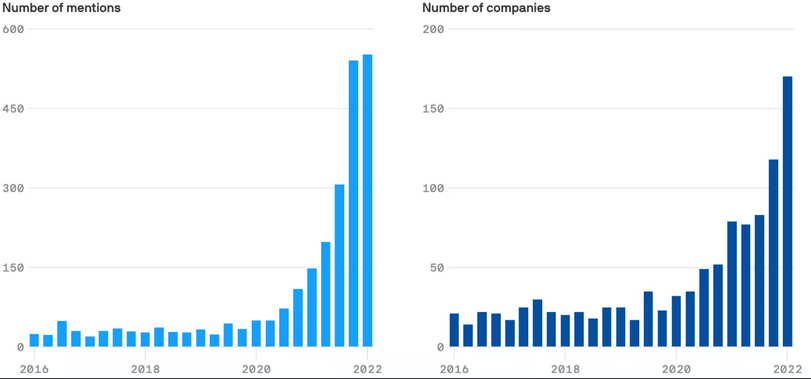
If you were looking at “metaverse” mentions alone in 2022 earnings calls, you might be fooled into thinking massive adoption is underway, a-la Facebook in 2007.

Mentions of “metaverse” in earnings calls (Q1 2016-Q1 2022)

Source: Axios

And in the last three years, three concurrent forces emerged that could have catapulted the metaverse into the next ubiquitous computing platform, similar to how the iPhone turned cell phones into pocket computers in 2008. These cultural moments have been catalyzed or amplified by the forced isolation of the a pandemic. They are:

  1. The loneliness epidemic
  2. Remote school and work
  3. Diversity, equity, and inclusion

Below we look at these three cultural moments and consider what the missed opportunities with each mean for the future of the metaverse.

1. The loneliness epidemic

As Luminary Labs summarized it, “before the coronavirus pandemic, there was the loneliness pandemic. Three in five Americans say they are lonely.” Forced isolation and social distancing during the pandemic exacerbated loneliness, but also jolted us into trying new ways of interacting remotely. Zoom Christmas became a thing that even grandma attempted.

Source: Business Insider

But the change in circumstance didn’t change the underlying mental health crisis. Loneliness leads to depression, and depression saps motivation, especially motivation to try new things. Ironically, virtual reality (VR) — the metaverse’s cornerstone technology — can effectively treat depression and anxiety, among other psychological and physical disorders. But outside of a few medical vanguards, no metaverse investor made significant strides to bridge the user motivation gap.

2. Remote school and work

Remote school and remote work are both here to stay. At a minimum, remote school will be a supplement to in-person schooling. (Goodbye snow days!) At a maximum, remote school will continue to unlock access, including for disabled, rural, and other student populations. Similarly, remote work will continue, as demand from workers is clear and employers are trending towards offering it in a competitive labor market. Metaverse solutions could arguably be the highest quality and lowest cost tech for both. An Oculus Quest 2 costs less than many Chromebooks, and offers many more capabilities. Further, two of VR’s biggest applications to date are in education and professional training, from surgeons to customer service reps.

Despite the high potential use cases and cost efficacy, no big employers or schools have announced the launch of internal metaspheres. This is likely for the same reason accounting firms issue buggy five-year-old laptops to employees making six figures: internal infrastructure is viewed as a cost center, not a value-generator. Why give employees infinite screens on their Oculus when they can still eke out the “same” work on their tiny laptop screens? Metaverse investors have done little to reverse this myth. So educators are likely to continue cobbling together free and lower cost resources, and employers are unlikely to significantly revise their budgets for remote work systems development.

3. Diversity, equity, and inclusion (DEI)

For as little as $15, anyone can begin to experiment with VR and, thus, the metaverse, via Google Cardboard. With one download, you can fly around the globe in Google Earth, visiting the Coliseum or the Pyramids. And on Oculus, popular games like Beat Saber cost half as much as Nintendo Switch games. This affordability presents an epic inclusion opportunity. Oculus Quest 2 sales have already topped 15 million, making the barriers to participation pretty low. In addition to being relatively affordable, the diversity of subcultures and self-expression possibilities are endless. Inclusion could be easier with the freedom to choose avatars that reflect your identity. A woman can choose a male avatar, a man could choose a wolf avatar, and perhaps in the future, a gender fluid person could change their avatar daily if they so chose.

Despite the metaverse’s economic accessibility, and its potential to welcome diverse populations equitably, most people don’t seem to see themselves participating. Critics hesitate to become legless floating bodies, and some women feel awkward in the currently male-dominated spaces. As many companies have learned in the great return-to-office debate, cultivating a sense of belonging is not as simple as just creating the persistent space. And its not clear that metaverse investors are creating welcoming on-ramps to expand inclusion.

Did metaverse miss its moment?

Why did the metaverse’s biggest advocates, from Microsoft to Facebook, not double down on pushing products like Mesh, the holographic collaboration tool, or experiences like Meta Quest meet-ups (surely a welcome alternative at the height of Zoom fatigue)? The problem seems to be two fold: lack of focus and premature hype.

The metaverse remains so loose a concept that even tech evangelists are confused about what it is. In theory it’s such a flexible concept — inclusive of most shared, persistent digital spaces — that, with some interest and ingenuity, early investors should be able to find pockets of growth. But instead that flexibility has cultivated a lack of focus. A very expensive lack of focus at that — Meta’s investors hammered the stock for having too little to show for its $10 billion of losses per year. While Oculus hardware is making great strides, the virtual experiences themselves haven’t reached the quality level that can attract everyday use. And with very public tech flubs like Facebook’s virtual Foo Fighter’s concert mishap, the technology clearly isn’t ready to support mass adoption.

The metaverse today is like QR codes in the 2000s — useful, but not convenient, intuitive, or ubiquitous enough to see mass adoption. That took a pandemic to change. And the metaverse has (hopefully) mostly missed this one. But that doesn’t mean it won’t catch the next growth opportunity. And we certainly can’t call the three cultural moments discussed above — loneliness, remote school and work, and DEI — solved problems. The metaverse is on its way. Just more slowly than its proponents would have you think.

Modern community: three levels being re-shaped by social distancing

Well before COVID-19 struck, the U.S. faced a loneliness epidemic: 61% of Americans reported feeling lonely prior to the pandemic. Compare this with a November 2020 study, where 80% of participants reported significant depressive symptoms. People have felt isolated because, well, they have been. Self-isolation and social distancing are our best prevention methods for mitigating COVID-19’s spread. While we protect our psychical health, people have also needed to find way to bolster mental health.

More than three in five Americans are lonely, with more and more people reporting feeling like they are left out, poorly understood and lacking companionship.

Elena Renken, NPR

In a testament to human resilience and ingenuity, with each social door that has closed, people have tested and tried a dozen alternative doors to open. I’ve seen social connection re-imagined at three levels: one-on-one, affinity groups, and the workplace. Below I share the trends that have warmed my heart to see, and my favorite examples within each.

Three levels of community

One-on-one

With space in our calendars, our collective memories have been stirred, to think of loved ones and old friends far and wide. We’ve felt the urge to connect with them using tools we almost forgot existed: telephones and pen and paper. Paper Source Inc.’s greeting-card sales jumped 1,200% following social distancing orders in March. And phone call volume surged more than internet use in the weeks following lock-down, as people wanted to hear the sound of each other’s voices.

Favorite for one-on-one: Lovepop cards are the notes I have both enjoyed sending the most and gotten the warmest responses for. In a world that feels mostly 2D right now because of excessive screen time, it’s revitalizing to inject some 3D into it.

Lovepop cards range from the lovely to the nerdy.

Affinity groups

Lockdowns across the globe have re-shaped and consolidated our social networks. People have focused on connecting with those they have the most in common with over people that are geographically near. This includes revived interest in hobbies and affinity groups. In Ireland, over 250,000 people joined Facebook hobby groups following lock-down orders, with 30,000 people joining Irish Gardening alone.

When social interactions moved online, only certain kinds of relationships seemed to survive.

Dr Marlee Bower, loneliness researcher, University of Sydney

While incumbent social media has done well, new platforms for online social interaction have proliferated. Clubhouse has enjoyed huge engagement. I’ve been invited to many Sims-esque social spaces, from Gather to Kumospace.

Favorite for affinity groups: Toucan wins for small (less than 15 people) social e-events. It’s essentially a virtual cocktail room where you can move between different social circles. Among the ‘organic’ platforms that permit free movement, it has been the easiest to interact with. However, the organic movement of participants starts to feel chaotic if the event gets too big.

Toucan lets you mix and mingle across different audio circles in the same event.

The workplace

Remote work has changed much of how we communicate with coworkers. For many, social distance has also created emotional distance. In a study by Sharehold, mental health was the top-reported factor that impacted employees after New York’s March 2020 stay-at-home orders (due to COVID-19). Another international survey showed 40% of employers felt concern for how remote work might impact workers’ mental health.

Many employers have tried to address our yearning for informal chats and ‘micro-interactions’ with new tools (Slack, Zoom) and new norms. My company started including personal checkins at the beginning of Monday stand-ups. And working sessions quickly transitioned from ‘business-first’ to ‘catch-up first’.

Favorite for the workplace: My company instituted quarterly ‘cafes’ with trivia pulled from our personal Readmes and Slack. It gamifies getting to know each other and is full of laughs.

Community in the long run

Loneliness experts hypothesize that people will recover from the lock-down-induced loneliness spike and return to their previous baseline over the long-term. So while we’ve explored new ways to engage in community virtually, nothing can supplant the human need to be with one another in person.

We are creatures of habit. . . I think we will revert back to our social groups [in the long run].

Michelle Lim, loneliness expert

Scaling company culture with AI: an interview with George Swisher, CEO of LiiRN

Can AI help foster cohesive community in an organization? LiiRN thinks so.

Source: Simplilearn

Creating a healthy work environment that scales is something of a holy grail for all growing companies. As internal networks become more dispersed and organizational structures grow more complex, it becomes easier for communication disconnects to occur. How can companies continue to cultivate a shared vision and culture, and give employees a chance to define and improve both? LiiRN CEO George Swisher thinks the answer is AI-driven.

Swisher founded LiiRN, a people-centric, AI-powered transformation software, in 2018. The AI platform has a two-fold purpose: to help leaders make decisions based on employee feedback, and then allow employees to participate in enacting those decisions. The LiiRN platform collects customized survey data on leadership performance and company priorities. The AI synthesizes upward feedback, converts it into leadership performance ratings, and identifies quantitative and qualitative trends and findings to inform decision-making. The platform also invites self-nominated change-agents to shape and drive forward company-wide initiatives.

In an interview with Swisher, he shared how AI can drive rather than reduce personal connection, and help business leaders to listen to and lean on their people.

What problem are you solving with LiiRN?

LiiRN aims to help companies drive change through people versus processes. Many leaders working to design strategy end up working with small populations of people, doing surveys or doing stakeholder interviews. But trying to drive a huge change with the input of a small group of people is a disservice to both the firm and the company. People are fearful of change when they don’t understand it. So a few years ago I thought, what if I had the ability as an individual consultant to work with all hundred thousand employees in real time? The impact would be tremendous.

And so the idea was to launch a software that could do that, that could physically touch people as if it was someone you knew and who understood the big program that was going on out there and help the employee relate. When you drive change from the bottom up instead of from the top down, you avoid the education and awareness gaps that come with large scale change.

Companies can use our technology as kind of a middleware between the leadership and staff, to find the gaps between what leadership thinks and what the people on the ground are actually seeing and thinking. Our voting feature makes people feel like they’re part of the decision-making process. If you can do that for a company, say, that’s 100,000 employees, you’re able to help 100,000 employees feel like they’re contributing to a decision that the leadership is making. You get people who are more empowered, and I think that’s a big emotional feature of how you activate people. It automates some of the change management processes and helps leadership make decisions and investments that their company believes in. With ongoing feedback collection, you can create a dynamic feedback loop, to continually shape the change journey.

What are some of the most common pain points the leaders you work with encounter?

New leadership teams are sometimes nervous to listen to data and to draw conclusions if it can be interpreted in multiple different ways. It’s one of the reasons that we have moved to partnering with consulting firms with expertise in software-based data analysis. We use the data to quantify how many people activate and why. Typically, we see north of 30% of the total population raising their hand to be on a work stream in a specific change management area.

If you have lower adoption, we use the data we collect to understand why. We track when people opt out or say “I don’t understand what you’re asking and talking about.” This feedback surfaces whether the real issue is understanding and awareness, versus the willingness of people to participate. Alternatively, the data can also show if people think the initiative is misguided or has implementation risk. Leaders gain transparency through the software’s data analysis.

It sounds like you’ve found ways for AI to create more human interactions. What are the limitations to leaning on AI? In what ways can AI tools be anti-social, and how do you mitigate those risks?

If you’re going to trust the output of our system, you have to know it’s based on the right input. Potential biases to data come in so many different forms. Ideally, if we look at, for example, who is in the sample population that you’re getting information from, we’d account for any skewing as we analyze it. We have limited control, of which population, the stakeholder at the enterprises chooses to invite into our software. So if they choose to only involve the US population and use that information to influence the way they make decisions for their Asia-based population, for example, that clearly creates a lot of challenges, given the cultural differences. We work to screen out and limit bias with some of our onboarding screens and some of the setup and training that we do. We promote as much as we possibly can an approach of widening the sample size, to make sure that you’re involving as large a population as possible that is as diverse as possible. But there’s definitely limitations to it. It’s hard to solve it when you’re collecting what others choose to input.

Also, if there is a high concentration of a certain demographic in a company, we can’t control for who they’ve hired. So if they’re only getting information from a specific group of people that’s the majority of their population, it clearly sways the input that we’re getting and the resulting outcomes. So for us, I think we’re trying to maintain a middle ground where we highlight who companies are asking for input from and how it impacts the output. 

We’re focused on making our data inputs more comprehensive by integrating with more internal systems in our upcoming work. HR systems can provide added layers of data, like performance management data and learning data; systems like NetSuite provide more business performance data. The more that we can integrate, the more our machines can learn, and the more we can build better cases for the viability of the decision we’re recommending.

Change management in the context of technology often raises the specter of worker displacement. How can technology-based change management tools like yours help us prepare for an unknown future of work?

What I learned personally moving from a tech-enabled service businesses working with big enterprises to being a full software company is that technology isn’t replacing us. There is a fear of tech advancing too fast. But I think the bigger question is how do we reskill and retrain ourselves? And how will we hold the enterprises of the world responsible for managing change? Even if there are people who will be losing jobs, which is never a good thing, we have the opportunity to say, “Well how do we rethink what workers are doing and what new skills they need to adapt? And how can we help them do that?” Yes, we’ve introduced self checkout into the grocery store. But if we’re going to replace those people, what are the skills they have that we can still benefit from? They may be really great at customer service and customer success — can you retrain them to help people shopping inside the store, to create a personalized experience? Flipping the way that you look at it can help people understand the opportunity. Then we all advance. But a lot of companies don’t think that way when they’re developing or implementing automation technology.

It’s a large number within consumer retail and manufacturing — upwards of 70% of some of the largest companies and employers in the world — whose jobs will be automated away in the next 10 years. The magnitude of that is scary. Unless you retrain people to think about it as an opportunity and change the way that they’re actively pursuing alternatives, we’re going to have problems. Being a coder isn’t the answer for everyone.

Shaping community in the age of Facebook: three success stories

 Source: Sagepub.com
Source: Sagepub.com

As American society is increasingly moving from towns to cities, and from meeting face-to-face to meeting on Facetime, we have had to re-imagine community. We are figuring out how to navigate the “iPhone Effect” on our social connections. And our choices about how we engage with others with technology have huge implications. Will our social capital die down as we withdraw from traditional community, as Robert Putnam feared, or will community simply take on a new form? What does it look like to create and maintain a network of reliable peers, to make meaningful connections in new ways that suit our modern context?

Three principles from three places

I have been a part of a few different communities – work, home, and church – and have observed a few features that have made each a place of belonging. I’ll share a story about each, and then explore why these features of community feel increasingly rare.

De-anonymize

It’s wonderful to be loved, but it’s profound to be understood.

— Ellen Degeneres

In hustle-bustle cities like New York, there’s a sense of anonymity as you walk the streets and peruse the shops. You may be having a bad hair day, but you’ll never see those people giving you side-eye again! It can be liberating. And isolating. And so when I walked into Abyssinian Baptist Church, I noticed the immediate difference in the environment. Famous for their role in the Civil Rights Movement, ABC‘s activist roots run deep and were laced through the sermon. But that is not what gave the church a palpable feeling of connection. Rather, it was their ability to lift their community members up and make them known to each other. The head pastor invested a quarter of the service in spotlighting congregation members, asking them to stand and share their two way relationship with the church. The children reading passages from the bible were introduced. A woman who leads a black women on Broadway group was announced and lauded for her contributions. With so many names and faces getting celebrated and supported, it de-anonymized everyone, made me proud of people I didn’t actually know. In other words, I didn’t just connect with the general experience of the church service. I felt I understood some of the people in it, and cared about their well-being.

But this sort of success in fostering connection doesn’t happen on its own. It needs to be deliberately structured into the cadence of community interactions. The next principle and example share a great success story of building relationships in a group whose members were simultaneously complete strangers and close peers.

Build a support system

Architecture starts when you carefully put two bricks together. There it begins.

— Ludwig Mies van der Rohe

Gathering a bunch of people who don’t know each other well in a room, even if they have a lot in common, can often lead to short, somewhat transactional exchanges. Yet that same room of people, with deliberate facilitation, can come alive together and seed the beginnings of lifelong friendships. I saw this arc in my company as we facilitated educator user groups, brought together virtually to develop free math resources online. At the end of the first user group, educators noted that, even with virtual summits and chat room discussions, they felt they’d missed an opportunity to connect more meaningfully with their peers. And so we designed more structured interactions into the next group’s architecture. We created peer pairings for ongoing support. We gave each educator two peer reviewers to provide feedback on the resources they designed. And we scheduled weekly discussion prompts for the chat rooms, giving educators a predictable rhythm of convening to exchange information and ideas. Engagement skyrocketed, and lasting friendships developed.

Providing structure to interactions led to shared expectations about engagement. This organically led educators to invest time into knowledge sharing above and beyond what the program required. Creating availability, it seemed, had been the key ingredient to relationship building. This has proven out in other communities, as I explore in the next example.

Be available

The more we can be in a relationship with those who might seem strange to us, the more we can feel like we’re neighbors and all members of the human family.

— Mr. Rogers

In many buildings I have lived in in New York, I never met my neighbors. My latest apartment is different. There are a number of retired folks who have lived in the building for many years, and they use their free time to be, well, neighborly. They have time to chat in the hallways. They knock on my door if they notice I have a package in the lobby. They offer to dog-sit. In short, they have time for me. And I, of course, have time for them. I offer to plant sit and pick up their mail when they travel. I have their phone numbers and know who their friends are in the building. We’ve inserted a bit of dependability into our network, by taking every small opportunity to be supportive of each other.

Where technology fits in

You may be wondering, why isn’t all of this obvious? Why is it so rare to know and support the people in your social circles in a reliable way? Why do we fail to consistently invest in relationship building?

Many would argue that today’s lower levels of community connection are a continuation of a multi-decade trend. Robert Putnam famously published a macro analysis in Bowling Alone: The Collapse and Revival of American Community, that identified a 58% decline in club meeting attendance, a 43% decline in family dinners, and 35% drop in having friends over between 1975 and 2000. Putnam identified changes in work, family structure, suburban life, and screen time, among other factors, as contributing to this decline in meaningful group relationships.

The solution to help buck this structural trend, according to the tech giants of the 2000s, was technology. Technology was supposed to bring us closer together. Facebook famously claimed that it could expanding the Dunbar number, the number of meaningful relationships a human can maintain. However, it turned out that the Dunbar number didn’t change. What social media has done is bring your outer circle of acquaintances in, rather than strengthening or growing your inner circle. Simultaneously, technology has increased our culture of distraction, competing for attention that could otherwise be focused on our close friends and communities.

If we rule our technology, and don’t let our technology rule us, it can still be a tool that builds community rather than undermines it. Use technology to make yourself available. Use the structure of a WhatsApp group to organize regular meetings. Carve out time in your group gatherings on and offline to hear more about the individuals that make your members. Abandon the convenience of liking a post, and actually speak directly to your friends, be it in-person or on Skype. Reject the loneliness of optionality and anonymity that big cities and infinite online interactions offer. Make your circles smaller and your world more personal.

From disrupting tech to disrupting finance, Apple is leading the way

Apple has been at the leading edge of the consumer technology industry for decades, earning itself a reputation for creating the “new normal” in product areas ranging from personal computers to mobile devices. This week Apple announced a foray into a new category: credit cards. Once again Apple has positioned itself as raising the standards of what consumers can expect in convenience, quality, and security – the Apple trifecta.

Apple has long branded itself as a prescient company, one that knows how to “skate to where the puck is going, not to where it is” – a Wayne Gretzky quote Steve Jobs loved to borrow. This meant defining what consumers want for them more than with them. In the early 2000s, Apple was the first to do away with CD ROMs in favor of USB drives. Consumers transitioned with external CD drives and soon did not miss massive CDs at all – and PCs quickly followed suit. In the last ten years, having a sleek phone that responds to gestures via a touch screen became a standard rather than a luxury, also thanks to Apple’s influence. And now, in a new sector, notorious for high fees, high security risk, and general opacity, Apple is busting up the old model with a clean, user-centric option: Apple is brining virtual credit cards to consumer finance.

Apple has cleaned up several pain points for consumers with the Apple Card in one fell swoop: complexity, hidden costs, and vulnerability to theft. Standard credit cards offer complex points systems, with varying thresholds for earning and redeeming benefits that require a fair bit of math to evaluate the value of. Apple provides a simple, real-time cash back system based on your spending. It also removed ATM and other fees, and is entirely transparent about interest rates. It promotes consumer health by visualizing the distribution of your weekly spend. And because it produces a randomized card number for each transaction, there is little risk of card theft.

Many companies have tried to provide these services in a piecemeal fashion to consumers. While Apple is increasing convenience by bundling all of these services together, the real disruption to the industry is Apple’s challenge to the standard business model of countless fees and selling consumer data. While you may love Mint’s free breakdown of your spending and credit status, you may not love that they package and sell your data to hedge funds. Simple, a banking and budgeting tool similar to Apple Card’s financial management tools, helps consumers contain their spending with recommended spending limits – but it does so at a premium to other banks. Apple is offering more for less: a comprehensive service that doesn’t cost you a pound of flesh or your privacy. Like Apple’s aesthetic, its revenue model is clean, based on simple, low transaction fees.

Much like the CD ROM sunset, there will be a period of transition. For example, hotels will have to figure out how to charge a reservation across multiple card numbers, from the time of booking to the time of checkout. Websites requiring the last four digits of your credit card to validate a transaction will also pose a problem. Yet the alternative is the wildly complex fee system and data selling of modern banks that we’ve all grown to know and hate, limited only by regulatory oversight. Surely Apple’s full service, low-fee offering will be refreshing to consumers. As a non-bank, Apple is unencumbered by bad business model norms, and holds the potential to help the average American reduce its significant debt. With such aligned interests with consumers, Apple’s competitive offering is likely going to create a forcing function for traditional banks to stop milking consumers for all they can and instead pushing them to provide real value to consumers, regardless of income. Apple is well positioned to win consumer confidence and, once again, define a new normal that is higher quality than the dated standard credit card model.

Cheers to the best communicators of 2018

It is immensely human to want to be understood, and a great skill to be able to make oneself understood by wide-ranging audiences. This end-of year post is a hats-off edition for those who take complex, multifaceted topics that otherwise appear unknowable and clearly describe the inner workings of our world in layman’s terms. Four communicators in four fields have been especially influential and necessary.

Four fields have outsized impact on our working present and future: finance, management, science and technology. With the 10 year anniversary of the financial crisis just past, the importance of financial liquidity as the lifeblood of our economy is palpably understood by our businesses. And if strong financial conditions offer a tailwind, good management readies a business to benefit in the near-term. At the same time, science and technology are changing the nature of work day by day. Previously manual jobs like automotive assembly now require a technical literacy that demands that each person arm themselves with the latest technical knowledge. Thus, a knowledge of finance, management, science and technology makes for one capable business leader.

Four experts in these four fields have continually contributed to the public’s ability to grasp big and small ideas with clarity. And the winners are…

Best financial communicator: Felix Salmon of Axios

Felix Salmon’s daily articles on Axios and weekly podcast, Slate Money, complement each other with punchy clarity and practical insights that are both local and global. He speaks directly to the lightly-financially literate American and to the globe, as he covers trends in other large economies as well as struggling economies. He reads what would be tea leaves to most and makes financial indicators approachable. His frequent podcast refrain is to interrupt jargon-laden explanations from co-hosts and say “explain that in English.” Britain-born, he proves we don’t always need to be divided by a common language.

Best management communicator: Adam Grant, author

Adam Grant is an organizational psychologist who has written three books on how to drive personal and professional success. Beyond his famed insights from Give and Take, which show that generosity towards others can drive your own success, he’s gone on to create a podcast called WorkLIfe, in which he interviews entrepreneurs, employees, and companies to unearth practical advice to improve our work lives. He is a prolific tweeter and poster on LinkedIn, where he offers bite-sized daily advice for the business leaders of today.

Best science communicator: Neil deGrasse Tyson, astrophysicist

Neil deGrasse Tyson’s Astrophysics for People in a Hurry has been on the New York Times Best Seller list for the better part of 2018, a testament to his famed ability to generate both wonder and create scientific understanding among his audiences. He has a foundational interest in encouraging curiosity and methodical discovery, which makes the everyman feel he or she can, with careful pursuit, know the unknown.

Astrophysics for People in a Hurry

By Neil de Grasse Tyson

Best technology communicator: Wired, technology magazine

All of Wired Magazine deserves recognition for making complex topics with broad social implications, from the blockchain to ag-tech, easily digestible (no pun intended), with the implications unpacked. Wired humanizes and empathetically portrays the thinking and motivations of the entrepreneurs seeding some of the mega tech trends that are rippling through society.

In summary…

Thank you for an insightful 2018 to the brilliant communicators who have synthesized the most important mechanics and trends in the four fields that are the pillars of modern business. Cheers to you!

Makers, makers everywhere! The top six features of the 2018 Maker Faire

I thoroughly enjoyed my time nerding out at the 2018 New York City Maker Faire. From grooving on the dance floor to cheering on the battlebots, there was fan fair and creativity in the air. The initiatives spanned every size and scale. A 40 foot mechanical clawed arm, controlled with a right-hand sensor-laden glove was picking up a totaled car, not unlike the Blade Runner 2049 villainess directing remote attacks on Officer K. On the other end of the size spectrum, a flexible chip maker, MellBell Electronics, showed how their product could be used in everything from wearables to interactive 2D visuals. There was something for everyone. Below is a short list of some of my favorite Faire features.

From big…
…to small.
Making the future.

Top things I loved about the Maker Faire

 Girls learning how to drill… Girls learning how to drill…

1. The spike in young girls…

STEM for girls initiatives have visibly turned the tides! Whereas four years ago the Maker Faire displayed a sea of prototypical boy engineers, this year’s Faire had little ladies of all backgrounds, getting hands-on with building.


 …from Disney princesses in work boots. Our 21st century role models have arrived. …from Disney princesses in work boots. Our 21st century role models have arrived.
2…and the role models there to meet them

Importantly, there was a heroine aesthetic being donned by many of the women instructors. One stand introducing kids to hand drills was run by Disney princesses in work boots. They were aptly named Beauty and the Bolt. Another activity had Princess Leia and Rey leading instruction.


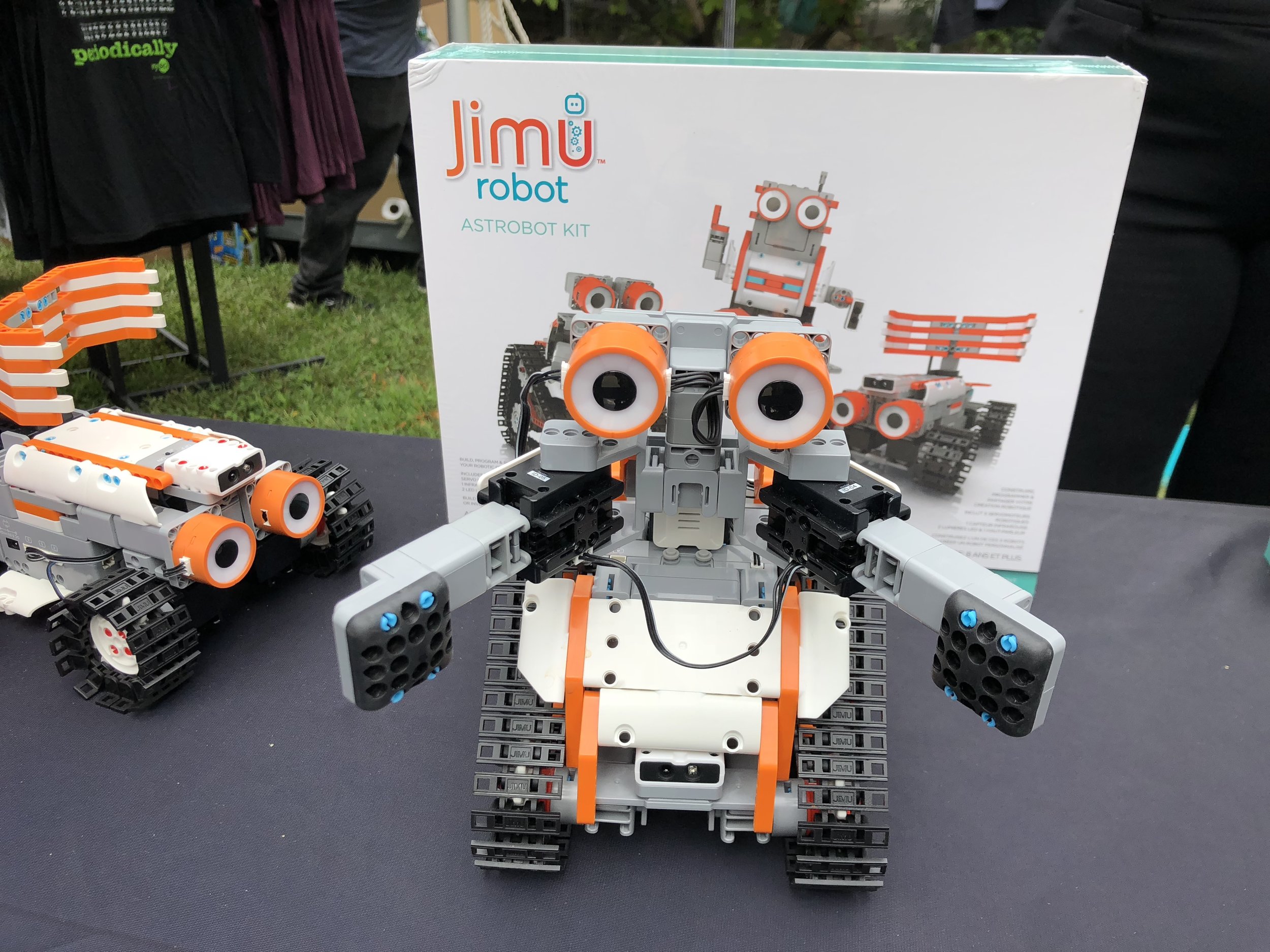
3. The number of Johnny 5 inspired robots

Every anthropomorphized consumer bot seems to look like Wall-E, who had clear influences from the Short Circuit humanoid robot, Johnny 5. I approve of this trend.

4. The Tesla coil made musical

Speaking of the past inspiring the future, oneTesla had the most epic demo of how a Tesla coil can be used to make lightning that both lights a wireless light bulb and plays music simultaneously. It was a light show, concert, and tech demo all in one. I don’t foresee Nikola Tesla’s vision of fully wireless electricity transfer coming to pass at scale, but this is not a bad alternative use case.

 Lightning jumped from the coil on the right to the light bulb on the left, all to an electronic beat. Lightning jumped from the coil on the right to the light bulb on the left, all to an electronic beat.

5. The next gen 3D printer

It’s nice to see equipment manufacturers beginning to combine capabilities for similar, but equally necessary tools for a makerspace. Specifically, one stand presented a combination CNC-3D printing machine, thus marrying related tooling with distinct software.

6. The sky is the limit thinking

It was fantastic to see the International Space Station represented alongside their many collaborators, including Magnitude.io. Magnitude.io’s prototype smallsats are blazing trails for educational accessibility. Where CubeSats have dramatically increased space access at a reduced cost, thanks to their 10 cm cubic size, Magnitude.io displayed concepts the size of a pack of gum.

 There’s a smaller game in town than CubeSats. Magnitude.io has launched CanSats and is developing even smaller sats. There’s a smaller game in town than CubeSats. Magnitude.io has launched CanSats and is developing even smaller sats.

The future is happening, and the brilliant minds of all ages and backgrounds present at the 2018 Maker Faire are leading the charge.

From individual to societal data: taking on bigger, badder problems

We have all heard the saying that “knowledge is power”. And in today’s modern economy, data is the new knowledge, which makes data power. We see it evidenced in the collective $1.3T market capitalization of Google and Facebook, whose pixels and cookies track us all over the internet. These massive data collectors began with an focus on individuals. Now, as we collect data about communities, societies, and supply chains, those holding the data will have growing power to impact not just individuals, but whole populations. 

The power of system-level data

Not only are today’s innovators collecting data about individuals, but they are collecting data about populations and processes. For example, Biobot Analytics hopes to transform sewers into public health observatories for whole communities by sampling wastewater from strategic points in a sewer system. Such collective samples can reveal issues as significant as an opioid epidemic, in neighborhoods as small as a few thousand people. Data tracking also promises to improve the fidelity of supply chain processes. Blockchain has been seen as a high potential technology for stemming the circulation of counterfeit drugs as well as upstream labor abuse.

This begs the question, how great is this latent potential? Are we reaching an inflection point where we no longer need to play whack-a-mole, and can finally clean up the messy problems that have previously upended communities, especially in the area of public health?

With great power comes great responsibility

Certainly the intentions of these technologies are to protect citizens, from counterfeit drugs, from themselves in the case of opioid detection. The question becomes how to ensure that the intended benefits manifest and unintended consequences do not.

We have all also heard the saying that power corrupts. Knowing this, we are forced to ask the question, how might the power of data be used corruptly in our own society? If recent technology deployments are any indication (e.g. AI blocking female doctors from the women’s locker room), we must ask, will we ultimately just re-manifest the problems of society using data?

We’ve observed the rise of “Big Brother” social monitoring in places like China, where social infractions as banal as jaywalking are caught by sophisticated monitoring, and have repercussions. Outside of monitoring, we’ve seen the weaponization of predictive algorithms in prison sentencing, resulting in worse outcomes for minorities. 

Given these patterns, we must imagine how cases like opioid overuse detection could be handled in the worst case. If an opioid crisis is detected, how might treatment differ in a poor versus a rich neighborhood? Will the doctors be the police targets in the wealthy neighborhoods, and the residents targeted in the poor places?

Writing society’s story

This — bias perpetuation — does not have to be how the story goes. Data is being used to empower many under-resourced communities. For example, an AI predictive model was able to increase the successful identification of corroded pipes in Flint Michigan from 20% to 97%, enabling the city to afford remediation of an additional 2,000 homes. Data can powerfully determine how we direct our limited resources to otherwise overwhelming problems. 

Knowledge is power, and while deep knowledge afforded by data can help solve problems by exposing them, it does not guarantee that those acting upon them have the best solutions. Impact is dependent on the social systems we operate in — how these analytical tools are used and how their analyses are received. We must ensure that those who can access and act upon community data are as effective at testing their own assumption and biases as they are at pinpointing social problems. 

AI enabled travel is here: 5 ways travel just got easier

All segments of the leisure industry seem to be having the same idea simultaneously – how can they make your travel experience more seamless. We all want to get the most out of each day, and to minimize the decision fatigue that degrades our experiences. Five companies stand out in their moves to integrate technology into a traveler’s day-to-day.

1. Before you go – KLM has your back with its voice-driven packing assistant

Just let service bot BB know where you’re going and when you’re leaving, and she will walk you through packing, piece by piece, equipped with silly pre-programed jokes to let you know bot makers have a sense of humor, too. Enabled by Google Home.

2. When you arrive – voice-driven concierge service in beta testing at Best Western

Best Western is testing out Amazon Dot for customers and staff, to quickly customize in-room experiences, from wake-up calls to room service requests.

3. For work trips – work from the shower

For those on a work trip or who are looking to create on the go, Marriott is beta testing a technology to whiteboard in the shower.

4. Also for work trips – work in a co-working space

Airbnb is offering WeWork day passes to guests.

5. For play trips – wearables making cruise navigation easy

Carnival Cruise has created the Ocean Medallion to provide customized experiences and recommendations based on your profile and location on the cruise ship.

All of these initiatives, striving to make the customer experience frictionless, both expand the customer experience, and more easily open customer wallets to ancillary offerings. I count this as a win-win.