Airport yoga: the basics

Long weekends like President’s Day can woo us to long flights to the sunshine. And to be in good form for the flight and your vacay, getting your zen on can get you in the right frame to handle the most primal of human settings: the airport gate waiting area. Below are a few simple moves that can be achieved with your travel essentials, including your phone and your luggage.

Upward iPhone

While you’re crafting your last #hashtag before boarding, make a gentle back arch, chin uplifted at a 30° angle, arms gently curved in half circles, holding your phone screen towards your face.

Luggage Lunge

Taking a wide stance, bend your right knee, with your right foot pointed outward, and lengthen your left leg, with the left foot pointing forward. Use your roller luggage handle to stabilize.

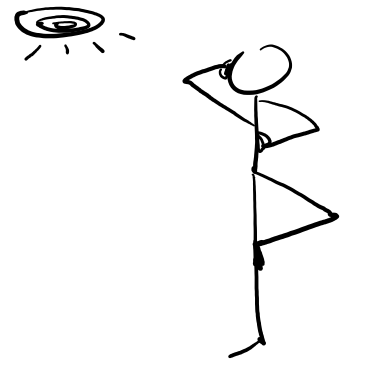
Listening Tree Pose

As you desperately crane to listen to sporadic announcements — in case they are for your flight — take a moment to re-center by balancing on one foot, one hand cupped to ear and one hand in prayer position.

Weekend Warrior 1

While waiting to board the plane, take a wider then hip distance stance. Place your hands slightly above your hips, and breath deep.

This may deter antsy travelers vying for overhead space from edging in front of you. Move forward at a regular pace, trusting that line-cutters will experience bad karma from observant flight attendants.

Snack Stretch

As the stewardess offers you a snack, accept with the outside hand (the one closest to the window), giving you an opportunity to rotate your torso and have a cross-body arm stretch.

Remember before you board to take each waiting opportunity to get that blood flowing and expand outward before you crunch into an economy seat.

Oh my God: Solar system re-branding

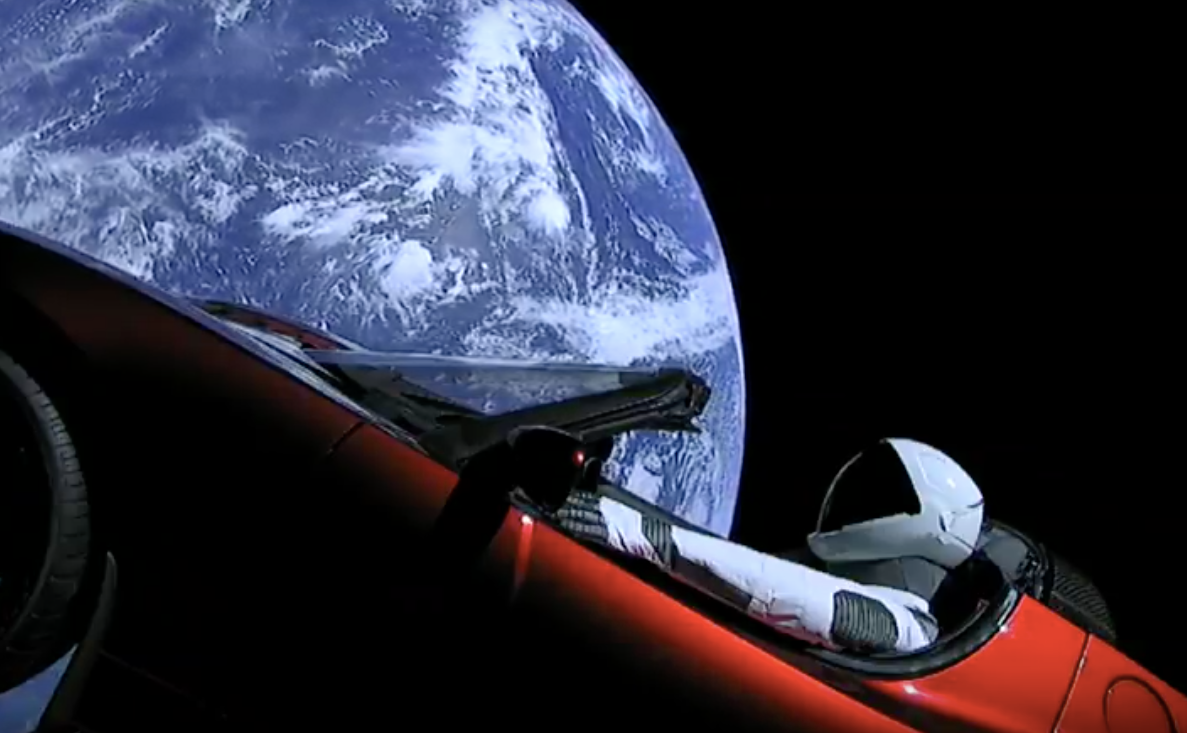
Mars, Pluto, who are these people anyway? Certainly they don’t resonate with a Millennial audience, who is more into astrology than into Catholicism. With Elon Musk launching Teslas into outerspace and making steps to relocate us to Mars, our solar system is attracting more public attention than it has in decades – which is why it’s time to makeover the Milky Way brand. It’s time for the old Gods to step aside and to make way for the new. It’s time to re-name the planets.

Old and busted New hotness Explanation
Mercury Flash The fast messenger Mercury has a perfect analogue in the vaguely entertaining Netflix series character and DC Comic hero Flash.
*
Venus Black Widow The goddess of love Venus is well represented by Black Widow, fem fatal, who can always get the Hulk to regain his cool.
*
Earth Gaea Earth is the one planet that never got a god-based name…and yet the Greek goddess of the Earth Gaea is hip with the hippies and comic fans of today.
*
Mars Iron Man Mars is red because it is made of – you guessed it – iron! Also, Tony Stark was an arms dealer, so only fitting that he takes the place of the Roman God of War.
*
Jupiter Thor Both thunder gods. Enough said.
*
Saturn Black Panther Saturn was the god of generation, dissolution, plenty, wealth, and liberation. I’d say the king and protector of Wakanda is a great fit, especially with his bad-ass body guards sporting protective neck rings, just like the fair planet.
*
Uranus Superman The Greek god personifying the sky should swap with the today’s god of the sky.
*
Neptune Aquaman The newer sea god has more extensive powers thanks to the blessing of Poseidon, the Greek analogue. #better
*
Pluto Loki Pluto had us fooled for years, but now we know it’s not a planet. But we can give it an honorary name change to Loki, the trickster god.

You might be asking yourself why these are all comic book heroes instead of religious gods. It’s because we know the origin stories of Superman and Iron Man better than we know the stories of our greatest religious texts. As Batman producer Michael Uslan put it, “superheroes are the logical descendant to Norse, Egyptian and Greek mythology”. We watch them on the big screen, read about them in our free time, take academic courses on them, and discuss them with our friends. It’s a central piece of modern culture, and soon, that culture could be extended into outer space. There’s a clear co-marking opportunity here between Marvel and SpaceX.

All squirrels are Eagles fans

Strolling through the city of Brotherly Love one winter weekend, I marveled at the grand success of a certain invasive species in the city where they were first introduced*. Yes, I’m talking about the grey squirrel. I’ve never seen one cross a street, yet there they are, in every park, perfectly content to play squirrel tag and scout for acorns on what they must think of as “their block”. And yet, as much as they seem to be home bodies, they are in every park in the entirety of the North East. So how did they get everywhere? My theories abounded:

1. They first made it to New York, and if you can make it here, you’ll make it anywhere

2. They traveled what must have been wooded superhighways and, eventually, got paved around

3. They were lured by acorn trails until they posted up in the urban backyards of gentry

Well, none of these guesses seem too far off the mark based on Gizmodo’s historic summary: they were a cute house pet until a few got loose, and people stuffed them fat, so much so that not only did they multiply, but they tumbled out of trees under the gravitational pull of their burgeoning middles. The habit never fully got shaken in some places *cough* Boston Commons *cough*. 

Most squirrels are too cagey for direct engagement these days, but still a playful touch to our manicured urban nature encounters.

*Yes, it all started in Philly, which is why all squirrels are Eagles fans.

Can Walmart beat Instacart?

It’s been fascinating to see Walmart level up from bargain bin to bleeding edge, as they entered the e-commerce race against Amazon. Their acquisition of Jet.com and expansion into e-grocery delivery were only the start. Their latest announcement left me beaming with hope for the future of online grocery shopping, as they step up as that someone to save me from my Instacart woes. This is Star Trek level next horizon tech, deployed for our shopping delight. Drum roll please….select your own produce via 3D imaging!

Okay okay, this may not sound as thrilling to you who have no trouble getting to a supermarket any given day. But if you’ve lived in an urban supermarket desert before, you know exactly what I’m talking about. You’ve tried FreshDirect and gotten a bruised $2 tomato. You’ve tried the Instacart route, where they had 90%+ accuracy on your first order, but your second order was half missing or substituted with “equivalent foods”. SPAM IS NOT HAM! GRADE A EXTRA LARGE EGGS ARE NOT THE SAME AS ORGANIC FREE RANGE VEGETARIAN GRASS FINISHED EGGS! AND DRIED CRANBERRIES…well, actually, those are all the same.

I think we all want food to taste good and not be wilted and on its way out when it arrives to our kitchen. When the patent clears and the tech is rolled out, I will be there to test it out, in the hopes that it is the harbinger of a brave new grocery world.

Robo-composed music to help you focus

Music has long been understood to have remarkable impact on mood and cognitive functioning – hence fun fads like expecting mom’s playing classical for their unborn children. And for me, moving from open office to open office, customizing my auditory environment has become an integral part of the focused work experience. Over the years I’ve tried playing all sorts of things, from white noise to movie sound tracks. Finally, I think I’ve found the ticket to getting on the right wavelength: brain.fm.

Brain.fm was dreamt up as a music writing software that has designed dozens of tracks to guide your brain into one of three states you select from: focus, meditation, and sleep.

 Brain.fm leverages emergent technology to create patterns of beats that get you in the right frame of mind Brain.fm leverages emergent technology to create patterns of beats that get you in the right frame of mind

Listening in, I hear binaural beats overlaid on soft melodies, which induce a deep state of engagement. While I haven’t hooked myself up to an electroencephalogram to measure efficacy, I’m sure the pros behind it are testing this out.

The focus option does the trick to blur out all distraction and leave you to think deeply. The first few sessions are free, so give it a try – you’ll thank yourself for it later when you see how well you’re using your time!

The Church of Deep Work

I have uncovered a mythical place, a place rumored of and nearly forgotten by the throws of modern life. It is a somber house, full of reverent heads bowed with devout focus over their written works, towards which their hearts turn. I walked in, uncertain of whether to speak. “May I help you?” the lady behind the booth asked. Slanting the volume of my voice downward, I reply, “The three last issues of Wired magazine, please.”

 The 42nd Street New York Public Library has the reverent quiet of the singularly purposed The 42nd Street New York Public Library has the reverent quiet of the singularly purposed

Yes, it was the New York Public Library. The silence hits you like a wall when you enter an archive or a reading room. There is a shared agreement and understanding: all come to work, to thrive upon the focus in the air, which each new devotee adds to.

I can almost imagine benefactor Samuel Tilden standing upon the steps of the 5th Avenue entrance, declaring in the lantern light: “Give us your addled, your burdened, your distracted masses who yearn to focus freely!”

 Patience the lion greets and guards the 5th Avenue entrance to the New York Public Library Patience the lion greets and guards the 5th Avenue entrance to the New York Public Library

The entrance to the Church of Deep Work is narrow – because of the bag check security – and it’s followers may be few, but I see a revolution coming! Robopocaplyse? No, it’s the fleet of knowledge workers striding singularly, together, on their independent, intertwining journeys.

Hats off to Patience and Fortitude for guarding the way for newspaper-readers, writers, and researchers alike to find their place in the stacks.

The Index Card Summary of “Deep Work”

Does it ever feel like your brain is overheating from fragmenting attention between too many things, flitting back and forth between tasks, with sometimes little progress to show for it? Well you’re not alone, and Cal Newport is going to be our Dr. Phil of attention, helping us to improve our quality of work and quality of life. The following summary of Deep Work walks through his advice on how to build our ability to engage deeply with our activities.

The Premise

Newport argues that in the modern economy there will be three types of winners: 1) those with access to capital, 2) those that are the best in their fields, and 3) those who work well with increasingly complex machines. The most viable route to economic success for must of us will be Path #3.

To work well with ever-evolving machines, you must be a great learner who can do deep work, i.e. focus intensely. Fun fact: intense focus triggers the same brain cells repeatedly and builds up myelin, which bulks up that neural pathway. Sort of like body building for your brain.

 Deliberate practice of a task bulks up the myelin in the related neural pathways

Deliberate practice of a task bulks up the myelin in the related neural pathways

The approach

1) The measure of deep work is time spent x intensity of focus. That’s what you want to maximize!

2) Deep work can be done bimodally (days to months as a time); rhythmically (several blocks of time each day); or like a journalist (whenever you can squeeze time in on the go)

Note on Technique: for those with less control over your schedule and less recent practice with deep work, the Pomodoro Technique may work best for blocking off deep work sessions followed by shallow work sessions or breaks. For example, 40 minutes of deep work followed by 20 minutes of shallow work 6 times a day can still achieve the target of 4 total hours of deep work per day. These shallow work periods may end up as over-flow buffers initially as you train yourself up to longer, unbroken periods of time.

You need to have 10 consecutive unbroken deep periods of a given time increment, as short as 10 minutes, before you start building up to longer periods.

3) Set up a systematized ritual – create a time bound, distraction free environment with all the right materials and enough food/energy

4) Avoid frequent task switching, as this leaves “attention residue”, a state of semi-attention as you’re still thinking about the last task when you start a new one

5) Choose to work on “the wildly important”

6) Collaborate with others in a way where you still break off for independent deep work

Pitfalls and solutions

1) Switching to an easier thought task – avoid this by structuring the path forward

2) Looping, i.e. reviewing what you know already – avoid this by consolidating gains upon which to build

3) Shallow activities – cut these out without excessive apology

4) E-mail – lay out a ‘path to closure’ to open-ended e-mails by laying out all steps to completion in one fell swoop

Note on E-mail: we’ve all rattled off quick replies that we know will generate three or more back-and-forths. Nip this in the bud by laying out everything you know will be discussed, including your availability for meetings requested, or any further information you will need. Add “no reply expected” or “I will consider your reply a confirmation” to minimize future e-mail traffic.

The path forward laid out by Newport is a call to action, with the knowledge that this means dragging our brains kicking and screaming. Our brains are seekers of distraction yet, paradoxically, convey the most satisfaction to us when we hit the “flow state” associated with deep work. Like eating your greens or hitting the gym, your body and mind will thank you for the deep work exercise you put it through. So pull out that weekly schedule or that Pomodoro timer, block out that time or set that target daily hours tally. You can start sculpting that focused mind today. (I say this having written this post with only one coffee break and two 5 minute side chats in between. We’re all a work in progress 🙂

My first Jewish Christmas

This Christmas we celebrated the family Christmas as they do in Eastern Europe and the Dominican Republic – on Christmas Eve – and reserved the 25th for my first Jewish Christmas! Honoring my 1/16th heritage, I made an early start to the new year with a new experience. Never had I realized that the burgeoning non-Christian population doesn’t just hunker down for indoor hibernation during other religious holidays: they keep NYC the City that never sleeps!

We started at Katz’s famous deli, best known for the filming of When Harry Met Sally, commemorated by a sign that reads “I hope you have what she had!” dangling above their table. The line was non-stop, but we lucked out with seating within 5 minutes of arrival, between the breakfast and lunch waves. Their pastrami never disappoints.

 Katz's deli is always hopping from counter end to counter end

Katz’s deli is always hopping from counter end to counter end

Next we hopped a cab to Herald Square to catch a movie. The Greatest Showman was indeed the greatest show! From there we were a short walk from the new 7 stop on 34th Street, which took us straight to Flushing for some epic dim sum. There were enough people out that I had to navigate the sidewalks midtown style. Our restaurant had the typical buzz of a Chinese restaurant, with green tea flowing and rapid service keeping the traffic moving. After a 15 minute wait, we were seated and ready for some duck, scallion pancakes, pork dumplings, and other deliciousness. Many belly-fulls later we contemplated whether to double down on more movies and food. The group split in two then, half for the Transit Museum exhibition in Grand Central and half for home and hot cocoa. Much like Friendsgiving, we were filled with warmth from a grateful day – and the repeated cold-to-warm transition that marks the start of winter!

The Index Card Summary of “So Good They Can’t Ignore You”

Cal Newport incisively speaks to the millenial heart that has been somewhat misguided by the role models of our day with the prompt to “follow your passion”. We’re told to just identify something we like doing, that we’re good at, and that people are willing to pay for. Simple, right? But if it were simple, college kids would not be picking up every single leaflet at every job fair. There would not be nearly so many applying to strategy consulting jobs. We’d all be on “a mission from God,” Blues Brothers style.

The “happy place” in the middle is what popular guidance tells us to seek…
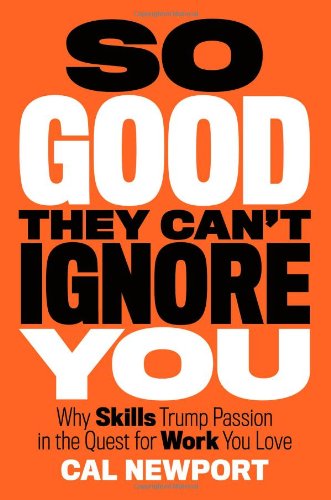
In fact, it seems to be the vast minority of people who have charted out a specific interest from a young age and don’t miss a beat on the way to med school or engineering. The secret truth is, most of the highly successful people we know didn’t experience the ven diagram above simultaneously, but sequentially. The order is 1) Develop a talent, 2) Prove out market demand, then 3) Experience the passion that comes from being skilled and the autonomy that comes with carving out a market niche. Here is how Cal Newport breaks it down.

  1. Passion comes from being good at something, not the other way around

  2. Being good at something – which we’ll call having “career capital” – comes from deliberate practice

  3. Deliberate practice requires continuous feedback, clear standards and goals, and stretching beyond your current abilities

  4. The Law of Financial Viability: Your skills must be something people are willing to pay for

  5. Think small, act big: have a mission, and identify “the adjacent possible” to push boundaries and inject meaning into your work

  6. Know your market: success requires that you knowing what kind of “game” you’re playing – is it an auction market, or winner-take-all?

Once you achieve exceptional skill, you can then command more autonomy, an essential element to satisfying work. Unfortunately Cal Newport observed in his research that this is typically they point when employers push back on unique demands from the highly skilled, since it means ceding more of the value generated by the employee to the employee. But the uber-skilled seem to win out in the end.

So the moral of the story, as Lin Manuel Miranda attributed his success to, is to pick a lane and start running ahead of everyone else.

Ready? Set? Go!

Big data for local pizza

I first read about Slice last summer and their impressive registry of 7,000+ pizzerias, banding together to take on mass-produced monsters like Pizza Hut, one pepperoni pie order at a time. I guess as a New Yorker, with a pizzaria every block or two, I never thought it too inconvenient to hop on the phone and dial in an order. But I have been troubled at the sights in smaller cities where people default to *shiver* Dominos… and like it! I want to preach to my peers “No, it’s not real pizza!” And Slice CEO Sela’s heart went out to the local shops that just don’t know how to throw up a good website. He’s incentivizing loyalty and sharing customer data with the mamas and papas outside of Papa John’s. Pizza for the people. I dig it.

 Love for the local pizzaria

Love for the local pizzaria